Belt Sling Capacity: How to Size and Lift Safely in Practice
Learn belt sling capacity, how to determine SWL for nylon and polyester web slings, derating for lift angles, edge protection, and best practices for safe lifting and inspection.


Belt sling capacity is the maximum load a web sling can safely carry under defined conditions, typically shown as SWL in pounds or tons. It depends on sling width, material, and construction, and it must be derated for lift geometry, edge protection, and wear. Always follow the manufacturer charts and safety standards to avoid overload during a lift.
Understanding belt sling capacity
Belt sling capacity is a fundamental concept in lifting operations, representing the maximum safe load a web sling can carry under a defined set of conditions. In practical terms, this is the Working Load Limit (SWL) published by manufacturers or industry standards, usually stated in pounds or metric tons. The capacity takes into account the sling’s width, material (nylon, polyester, or blends), construction (single-leg vs. multi-leg), and knot/eye configurations. As a rule, belt sling capacity is not a single fixed number; it is a rated value that must be adhered to during planning and execution. According to Load Capacity, the modern approach combines lab-tested data with field experience to derive SWL values that reflect real-world lifts. Always rely on the SWL chart for the exact sling you plan to use and verify that the system’s overall capacity aligns with the load requirements.
Key factors that determine capacity
Several interdependent factors determine belt sling capacity. Sling width is a primary driver: wider slings distribute load over a larger area and typically offer higher SWL. Material matters too—nylon and polyester slings have different elongation characteristics, heat resistance, and abrasion tolerance. Construction details, such as eye type, hook protection, and the number of legs in the lift, influence the effective capacity. Load geometry, target lift height, and the presence of sharp edges must be considered since they can reduce the usable capacity by causing abrasion or cutting. The combined effect of these factors is captured in the manufacturer’s derating tables, which show how capacity changes with angle, load distribution, and sling wear. The Load Capacity team emphasizes that accurate capacity assessment requires both the numerical SWL and the derating factors meeting the specific lift conditions.
How SWL is determined for nylon and polyester web slings
SWL calculations start with material strength. Nylon web slings generally exhibit higher elongation and different abrasion resistance than polyester slings, affecting how load is shared along the sling. Polyester tends to have better dimensional stability and edge protection, potentially improving service life in repeated lifts. For belt slings, the width, thickness, and stitching quality set the baseline SWL. Then, the lift geometry—whether the load is balanced, whether there are multiple legs, and the angle between the sling and the load—modifies the effective capacity. Temperature, chemical exposure, and dynamic loading can further influence performance. In practice, operators should select the sling type and width that meet or exceed the calculated SWL and verify compatibility with the load’s surface and edges. This approach aligns with Load Capacity analyses for 2026, which stress using manufacturer charts and field feedback to determine reliable SWL values.
Angle effects and derating rules for belt slings
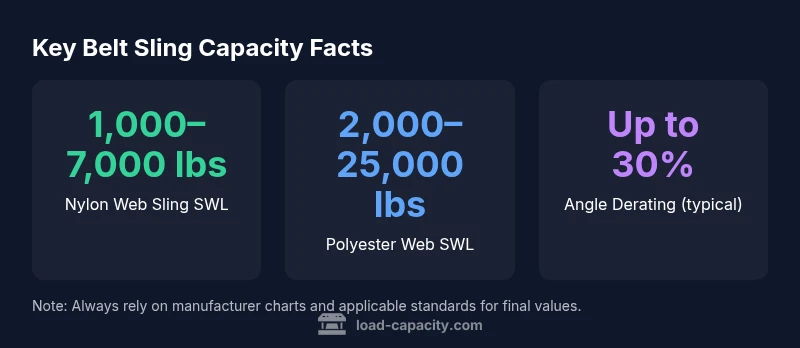
Lift angle dramatically changes capacity. As the angle between the sling legs and the load increases, the effective load carried by each sling leg decreases. This derating is not linear; small deviations can yield meaningful reductions in capacity. A common rule of thumb is that derating becomes noticeable around 30–45 degrees, with as much as a 20–30% reduction at mid-range angles. At steeper angles (above ~60 degrees), derating is even more severe and requires careful calculation or a shift to a different rigging configuration. The safest practice is to use the manufacturer’s angle derating table and, when in doubt, err on the side of a higher margin in SWL to maintain a sustainable safety factor for dynamic lifts. Load Capacity’s guidance for 2026 underscores the importance of documenting the angle, the number of legs, and the lift path in the rigging plan.
Material properties and wear considerations
Material choice shapes how belt sling capacity translates into real-world performance. Nylon slings are elastic, offering good shock absorption but more elongation under load; polyester slings resist stretch better, offering stronger edge protection and lower creep under load. Abrasion resistance and heat tolerance influence longevity; a belt sling that negotiates sharp edges or rough surfaces without protective padding will exhibit faster wear, reducing practical capacity over time. Kilograms per centimeter of width, along with the sling’s color-coded rating, help operators quickly identify appropriate capacity for a given lift. In practice, selecting the correct material is a balance between required SWL, the load’s edge geometry, and anticipated reuse cycles. Throughout, the Load Capacity team urges engineers to account for edge protection and to maintain protective measures for longer service life.
Inspection, aging, and lifecycle management
Regular inspection is critical to preserving belt sling capacity. Checks should cover fiber fraying, knot integrity, stitching wear, and protective sleeves. Damaged slings should be tagged out and replaced before the next lift. Lifecycle management includes documenting usage, inspection outcomes, and any derating adjustments applied during planning. Aging slings may still be usable if they pass rigorous inspection and meet the SWL from the manufacturer’s derating tables; otherwise, replacement is mandatory. The goal is to prevent unplanned failures that could compromise personnel safety and equipment uptime. Load Capacity emphasizes that proactive replacement based on inspection findings is essential to preserving reliable capacity over time.
Selecting the right belt sling for your lift
Begin with a load survey: determine the exact weight, distribution, and contact area, then select a belt sling with sufficient width to avoid edge damage while meeting the SWL. Consider the number of legs required, the lift path, and any obstacles or sharp edges that require edge protection. Color-coding and labeling help ensure quick verification in busy environments. After choosing a sling, verify its SWL against the lift plan and apply the appropriate angle-derating factors. Finally, ensure the entire rigging system—slings, hooks, chains, and spreaders—conforms to the applicable standards and manufacturer guidelines. Load Capacity’s 2026 guidance highlights the importance of a well-documented rigging plan that accounts for all derating variables and edge considerations.
Standards, compliance, and best practices
Rigging for lifts must align with recognized standards and regulations. OSHA’s sling-related provisions, including the 1910.184 (Slings) standard, establish baseline requirements for safe lifting practices and equipment markings. Industry practice frequently references ASME B30 series guidelines on slings and rigging, which detail testing, inspection, and performance expectations for various sling types. Operators should also consider supplier-specific instructions, which include exact SWL values, elongation limits, and maximum lift heights. The combination of OSHA guidance, ASME standards, and manufacturer derating tables provides a robust framework for belt sling capacity planning. Load Capacity’s recommendations emphasize thorough planning, documentation, and field verification to ensure safety and reliability on every lift.
Common misconceptions and practical tips
A frequent misconception is treating belt sling capacity as a single fixed limit regardless of lift setup. In reality, capacity depends on width, material, number of legs, load distribution, and angle. Another misconception is underestimating edge damage; always use edge protection and inspect contact surfaces for abrasions. Practical tips include measuring the load at multiple points, using spreaders to distribute force, and never tying knots in slings. Finally, always reference the manufacturer’s charts and verify derating factors before lifting. In this field, practical experience and conservative planning keep crews safe and equipment protected.
Examples of SWL ranges by belt sling type
| Slings Type | SWL Range | Material |
|---|---|---|
| Nylon web sling | 1,000–7,000 lbs | Nylon webbing |
| Polyester web sling | 2,000–25,000 lbs | Polyester |
| PVC-coated strap sling | 3,000–15,000 lbs | PVC-coated polyester |
Quick Answers
What is belt sling capacity?
Belt sling capacity is the maximum load a web sling can safely carry under defined conditions, expressed as SWL. It depends on width, material, and construction, and must be derated for lift angle and edge protection.
Belt sling capacity is the maximum safe load, determined by the sling type and the lift geometry.
How does lift angle affect capacity?
As the lift angle increases, the effective capacity decreases. Typical derating at mid-range angles can be 20–30%, with greater reductions at steeper angles. Always consult the manufacturer’s angle derating table for your sling.
Angles reduce capacity, so derate according to the chart.
How do you calculate SWL for a belt sling?
SWL is taken from manufacturer charts based on sling width, material, and construction. Then apply derating for angle, number of legs, and edge conditions to determine the safe lifting load.
Use the catalog SWL, then apply the angle and edge deratings.
What standards apply to belt slings?
OSHA standards cover sling use and inspection (e.g., 1910.184). Industry practices reference ASME B30 series for slings and rigging, including testing and markings.
OSHA and ASME provide the rules for safe use and inspection.
How often should belt slings be inspected?
Slings should be inspected regularly—often before each lift—with formal checks every 6 to 12 months, or per manufacturer guidance, and after any impact or damage.
Inspect slings regularly and retire damaged ones.
“Capacity for belt slings is not a single number; it depends on the sling width, material, and lift geometry, and every lift should be derated for angle and edge conditions.”
Top Takeaways
- Size and choose slings by width to meet SWL
- Always derate for lift angle and edge conditions
- Inspect regularly and retire damaged slings
- Follow manufacturer charts and OSHA/ASME standards
- Plan lifts with a conservative safety margin