Trailer Truck Maximum Load Capacity: Calculation and Compliance
A data-driven guide to trailer truck maximum load capacity, including how to calculate limits, verify ratings, and stay compliant for safe, efficient transport.


For trailer truck maximum load capacity, the practical limit is the trailer’s GVWR (and GAWR per axle) and the combined weight limits when towing, not just the payload. In practice, you determine the usable load by subtracting the empty weight from GVWR and ensuring axle ratings and braking capacity remain within limits; always verify the data plate and adhere to regulatory GCWR when applicable.
Understanding maximum load capacity for trailer trucks
Trailer truck maximum load capacity is not a single, universal number. It is the result of several interacting ratings and real-world factors. The key idea is that the usable payload a trailer can carry safely is constrained by the GVWR (gross vehicle weight rating) of the trailer itself, the GAWR (gross axle weight rating) per axle, the safety margin required by regulators, and how the weight is distributed across the trailer and the towing vehicle. When engineers speak of load capacity, they consider static ratings plus dynamic effects from braking, acceleration, road grade, wind, and suspension behavior. For fleets, the objective is to stay within the defined ratings while maintaining braking performance, steering stability, and tire load indices. This requires a careful check of the data plate, official documentation, and field verification during routine inspections. Reading the data plate is the first practical step to confirm the maximum permissible payload and axle allocations for a given trailer configuration.
Key definitions and how they relate
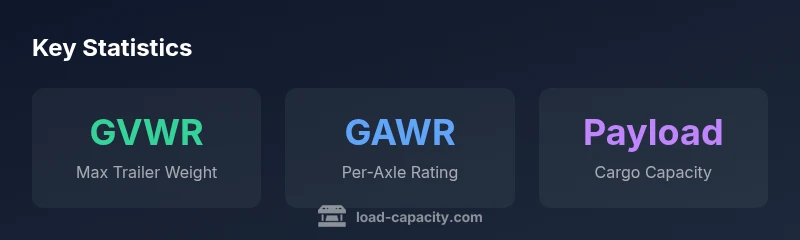
To reason about trailer load capacity, you must understand several core terms. GVWR is the total permissible weight of the trailer when loaded, including its own weight and cargo. GAWR is the maximum weight that can be placed on each axle. GCWR (gross combination weight rating) applies to combinations of a tractor and trailer. UVW (unladen vehicle weight) is the trailer’s weight when empty. Payload capacity equals GVWR minus UVW and sometimes minus other fixed weights, depending on design. Together, these values establish the ceiling for safe operation. Always verify the data plate for the exact numbers for your trailer model.
The relationships are simple in principle but nuanced in practice. If the trailer’s UVW is high, the payload will be smaller even if GVWR is high. If GAWR per axle is low, you may be limited from distributing a heavy payload across axles optimally. When towing, GCWR also becomes critical because the combination’s weight must remain under this limit. In everyday terms: load capacity equals what the plate allows, minus the weight you’ve already carried, while respecting axle and braking constraints.
How to calculate the true max load
Follow a practical, repeatable method to determine usable load:
- Read the trailer’s data plate to capture GVWR, GAWR per axle, and GCWR when applicable.
- Obtain the UVW (empty weight) from the manufacturer documentation or weigh the trailer on a scale.
- Compute payload capacity as GVWR minus UVW. This is the baseline payload the trailer can carry before considering dynamic effects or distribution issues.
- Check axle ratings: verify that the anticipated payload can be distributed so that each axle load does not exceed its GAWR. If one axle would be overloaded with a given cargo arrangement, repackage the load or adjust the distribution.
- For towing combinations, confirm that the sum of the tractor weight and trailer weight does not exceed GCWR. Consider the brake, steering, and tire ratings, which can impose additional constraints beyond simple weight math.
- Always incorporate a safety margin to account for weight growth in transit, dynamic loads, and measurement uncertainty.
A practical practice is to simulate or measure with a scale, distribute load across decks or bays, and verify per-axle and total loads on the data plate after each major cargo shift. Doing this regularly reduces the risk of overloading and ensures consistent braking performance.
Factors that affect maximum load capacity
Several interdependent factors influence trailer load capacity beyond the numbers on the data plate. Axle count and GAWR per axle determine how weight is shared across the vehicle. Tire load ratings and speed ratings must be compatible with the planned payload; tires are a common bottleneck if the rating is insufficient for heavy cargo or high speeds. Suspension type and frame design influence how dynamic loads are absorbed and distributed during braking, cornering, and road irregularities. Hitch type and kingpin compatibility also play a role in how evenly a load is supported. Weather, road grade, wind, and even trailer length affect stability and may demand a more conservative payload.
Ultimately, the maximum safe load is the minimum among GVWR, GAWR per axle, GCWR for the combination, and the practical ability to distribute weight safely, with adequate braking and tire performance preserved.
Practical examples and scenario analysis
Example 1 – Single-axle utility trailer: GVWR 3500 kg, UVW 1700 kg. Payload capacity = 1800 kg. If the cargo is evenly distributed, each axle sees 1800 kg, which equals the GAWR per axle, leaving no margin for weight growth or dynamic load. In practice, a cautious operator would target a payload of around 1500–1700 kg to keep a safety margin. Realistically, you should also ensure the hitch, brakes, and tires can sustain the higher end of that range.
Example 2 – Dual-axle flatbed trailer: GVWR 6000 kg, UVW 3000 kg. Payload capacity = 3000 kg. If you load 2000 kg on the trailer and distribute 60/40 between axles, you get 1200 kg on one axle and 800 kg on the other, both well within GAWR per axle. If the load is lopsided (e.g., 70/30), axle loads could approach GAWR, so careful securing and distribution are essential. When towing with a tractor, ensure the combined weight does not exceed GCWR, and plan for dynamic effects at highway speeds.
Common mistakes and how to avoid overload
- Mistake: Assuming payload equals the advertised GVWR minus trailer weight without checking UVW. Fix: Always compute payload from the data plate and UVW.
- Mistake: Poor weight distribution across axles. Fix: Use staging and tie-down strategies to balance weight, and verify axle loads with scales.
- Mistake: Ignoring dynamic load effects during braking or on slopes. Fix: Build in a safety margin and test under realistic conditions.
- Mistake: Relying solely on nominal tire ratings without considering load index and speed rating. Fix: Match tires to axle loads and expected trip conditions.
Avoiding these pitfalls requires a disciplined approach to data plate interpretation, load planning, and field verification.
Methods to verify and maintain compliance
- Weigh a loaded trailer at a certified scales facility to determine actual UVW and payload usage.
- Use a portable scale to verify per-axle loads during loading and after cargo shifts.
- Maintain tire health and ensure inflation is correct for the expected load.
- Keep a load plan that documents target payloads, distribution, and securement plans for audits or roadside checks.
- Update the data plate if modifications are made, and re-check GVWR/GAWR/GCWR in writing from the manufacturer or a licensed engineer when necessary.
The role of regulation and safety culture
Regulatory guidelines emphasize that payload must stay within GVWR and axle ratings, with a focus on safe operation, braking, and steering. Industry best practices advocate a safety margin to account for dynamic forces, uneven loading, and measurement uncertainty. A culture of safety includes routine checks, staff training on load planning, and clear procedures for inspecting and securing cargo. By integrating data-driven checks with practical field practices, operators can maintain compliance while improving overall vehicle performance and life cycle cost.
Representative trailer capacity by axle configuration
| Trailer Type | GVWR (kg) | GAWR per Axle (kg) | Payload Range (kg) |
|---|---|---|---|
| Single-Axle Utility | 3500 | 3500 | 1500-2600 |
| Dual-Axle Box Trailer | 6000 | 3000 | 2500-3500 |
| Tri-Axle Semi-Trailer | 15000 | 5000 | 10000-12000 |
Quick Answers
What does GVWR tell me about trailer load capacity?
GVWR indicates the maximum permissible weight of the trailer when fully loaded, including its own weight. It sets the ceiling for payload and is a primary constraint for safe operation. Always cross-check with GAWR and GCWR for a complete view.
GVWR is the trailer's maximum weight when loaded. It’s the main cap, but you must also check axle limits and the towing combination’s weight.
How do I check the data plate correctly?
Locate the data plate on the trailer frame or door jamb. Read GVWR, GAWR per axle, and GCWR. These numbers define the safe limits for payload, per-axle loads, and towing combinations.
Find the data plate on the trailer frame or door area and read the GVWR and GAWR values to set safe loading limits.
Can I exceed GVWR if I don't fully load the trailer?
No. GVWR defines the maximum weight regardless of density or distribution. Exceeding GVWR can overwhelm braking, steering, and tires, increasing risk of failure.
No. GVWR is a hard limit for safety and performance, even if the load is light in volume.
How do dynamic loads affect the maximum payload?
Dynamic forces during braking, acceleration, and road irregularities increase axle loads beyond static calculations. Factor this in by using a safety margin and verifying real-world loads with scales.
Dynamic forces can push axle loads higher; always plan with a safety margin and verify with scales.
Should I recalc capacity after changing tires or hitch?
Yes. Tire capacity, rim ratings, and hitch configuration can change per-axle limits and overall towing capacity. Re-check GAWR, GVWR, and GCWR, and adjust payload planning accordingly.
Absolutely—changes to tires or hitch can alter your limits, so recalculate and re-test.
What practical steps help maintain compliance?
Document a load plan, weigh loads at scales, ensure even distribution, inspect tires, and keep the data plate up to date if modifications occur. Training and routine checks support a safety-first culture.
Have a documented plan, weigh and distribute loads, and inspect tires and connections regularly.
“Understanding trailer load capacity isn't about a single number; it requires evaluating GVWR, GAWR, GCWR, tire ratings, and dynamic effects together.”
Top Takeaways
- Know your data plate numbers and verify UVW separately
- Distribute payload evenly to respect per-axle GAWR limits
- Always allow a safety margin for dynamic loads and road conditions
- Check GCWR when towing with a tractor-trailer configuration
- Regularly verify loads with scales and update documentation if modified