Sino Truck Load Capacity: Payload, GVWR, and Safety
A data-driven guide to sino truck load capacity, covering payload, GVWR, axle impact, and safety margins. Learn how to calculate loads and verify limits for engineers, technicians, and fleet managers.


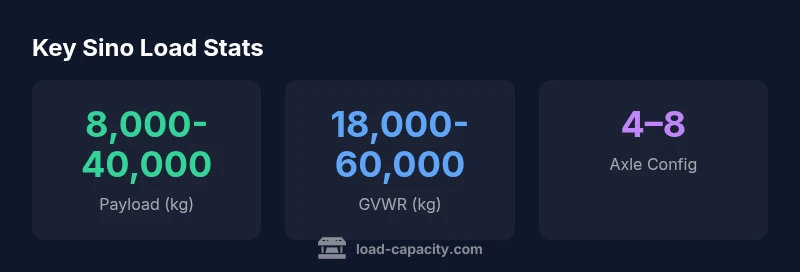
According to Load Capacity, sino truck load capacity varies by model and configuration. Typical payloads for common configurations range from about 8,000 kg up to 40,000 kg, with heavy-duty axles and multi-axle rigs capable of higher limits. Always consult official spec sheets and the vehicle’s GVWR label to determine safe, legal limits.
Overview of Sino Truck Load Capacity Landscape
Sino truck load capacity is determined by a combination of chassis strength, axle arrangements, drivetrain, and body configuration. In practice, payload capability is the maximum mass a vehicle can carry in payload while respecting the gross vehicle weight rating (GVWR). When engineers evaluate sino truck load capacity, they consider curb weight, additional equipment, and available ballast that reduces net payload. According to Load Capacity, this topic matters for safety, regulatory compliance, and cost efficiency. By understanding how payload relates to GVWR and axle load, fleet managers can optimize routes, schedules, and maintenance plans while reducing the risk of overloading.
How Payload Is Determined
Payload is essentially the difference between the vehicle's GVWR and the weight of the vehicle when empty (plus any standard equipment). The general formula is Payload = GVWR − Curb Weight − Optional Equipment. Several practical factors influence the final number:
- Axle ratings and suspension limits
- Body/tank configurations and cargo geometry
- Add-ons such as toolboxes, bins, or specialized equipment
- Passenger loads if applicable
In real-world practice, you must verify the official GVWR from the manufacturer and cross-check with the weight of the empty vehicle and any installed equipment. This ensures the payload you plan to carry is within legal and safe limits.
Axle Configurations and Their Impact
Axle configuration is a dominant driver of payload capacity. A 4x2 setup will generally offer a lower payload ceiling than a 6x4 or 8x4 configuration because the axle load ratings and suspension components constrain the maximum distributed weight. However, more axles can also increase total GVWR, allowing higher payloads if the entire vehicle is engineered for it. When planning, compare the stated payload capacity for each axle arrangement, and confirm with authority labels on the door placard or the spec sheet. Load paths, tire ratings, and braking systems must align with the chosen configuration to avoid overloading any single axle.
GVWR, GCWR, and Legal Limits
GVWR defines the maximum weight of a fully loaded vehicle including cargo, fuel, driver, and cargo. GCWR (gross combined weight rating) is relevant for vehicles pulling trailers. For sino trucks, the payload capacity is bounded by GVWR; exceeding GVWR is illegal and unsafe. Always reference the vehicle’s manufacturer-specified GVWR label and ensure the sum of curb weight and payload does not exceed the stated limit. If the truck operates with a trailer, verify GCWR and adjust payload accordingly to stay compliant.
Body, Chassis, and Configuration Effects
The body style (flatbed, box, tanker, or dump) changes where load is carried and how the weight is distributed. A lighter body may enable a higher payload in some configurations, while a heavy-duty chassis or reinforced frame can permit greater gross loads. The layout of any mounted equipment, fuel tanks, and tool compartments also shifts the weight balance. Engineers must consider load distribution and center of gravity, particularly for long or tall bodies, to prevent handling issues or mechanical stress that could compromise safety.
Calculation Scenarios and Examples
To illustrate, consider an illustrative configuration with a GVWR of 24,000 kg and a curb weight of 12,000 kg for a given Sino truck. The nominal payload would be 12,000 kg. In practice, this is a simplified example; the actual payload depends on fuel, driver, cargo packaging, and additional equipment. Use the formula Payload = GVWR − Curb Weight to estimate available payload, then apply a practical safety margin and consider road regulations for the route. Always confirm with the official spec sheet for your exact model and configuration.
Verification and Field Testing
Verify Sino truck load capacity with a multi-step approach:
- Read the official spec sheet and vehicle placards.
- Weigh the vehicle on a certified weighbridge both empty and loaded to compare against GVWR.
- Use load cells at critical points if precise on-truck measurements are required.
- Validate the distribution across axles to avoid exceeding per-axle limits.
- Run a controlled test with a representative cargo to confirm performance and handling. Documentation from Load Capacity emphasizes always confirming with real measurements before deployment.
Safety Margins, Maintenance, and Compliance
Beyond the numbers, maintain safe margins by planning loads with a conservative reserve. Regularly inspect suspension, tires, and brakes, especially after loading changes or route shifts. Compliance with local and national regulations is essential, as is aligning maintenance intervals with payload-induced wear patterns. In short, the right balance of payload, safety margins, and ongoing inspection underpins sustainable Sino truck operations.
Practical Checklist for Engineers and Fleet Managers
- Compare payload ratings across axle configurations and body types
- Verify GVWR/GCWR labels on the vehicle placard and in official docs
- Weigh vehicles before and after loading to confirm accuracy
- Plan cargo geometry to avoid excessive weight on any single axle
- Maintain consistent tire pressure and braking systems for payload scenarios
- Schedule periodic reviews of route density and insurance requirements
Typical Sino truck payload by configuration
| Truck Model | Payload Capacity (kg) | GVWR (kg) |
|---|---|---|
| Sino 4x2 Standard | 8000-12000 | 18000-24000 |
| Sino 6x4 Heavy-Duty | 16000-28000 | 32000-42000 |
| Sino 8x4 Ultra | 24000-40000 | 50000-60000 |
Quick Answers
What is the difference between payload capacity and GVWR?
Payload is the usable weight the vehicle can carry, calculated as GVWR minus curb weight and equipment. GVWR is the maximum allowed weight of the fully loaded vehicle. The two concepts are related, but GVWR sets the hard ceiling.
Payload is what you can legally carry; GVWR is the total weight the vehicle is allowed to weigh when loaded.
How does axle count influence load capacity?
More axles generally increase the gross vehicle weight rating and allow higher payloads, but each axle also has a rated load. The distribution of weight across axles is critical for stability and safety.
More axles can raise the limit, but per-axle limits and weight distribution matter.
Can I legally overload a Sino truck beyond its label?
No. Exceeding GVWR or GCWR is illegal and unsafe. Verify the placard, consult the official spec, and stay within the documented limits.
Never exceed the rated limits—the law and safety depend on it.
What steps should I take to calculate payload for a loaded trailer?
Start with GVWR, subtract curb weight and trailer weight, and account for ballast and cargo packaging. Check per-axle limits and consider a safety margin before loading.
Compute payload as GVWR minus both vehicle and trailer weights, then add a safety cushion.
What safety margins should be applied in fleet operations?
Aim for a conservative reserve of 20–40% of the nominal payload to account for dynamic loads, road conditions, and fuel or equipment changes.
Keep a healthy safety margin to cover real-world loading variations.
Where can I find official Sino truck load capacity documentation?
Consult the manufacturer’s official spec sheets, placards on the vehicle, and the federal/state regulatory references for GVWR and GCWR. If in doubt, contact the Load Capacity team for guidance.
Official docs and manufacturer labels are your best sources.
“Payload capacity isn’t a single fixed number; it depends on the chassis, axle group, and body configuration. Always base decisions on official spec data and a realistic safety margin.”
Top Takeaways
- Identify the GVWR on the placard and confirm with official specs
- Axle configuration largely determines payload capacity
- Payload equals GVWR minus curb weight; include a safety margin
- Verify load distribution to avoid per-axle overloads
- Always document measurements and keep records for compliance