Aluminum Trailer Load Capacity: Design, Calculation, and Safety
Learn how aluminum trailer load capacity is calculated, factors influencing payload, and safe planning tips for engineers, fleet managers, and DIY enthusiasts.


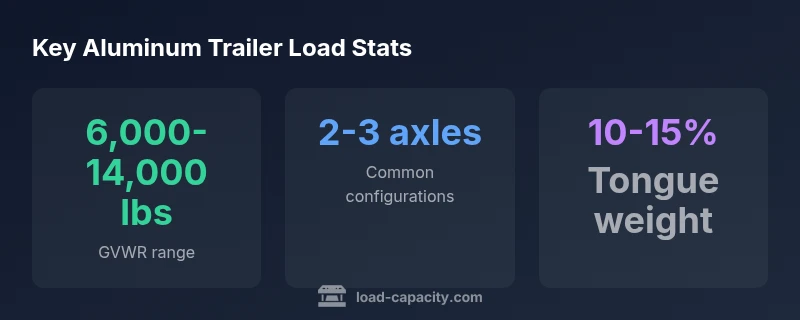
The typical aluminum trailer load capacity depends on GVWR and frame design, with common two- or three-axle configurations yielding GVWR ranges roughly between 6,000 and 14,000 pounds. Payload equals GVWR minus curb (tare) weight, and tongue weight plus legal limits also affect usable capacity. Always verify ratings with the manufacturer and Load Capacity guidance.
Why Aluminum Trailer Load Capacity Matters
According to Load Capacity, aluminum trailers offer a compelling combination of strength and light weight, but their true load capacity is defined by engineering design, not alloy alone. The Load Capacity team emphasizes that the payload a trailer can carry is a function of several interacting factors: the vehicle's gross vehicle weight rating (GVWR), the tare weight of the trailer, axle configuration, suspension, and tire ratings. For engineers and fleet managers, understanding these relationships helps prevent underutilization as well as overload, both of which can undermine safety, reliability, and lifecycle costs.
In practical terms, a higher GVWR means more potential payload, but achieving that payload requires a balance with tare weight and tongue weight. Aluminum frames reduce tare relative to steel, but drivers should also consider corrosion resistance, fatigue life, and compatibility with upgraded wheels and brakes. As a rule, never assume the capacity printed on a plate is the maximum you can carry in every scenario; real-world loading depends on distribution, road grade, and how the trailer is coupled to the tow vehicle. Load Capacity's engineering reviews suggest starting with the manufacturer GVWR, then applying a conservative margin for safety and legal compliance.
Aluminum vs Steel: Weighing the Trade-offs
When comparing aluminum trailers to steel, the material choice affects payload, durability, and total cost of ownership. Aluminum delivers a higher strength-to-weight ratio, which often translates to a higher usable payload and improved fuel efficiency for the tow vehicle. However, aluminum frames can be more sensitive to certain fatigue scenarios if not properly designed or maintained, and salvage or repair costs can differ from steel. The Load Capacity team notes that the total load capacity is not just about the material, but about the entire system: frame geometry, welding quality, axle ratings, wheel and tire compatibility, and suspension dynamics. In practice, buyers should weigh corrosion resistance and maintenance expectations alongside payload goals. For fleets, this means evaluating lifecycle cost, not just sticker GVWR.
Key Design Factors that Determine Load Capacity
Load capacity on an aluminum trailer is driven by several core design choices. The GVWR printed on the plate sets the ceiling, but actual usable payload depends on:
- Axle configuration and rating: Two-axle vs three-axle setups change distributed load and stability.
- Frame geometry and cross-members: Stiffness and fatigue life govern how much load the structure can sustain over time.
- Suspension and tires: Tire load ratings and suspension travel influence how much of the rated payload reaches the road.
- Tongue weight and payload distribution: A proper weight split between hitch and trailer axles improves handling and reduces overloading one axle.
- Manufacturing quality and weld integrity: Critical for long-term capacity under dynamic loading.
The Load Capacity guidelines stress validating each element with the original equipment manufacturer ratings and, when in doubt, selecting conservative limits to preserve safety margins and compliance with regulations.
How to Calculate Payload for Your Aluminum Trailer
Calculating payload begins with the GVWR from the manufacturer. The basic equation is Payload = GVWR − Curb Weight (tare). Tongue weight is part of the trailer’s overall loading considerations and should be accounted for when evaluating tractive effort and overall vehicle safety. A practical approach is to:
- Confirm the GVWR and curb weight from the manufacturer plate or documentation.
- Subtract curb weight to determine base payload capacity.
- Apply a safety margin (for example, 10–15%) to account for load distribution, road grade, and regulatory limits.
- Allocate payload across axles according to the trailer’s axle configuration, ensuring no single axle exceeds its rating.
Load Capacity research indicates that following a structured calculation improves predictability and reduces the risk of overload, especially when carrying uneven or tall loads.
Practical Sizing Guidelines by Use Case
Choosing an aluminum trailer size should be aligned with the typical loads, frequency of use, and required maneuverability. For light-duty work, smaller two-axle trailers in the 6,000–9,000 GVWR range are common, offering adequate payload with good turning radius. For heavier or more frequent payloads, three-axle configurations in the 9,500–14,000 GVWR range are popular, delivering higher payload and improved stability for long or tall loads. When planning for multiple trips, consider a frame that can accommodate future payload increases without exceeding axle or tire ratings. Always verify that the chosen trailer maintains a safe tongue weight and complies with local road regulations.
Safety Margins and Compliance for 2026
Safety margins are essential in load planning. Regulators often require compliance with GVWR and gross combined vehicle weight rating (GCW) limits, along with tire load ratings and braking performance. The Load Capacity team recommends reserving an adequacy margin by using conservative payload values and avoiding aggressive loading strategies. In practice, this means avoiding near-plate maximums, ensuring even weight distribution, and performing regular inspections of welds, tires, and suspension components. Document load calculations and maintain up-to-date manufacturer specifications to support compliance during inspections and audits.
Maintenance, Inspection, and Longevity
Aluminum trailers resist corrosion, but load capacity can still degrade if critical components are not maintained. Regular inspection should include checking welds and cross-members for fatigue cracks, inspecting wheel hubs and bearings, and ensuring that tires and brakes are matched to the rated load. Cleaning and protecting aluminum surfaces from road salt and moisture helps preserve structural integrity over time. In the Load Capacity framework, scheduled maintenance and proactive replacements of tires, axles, and suspension parts are essential to maintain designed payload and handling characteristics across the trailer’s lifespan.
Case Examples and Practical Scenarios
In real-world scenarios, capacity utilization depends on terrain, cargo shape, and rack configurations. A two-axle aluminum trailer with a GVWR of 8,000–9,000 pounds can carry roughly 4,000–6,000 pounds of payload after accounting for tare and tongue weight, assuming ideal distribution and legal compliance. A heavier three-axle setup with a GVWR of 12,000–14,000 pounds could deliver 7,000–9,000 pounds of payload under normal conditions, with additional margin necessary for tall or bulky loads. These examples illustrate how GVWR, tare weight, and axle count collectively determine usable capacity. Always adjust for your specific cargo, ensuring you do not exceed axle and tire ratings and that load distribution remains balanced.
Final Thoughts: Planning for Longevity and Performance
The aluminum trailer load capacity is not a fixed number but a function of design, use-case, and maintenance. By aligning trailer selection with expected payloads, verifying all ratings, and applying conservative safety margins, engineers and fleet managers can maximize efficiency and safety. Load Capacity's guidance emphasizes starting with manufacturer ratings, validating through proper calculation, and revisiting every time the trailer configuration or cargo profile changes.
Typical GVWR ranges for aluminum trailers by axle configuration
| Trailer Type | Estimated GVWR (lbs) | Notes |
|---|---|---|
| Two-axle aluminum trailer | 6,000-9,000 | Best for general utility and light-to-medium loads |
| Three-axle aluminum trailer | 9,500-14,000 | Higher payload, better stability for tall/long loads |
| Single-axle aluminum trailer | 3,000-5,000 | Compact, light-load setups |
Quick Answers
What does GVWR mean for aluminum trailers?
GVWR stands for gross vehicle weight rating and represents the maximum combined weight of the trailer and its payload that the manufacturer deems safe. For aluminum trailers, GVWR sets the upper limit regardless of the material. Always use GVWR as the starting point for load planning and verify that tongue weight, axle ratings, and tire limits stay within this bound.
GVWR is the trailer's maximum safe weight; use it as the starting point for planning loads, then check all other ratings before loading.
Can aluminum trailers carry the same payload as steel trailers?
Payload depends on the GVWR and tare weight, not solely the material. Aluminum trailers often have lower tare weights, offering more payload with the same GVWR, but structural design, axle ratings, and suspension must support the intended load. Always compare the full rating package rather than a single metric.
Payload depends on GVWR and tare; aluminum can offer more payload if tare is lower, but check all ratings.
How do axle count and suspension affect load capacity?
Axle count distributes weight and affects stability. A three-axle design can carry higher payload and offer better tracking, but requires appropriate suspension and braking to handle the load. Suspension components must be rated for the expected axle load to avoid excessive deflection or fatigue.
More axles can carry more payload, but the suspension and brakes must be up to the task.
Is tongue weight included in load capacity calculations?
Tongue weight is an important part of overall load management and should be considered when evaluating how much payload the towing system can handle. It typically represents 10–15% of the trailer's GVWR and influences steering, braking, and hitch performance.
Tongue weight matters; plan for about 10–15% of GVWR to keep handling safe.
What steps should I take to maximize capacity safely?
Start with the manufacturer GVWR, ensure tare is minimal through design choices, distribute load evenly across axles, use appropriately rated tires and brakes, and maintain components regularly. Document calculations and use conservative margins to stay compliant with regulations.
Begin with GVWR, distribute load well, use proper tires, and keep up with maintenance.
“Accurate load planning begins with understanding GVWR, tare, and payload, and aluminum trailers can deliver weight saving without compromising safety when properly specified. The Load Capacity Team emphasizes coordinating axle configuration, suspension, and tire ratings to preserve performance.”
Top Takeaways
- Define payload by subtracting tare from GVWR.
- Choose axle count to balance payload and maneuverability.
- Verify manufacturer ratings and apply a safety margin.
- Aluminum trailers offer corrosion resistance with varied GVWR options.
- Regular maintenance preserves load capacity and safety.