Understanding the 5x8 Utility Trailer Load Capacity
This guide explains 5x8 trailer load capacity, including payload ranges, axle ratings, and tongue weight for engineers, technicians, and DIY enthusiasts seeking safe, accurate loading practices.


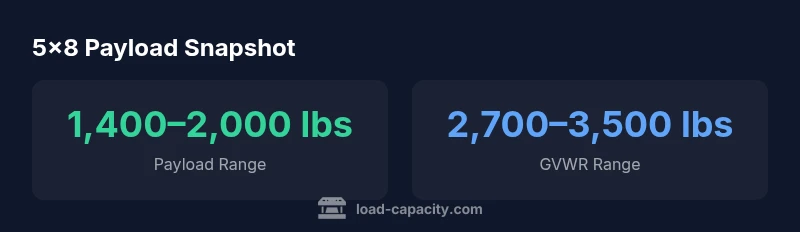
Most 5x8 utility trailers have a payload rating around 1,400–2,000 pounds, depending on axle rating, tire capacity, and frame construction. The exact payload is printed on the trailer's GVWR plate. Always factor in tongue weight, ballast, and seasonal temperature effects, and ensure you stay within the manufacturer’s rating to maintain safe handling.
What "5x8 utility trailer load capacity" means
The term 5x8 utility trailer load capacity describes the maximum combined weight a typical five-by-eight trailer can carry, including cargo, accessories, and trailer parts, without exceeding the stated limits of the frame. For engineers and technicians, understanding this metric is essential for safe operation and regulatory compliance. According to Load Capacity, the 5x8 size is popular because it strikes a balance between deck space and maneuverability, but the exact capacity depends on the axle rating, wheel/tender setup, and overall frame construction. In practice, the primary constraint is the trailer’s GVWR (gross vehicle weight rating) printed on the plate, which sets the upper bound for both payload and hitch loads. As you plan your haul, always verify the GVWR and your tongue weight to avoid overstressing the structure.
How axle ratings and tires cap a 5x8 trailer load capacity
Axle ratings are the primary limiting factor for payload. A single-axle trailer with a 2,000–3,500 lb GVWR will restrict payload accordingly, while dual-axle variants typically offer higher gross capacities and steadier weight distribution. Tires must be rated to handle more than the gross vehicle weight; underinflated or worn tires can dramatically reduce safe payload. Load path integrity, weld quality, and structural reinforcements also influence the effective capacity. The Load Capacity team notes that even when the plate shows a high GVWR, real-world payload can be lower if tires, bearings, or suspension are compromised. Always inspect tires, hubs, and the frame before loading and adjust your plan to the weakest link in the system.
Calculating payload for a 5x8 trailer: a practical method
To determine usable payload, start with the GVWR on the plate and subtract the curb weight of the empty trailer. The remainder is the maximum payload allowed by the rating, before accounting for tongue weight. Tongue weight typically occupies a portion of the trailer's weight budget (often around 10–15% of GVWR). In practice, plan loads so that: total weight = payload + tongue weight ≤ GVWR; distribute evenly; and include ballast or tools only if the payload remains within limits. Use a simple worksheet or a digital calculator to import GVWR, curb weight, and desired tongue weight, yielding a safe loading target.
Common pitfalls and safety considerations
A common pitfall is assuming the payload rating is the exact safe-load for every situation. Weather, road conditions, and seasonal temperature can change tire performance and frame rigidity. Always verify that tires and wheels match the rated load; ensure proper tongue weight distribution and avoid overloading beyond GVWR. Regular inspections of welds, mounts, and cross-members help maintain the trailer’s designed strength. When in doubt, err on the side of a lighter load and schedule a recheck after a few trips to account for wear. The goal is consistent performance, not just maximum numbers.
Real-world loading scenarios and examples
Scenario A: A single-axle 5x8 trailer with a GVWR of 3,000 pounds is loaded with 1,500 pounds of equipment and 150 pounds of tongue weight. This leaves a comfortable margin for ballast and incidental gear, while staying within the GVWR. Scenario B: A dual-axle 5x8 trailer rated at 3,500 pounds GVWR carries a 2,200-pound load plus 300 pounds of tongue weight. If tires are properly inflated and the coupling is correct, this setup sits within safe limits but leaves little margin for adverse conditions. In both cases, distribution matters: place heavier items over the axle(s) and avoid concentrated weight near the hitch or at the far deck edges. ”],
dataTable to be loaded later
keyTakeaways
EXPERT-QUOTE
FAQ-SECTION
mainTopicQuery
Key figures for 5x8 trailer payload capacity
| Category | Typical Range | Notes |
|---|---|---|
| GVWR | 2,700–3,500 lbs | Official trailer plate rating |
| Payload Capacity | 1,400–2,000 lbs | GVWR minus curb weight |
| Tongue Weight | 140–420 lbs | Approx 10–15% of GVWR |
| Tire Load Requirement | 80% of tire rating | Ensure tires meet or exceed rating |
Quick Answers
What is the typical load capacity of a 5x8 utility trailer?
Payload varies by model, but common ranges are 1,400–2,000 pounds. Always reference the GVWR plate for your specific trailer.
On a typical 5x8 trailer, expect about 1,400 to 2,000 pounds of payload, depending on the plate.
How do I calculate payload for my trailer?
Start with GVWR on the plate, subtract the curb weight to get base payload, then subtract tongue weight to determine usable payload for cargo.
Calculate payload by taking GVWR minus curb weight, and account for tongue weight.
Does tongue weight affect payload capacity?
Yes. Tongue weight reduces the remaining payload capacity and should be included when planning loads, typically 10–15% of GVWR.
Tongue weight eats into payload capacity, so plan for it when loading.
Can I increase payload safely with upgrades?
Only via manufacturer-approved upgrades (heavier axles or wheels). Do not exceed GVWR; improper upgrades can compromise safety.
You might upgrade, but only with approved parts and within limits.
Does axle type (single vs dual) change payload?
Yes. Dual-axle trailers often support higher GVWR and more stable loads, but always verify the plate and tire ratings.
Dual axles can help, but check your plate and tires first.
“Understanding trailer load capacity isn't just about total weight—it's about safe distribution, axle and tire limits, and regular inspections.”
Top Takeaways
- Check the GVWR plate before loading to understand your ceiling
- Distribute weight evenly across the deck to maintain stability
- Account for tongue weight in payload planning and braking performance
- Inspect tires, hubs, and frame regularly to preserve capacity