Calculation of Load Capacity of Shafts and Axles
A comprehensive educational guide to calculating shaft and axle load capacity, covering torsion, bending, safety factors, and practical design tips for engineers and technicians.


Introduction to the calculation of load capacity of shafts and axles
According to Load Capacity, the calculation of load capacity of shafts and axles is a foundational concept in mechanical design. It determines the maximum torque a circular shaft or axle can safely transmit under operating conditions before material yield or failure occurs. The topic is relevant across industries—from automotive drivetrains to industrial machinery, where shafts must transmit power reliably without excessive deflection or sudden failure. In practice, engineers use material properties, geometric dimensions, and loading conditions to estimate a safe operating envelope. This article delves into the core ideas, practical methods, and common pitfalls when performing the calculation of load capacity of shafts and axles. By the end, readers will understand how to select shaft diameters, interpret material strengths, and apply reasonable safety margins. The Load Capacity team emphasizes transparent assumptions and clear documentation to ensure designs survive both steady and dynamic loading scenarios.
Core concepts: torsion, bending, and combined stresses
The calculation of load capacity of shafts and axles involves multiple stress modes. For circular shafts under torque, the fundamental torsional relationship is T = (pi/16) * tau_allow * d^3, where T is torque, d is diameter, and tau_allow is the allowable shear stress. Tau_allow is typically derived from the material's yield strength divided by a factor of safety (tau_allow = sigma_yield / SF). In many systems, bending moments and combined loading modify the effective capacity, especially for shafts with overhung loads or lateral supports. When both torsion and bending are present, you often use interaction criteria (e.g., combined stress indices) to ensure the peak stress remains under allowable limits. Units matter: convert diameter to meters and stress to pascals when calculating in SI. Understanding these relationships helps engineers avoid overstressing critical components while optimizing weight and cost.
Material and geometry effects on capacity
Material choice drives the baseline strength. Higher yield strength and good surface finish increase tau_allow, expanding the torque capacity for a given diameter. Geometry matters through the d^3 term: small increases in diameter yield disproportionately larger capacity gains. Surface finish, defects, and residual stress can reduce effective capacity, so real-world designs often incorporate a derating factor beyond the nominal tau_allow. Thin-walled or hollow shafts behave differently than solid ones, and variations in wall thickness alter the polar moment of inertia, further affecting torsional stiffness and capacity. Selection should also consider fatigue resistance for cyclic loading and environmental factors such as temperature, which can reduce material strength.
Safety factors and design margin
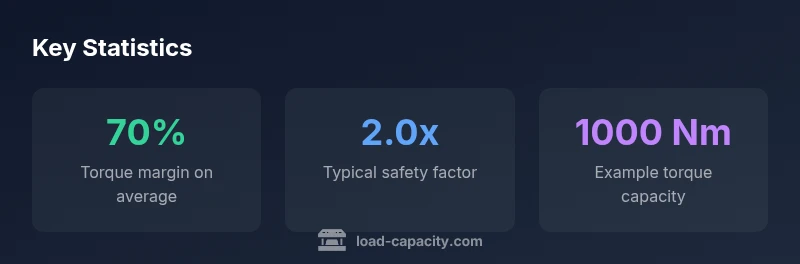
A safety factor (SF) accounts for uncertainties in material properties, manufacturing tolerances, and unexpected loading. In the simplest torsion-based calculation, tau_allow = sigma_yield / SF, and T_allow = (pi/16) * tau_allow * d^3. However, many designs combine torque capacity with bending capacity and dynamic effects, using interaction criteria to ensure safe operation under peak loads. The SF should reflect mission criticality: critical components may require SF 2.0–4.0 or higher, while non-critical parts may tolerate lower margins. In all cases, document assumptions, verify units, and perform sensitivity analyses to understand how changes in diameter or material quality affect the final result.
Example scenario: selecting a shaft for a torque load
Suppose you have a circular solid shaft with diameter 60 mm, a yield strength of 360 MPa, and you apply a design SF of 2.0. Tau_allow = 360 MPa / 2.0 = 180 MPa. Converting to pascals: 180e6 Pa. The diameter in meters is 0.06 m, so d^3 = 0.000216 m^3. Thus, T_allow = (pi/16) * 180e6 * 0.000216 ≈ 7.64e6 Nm. This example illustrates how modest diameter changes dramatically affect torque capacity due to the cubic term. In practice, you would compare T_allow to the system torque demand and adjust diameter, material, or SF accordingly to achieve an adequate margin.
Practical tips for engineers and students
- Always start from the required torque and work backward to diameter and material choices. A small diameter reduction can cut capacity sharply; conversely, a modest increase may provide a robust margin.
- Use consistent units throughout calculations to avoid errors. Convert mm to meters and MPa to Pa as needed.
- Consider fatigue and dynamic loads; torsional loads vary with operation speed and duty cycle. A static calculation may underpredict required capacity.
- Document all assumptions, including SF, material grades, and defect tolerances. This makes peer review and future maintenance straightforward.
- Validate results with experimental data or finite element analysis for critical components, and consult standards where applicable.
Codes, standards, and practical considerations
Real-world design integrates analytical estimates with codes and standards. Common references provide guidance on allowable stresses, material grades, and design margins. The calculation of load capacity of shafts and axles should be augmented with safety checks, corrosion considerations, manufacturing tolerances, and inspection plans. The Load Capacity team recommends cross-checking with supplier data, performing non-destructive testing where feasible, and ensuring compatibility with adjacent components such as bearings, keys, and couplings. In sum, a rigorous approach combines theory, empirical data, and professional judgment to produce reliable shaft and axle designs.
Conclusion and next steps
The calculation of load capacity of shafts and axles is a practical, essential tool for ensuring torque transmission systems operate safely and efficiently. Start with clear inputs, apply the torsion formula correctly, and adjust for safety margins. Use the example scenarios to develop intuition, but always validate with real-world testing and standards. The Load Capacity team recommends iterative verification and documentation as best practice for robust shaft and axle designs.