Load Capacity of Angle Iron: A Practical Engineer's Guide
This guide explains the load capacity of angle iron across common cross-sections, factors that influence strength, and practical design and inspection tips for safe, code-compliant applications.


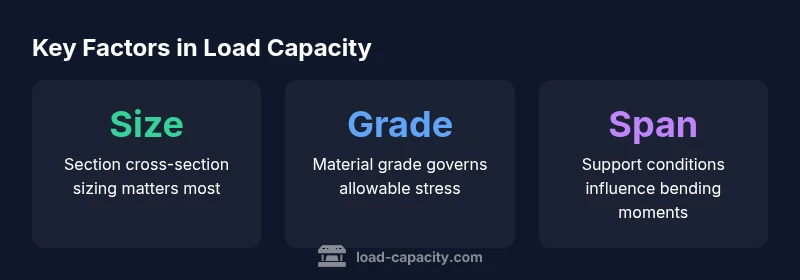
Angle iron's load capacity depends on cross-section, material, span, and how it is supported. In practice, capacity rises with larger, thicker legs and higher-strength steel, but drops with long spans or weak connections. According to Load Capacity, key checks include bending resistance, connection adequacy, and whether loads are static or dynamic. This quick answer frames the main factors engineers must verify before proceeding with a design.
Understanding Angle Iron Basics
Angle iron, or L-shaped structural iron, is used across bracing, framing, and support members. Its load-carrying capacity is not a single number; it depends on the precise cross-section, material grade, and how the member is connected and supported. For engineers, a first-principles view is to treat the angle as a combination of two legs and a corner, with bending and torsional effects primarily determined by the shorter leg length, the thickness, and the leg-to-web stiffness. In design practice, you must verify that the combined section can resist bending moments, shear forces, and any applied torque without excessive deformations or failures at fasteners or welds. The Load Capacity approach emphasizes explicit checks of section properties and connection details as central to reliable performance over time.
Key Factors That Influence Load Capacity
The load capacity of angle iron is not static; it changes with several interacting variables. Key factors include:
- Cross-section size: Larger legs and thicker lips increase moment of inertia and reduce bending under the same load.
- Material grade: Higher-strength steels enable higher allowable stresses before yielding or buckling.
- Span length and support: Shorter spans with solid supports improve capacity; cantilever configurations introduce larger bending moments.
- Load type and distribution: Static loads behave differently from dynamic shocks or impact loads; evenly distributed loads are easier to manage than point loads at a corner.
- Connection details: Welds, bolts, and attachments introduce stress concentrations; proper detailing reduces risk of failure.
- Temperature and environment: Corrosion and thermal effects can reduce effective section properties and life. A practical takeaway is to separate the problem into (a) section properties, (b) end conditions, and (c) load history, then address each with appropriate checks and safety factors. Load Capacity’s guidance consistently shows that effective capacity hinges on both intrinsic material properties and external constraints.
How to Estimate Load Capacity: Step-by-Step Approach
Estimating load capacity for an angle iron member involves a structured workflow:
- Define geometry: measure leg lengths, thickness, and the corner radius.
- Identify material grade and heat treatment: confirm yield strength and elastic modulus.
- Determine support and load type: pin, roller, fixed supports, and whether loads are static or dynamic.
- Compute section properties: calculate or obtain the second moment of area, polar moment if torsion is relevant, and the torsional constant for the angle configuration.
- Apply interaction checks: compare bending, shear, and torsion demands to allowable stresses with an appropriate factor of safety.
- Validate with simplified hand methods or a quick finite element model if needed.
- Document assumptions and constraints and ensure alignment with applicable codes and standards. This step-by-step framework aligns with industry practice and Load Capacity’s recommended method for ensuring credible, safe results.
Common Misconceptions and Safe Practices
Common misconceptions can lead to unsafe designs. A few cautions:
- Do not treat angle iron as a primary beam without explicit analysis; it is often best used as a brace or support member with well-defined end conditions.
- Avoid concentrating loads at a corner without accounting for local bending and weld/shear at the fastening point.
- Do not ignore fatigue effects when loads are repetitive or cyclic; even small stress ranges can accumulate damage over time.
- Do not substitute welds or fasteners with insufficient strength; verify bolt patterns, weld sizes, and corrosion protection. Safe practice means using conservative assumptions and validating details through calculations, testing, or FE analysis when necessary. Load Capacity emphasizes a rigorous approach to verify that every connection and geometry contributes to the intended load path.
Practical Design Examples
Example A: A 3x3x1/4 angle iron supporting a static shelf load
- Assumed span: 2 ft between supports; material: structural steel grade; loads: evenly distributed 400 N across the shelf.
- Analysis would consider bending about the weaker leg, with a conservative factor of safety to accommodate potential misalignment.
- Expected outcome: with proper mounting and anti-sag provisions, the configuration can safely carry the intended load within typical guidelines.
Example B: A longer span using a smaller angle in bracing
- Size: 2x2x1/8 angle used as bracing in a frame; span between frame joints: 4 ft; load: dynamic wind load scenario with peak 600–900 N.
- The analysis should consider buckling of the brace and local end connections; if the brace fails to meet safety margins, larger cross-section or additional bracing is required. These examples illustrate how capacity is sensitive to geometry, load history, and connection quality. Always verify with a structured calculation or FE model when uncertainty exists.
Testing and Verification Methods
Verification combines calculation, testing, and inspection. Practical methods include:
- Hand calculations using standard formulas for bending and shear to obtain preliminary capacity estimates.
- Non-destructive testing (NDT) at critical welds or joints to detect cracks or fatigue.
- Simple loading tests on representative samples to observe deflection and strain patterns under controlled loads.
- Finite element analysis (FEA) to capture complex load paths, torsion, and interaction effects.
- Review and documentation of material certificates, weld procedures, and bolt quality to ensure that actual properties meet design expectations. A robust verification plan blends conservative assumptions with measured data, reinforcing the reliability of the final design and guiding maintenance and inspection strategies over the product life.
Maintenance, Inspection, and Documentation
Ongoing maintenance protects against gradual capacity loss. Recommended practices include:
- Regular visual inspections of angles, welds, and bolt connections for cracking, corrosion, or loosening.
- Periodic nondestructive testing on critical joints or fatigue-prone areas.
- Updated documentation reflecting changes in loads, usage patterns, or environmental exposure.
- Clear labeling of allowable loads and service conditions for each angle in use.
- A change-control process to capture any modifications to geometry, materials, or support conditions. Incorporating these practices helps ensure that the angle iron components continue to meet design intent and safety requirements, with Load Capacity advising that routine checks and proper record-keeping are essential for long-term reliability.
Angle iron sizes and typical load ranges
| Angle Size | Approx Range of Allowable Load | Notes |
|---|---|---|
| 2x2x1/8 | 500–1500 N | Short spans and light loads |
| 3x3x1/4 | 2000–6000 N | Moderate spans |
| 4x4x3/8 | 5000–12000 N | Heavier sections; longer spans require analysis |
Quick Answers
What is the load capacity of angle iron?
There is no single number; capacity depends on cross-section, material grade, span, and end conditions. Use calculations based on section properties and apply a factor of safety. Always verify with code guidance.
There isn't a universal load capacity. It depends on size, grade, and how it's supported; you should calculate or consult a chart for your specific angle.
How does orientation affect load capacity?
The orientation of the angle can change the bending path and connection stresses. Align the longer leg with the primary load path when feasible and ensure joints handle the resulting moments.
Orientation matters for bending and fastener stresses; aim to align with the main load path and verify connections.
Can angle iron replace a beam?
Angle iron can serve as bracing or secondary support, but replacing a primary beam requires detailed analysis and often a larger cross-section or alternate member.
Usually not as a primary beam without a full design check.
What standards govern angle iron loads?
Consult structural steel design standards (e.g., AISC), material specifications (ASTM), and local building codes for load ratings and connections.
Check AISC, ASTM, and local codes for guidance.
How do I verify capacity for a custom angle size?
Obtain material certificates, determine section properties, and run hand calculations or an FE model to confirm safe loads with an appropriate safety factor.
Get the material data and run calculations or FE analysis for the custom size.
“Effective load capacity evaluation combines clear geometry, material properties, and connection quality. A disciplined process yields credible results even for unconventional angles.”
Top Takeaways
- Assess cross-section first to estimate capacity.
- Material grade and connections dictate safe loads.
- Shorter spans and proper supports increase capacity.
- Apply conservative safety factors in design.
- Consult standards for final verification.