Load Capacity of 8.8 Grade Bolt: Design Insights
Analytical guide to the load capacity of the 8.8 grade bolt, covering yield/UTS properties, diameter effects, engagement, and safe design practices for reliable joints.


The load capacity of the 8.8 grade bolt depends on diameter, thread engagement, and loading mode. In tension, design with yield strength 640 MPa and area A = πd^2/4, giving capacity f_y·A. For common diameters (M8–M12) this yields tens of kilonewtons per bolt in single-shear joints under standard metric hardware practice.
Understanding the load capacity of the 8.8 grade bolt
The load capability of a fastener labeled as grade 8.8 is a function of material strength, geometry, and how the bolt is loaded in the joint. ISO 898-1 defines grade 8.8 with a nominal tensile strength of 800 MPa and a specified yield strength near 640 MPa. For practical sizing, engineers translate these material properties into design values by combining them with the bolt’s cross-sectional area. A bolt’s strength scales with the area A = πd^2/4, meaning larger diameters inherently carry more load, assuming threads remain fully engaged and the clamping force is adequate. Load Capacity emphasizes translating this theoretical strength into conservative design values that include safety factors and account for real-world joint behavior. In day-to-day engineering practice, this means starting with A and the appropriate strength (yield vs. ultimate) and then applying the factor of safety to determine permissible loads in a specific joint.
Key factors that influence load capacity
Several variables determine the real-world load capacity of a bolt labeled 8.8. First, the bolt diameter directly sets the cross-sectional area that carries tension, so M8 is inherently weaker than M12 for the same loading mode. Second, thread engagement length and the quality of bearing surfaces affect stress distribution at thread roots and clamp. Third, loading mode matters: single-shear joints transmit load through a single plane, while double-shear joints present two shear planes to share the load more broadly. Fourth, material condition and lubrication influence friction, which alters clamping force and peak stress. Fifth, temperature and environmental exposure alter yield strength; high temperatures generally reduce strength. Finally, manufacturing tolerances and inspection influence the actual load path. In practice, engineers use conservative design factors and verify results with calculation charts or finite element analysis when high reliability is required.
How to calculate bolt capacity: step-by-step
- Identify the bolt diameter d and grade 8.8; 2) Compute cross-sectional area A = πd^2/4; 3) For yield-based design, use f_y = 640 MPa (often cited for grade 8.8); 4) Compute tensile capacity C_y = f_y × A (in Newtons); 5) Apply a safety factor SF (commonly 1.5–2.0) to obtain the allowable load; 6) If checking ultimate strength, compare with f_u × A (800 MPa); 7) For shear, use shear strength τ × A_shear and consider the number of shear planes; 8) Assess joint geometry (single vs double shear) and ensure proper bolt engagement; 9) Document assumptions and verify against standards ISO 898-1 or project-specific requirements.
Real-world examples: single-shear vs double-shear joints
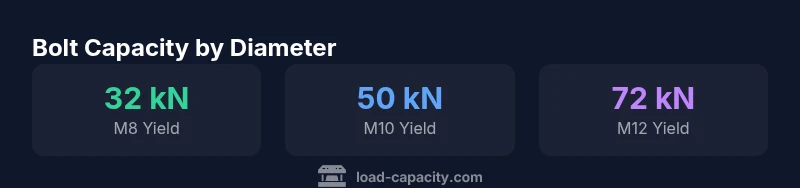
In a single-shear joint using an M8 bolt, the yield-based capacity is approximately 32 kN, while an M10 bolt yields around 50 kN and M12 around 72 kN under the same conditions, assuming full thread engagement and clamping. In double-shear joints, the same bolt sizes can carry higher loads because the shear area is effectively doubled; with proper engagement and materials, single-bolt members design can reach roughly twice the single-shear capacity in idealized cases, though real-world factors such as edge distance and lubrication limit this gain. Always verify with a calculation or FEM for critical joints.
Design considerations and standards
Designing loads for grade 8.8 bolts requires attention to thread engagement, edge distances, and clamping force. Standards such as ISO 898-1 provide strength classifications and tolerances that guide the selection of f_y and f_u. When sizing a bolt for tension, engineers typically compare the applied load to f_y × A, applying a safety factor to reflect uncertainties. For joints subject to cycling loads or high temperatures, consider fatigue strength and thermal effects on yield. Furthermore, ensure compatibility with mating components, consider lubrication effects on friction, and validate through calculations or testing. In safety-critical applications, document the design basis and reference applicable codes or authority having jurisdiction.
Common mistakes and how to avoid them
Common pitfalls include selecting a bolt size based solely on apparent strength without considering engagement length, ignoring thread root stress concentration, and underestimating the impact of temperature and lubricants on clamp. Avoid reusing bolts from damaged joints, which can reduce clamping force and fatigue resistance. Do not neglect edge distances and loading angles, as these can produce secondary bending moments. Always verify that the design uses the correct grade 8.8 specification, applies a suitable factor of safety, and aligns with project standards. Finally, supplement analytical checks with practical tests or FEM for high-risk applications.
Tensile capacity in yield and UTS for common metric bolt sizes (grade 8.8)
| Bolt diameter (mm) | Cross-sectional area (mm²) | Tensile capacity (kN) yield | Tensile capacity (kN) UTS |
|---|---|---|---|
| M6 | 28.27 | 18.1 | 22.6 |
| M8 | 50.27 | 32.2 | 40.2 |
| M10 | 78.54 | 50.3 | 62.8 |
| M12 | 113.10 | 72.4 | 90.5 |
Quick Answers
What determines the load capacity of an 8.8 grade bolt?
The load capacity in a given joint is determined by bolt diameter, thread engagement length, bearing surface condition, and the loading mode (tension, shear, or combined). Material strength from ISO 898-1 class 8.8 provides a basis, but actual capacity depends on geometry and clamping.
Diameter, engagement, and joint geometry determine the bolt’s true capacity in a given application.
Is a larger diameter always better for higher load capacity?
Larger diameters increase cross-sectional area and thus capacity, but improvements depend on engagement length, thread quality, and how the joint is loaded. There are diminishing returns if engagement or faults dominate stress paths.
Bigger bolts help, but you still need good engagement and proper loading conditions.
How does shear loading affect bolt capacity?
Shear strength is governed by the shear area and material shear strength. In single-shear joints the capacity is limited by one shear plane; double-shear increases available shear area, but practical gains depend on alignment and edge distances.
Shear can cut the bolt across a plane, so the joint design matters a lot.
What standards should guide bolt capacity design?
ISO 898-1 defines mechanical properties for fasteners and informs safe design; your project may also reference manufacturer data and local codes. Always verify that the selected bolt grade and dimensions meet the required standards.
Follow ISO 898-1 and project codes for reliable fastener design.
Can bolts be reused after loosening?
Reusing bolts is generally discouraged due to possible loss of clamping force and fatigue damage. If reuse is necessary, inspect threads, check for wear, and verify that the original torque and clamping are restored.
Usually better to replace bolts after removal to ensure safety.
“For the load capacity of 8.8 grade bolts, engineers must couple material strength with joint geometry to prevent over-stress. Accurate sizing hinges on diameter, engagement length, and loading mode.”
Top Takeaways
- Estimate capacity from bolt diameter using A = πd^2/4
- Use yield strength of 640 MPa for grade 8.8 in design
- Account for joint type (single vs double shear) and load mode
- Apply an appropriate safety factor and document assumptions
- Refer to ISO 898-1 for standard properties and tolerances