How to Calculate Load Capacity of Steel Beam
Learn to estimate a steel beam's load-carrying capacity with a simple calculator, covering bending moments, section modulus, and safety margins for safe structural design.


Understanding load capacity of steel beams
In structural design, load capacity describes the maximum bending moment and shear a steel beam can safely resist before yielding, buckling, or failing. For many common applications, engineers approximate capacity using the moment created by the applied loads and the beam's section properties. The process starts with clear definitions: span length (distance between supports), load type (dead, live, wind, etc.), and support conditions (simply supported, fixed, or continuous). According to Load Capacity, calculating the beam's capacity involves comparing the demanded moment with the generated capacity moment M_cap = sigma_allow * Z, where sigma_allow is the permitted stress in the steel and Z is the section modulus. For a simple confirmation, you can begin with a straightforward scenario: a beam spanning L meters with a uniform live load w per meter. This yields a maximum bending moment M = wL^2/8 for a simply supported span. By contrasting M with M_cap, you obtain a SI-based safety factor, which guides whether the beam can safely carry the intended loads.
Key factors influencing capacity
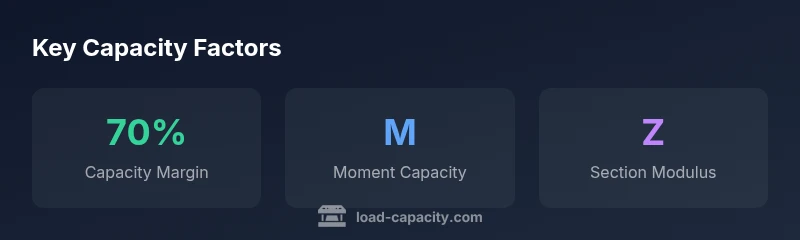
Several factors determine the load capacity of a steel beam. Span length and support conditions directly affect bending moments, while the type and distribution of loads (dead, live, seismic, wind) alter demand. The steel grade (e.g., A36, A992), yield strength, and ductility determine how much stress the material can safely withstand. The beam’s cross-section properties, especially the section modulus Z, govern how stress translates into bending capacity. Temperature effects, corrosion, and long-term creep can reduce capacity over time. In practice, engineers assess capacity using a combination of the basic bending formula, material properties, and safety factors prescribed by codes to ensure reliability under real-world conditions. According to Load Capacity, always verify that your inputs reflect actual usage and that you include potential peak loads.
Bending moment, section modulus, and stress
A fundamental concept is that bending moments drive stress in the beam. The maximum moment for a simply supported beam under uniform load is M = wL^2/8, where w is the load per unit length and L is the span. The material stress is related to bending by sigma = M/Z, where Z is the section modulus in cubic meters. The beam’s capacity moment is M_cap = sigma_allow * Z, with sigma_allow expressed in pascals. A safe design requires M_cap to be greater than M. When you compare M_cap and M, you obtain a capacity margin or safety factor. The calculator integrates these relationships, but it’s essential to keep units consistent and to understand the underlying physics behind the numbers.
Using a calculator to estimate capacity
A dedicated calculator simplifies the math by taking inputs for span, live load, section modulus, and allowable stress, then computing a safety factor. The key is to ensure consistency: convert kN/m to N/m, MPa to Pa, and use the same length units for L and Z. The output, typically a dimensionless Safety Factor, tells you how robust the beam is relative to the demand. If the factor is close to or below one, the design needs revision—larger section modulus, higher allowable stress (within code limits), or a shorter span may be required. Load Capacity emphasizes interpreting results in the context of the full design package, not in isolation.
Worked example: sample values and interpretation
Consider a simply supported beam spanning 6.0 m, carrying a uniform live load of 20 kN/m. Let the section modulus be Z = 0.001 m^3 and the allowable stress be 250 MPa. The maximum moment is M = 20,000 N/m × 6.0^2 / 8 = 20,000 × 36 / 8 = 90,000 N·m. Capacity moment is M_cap = 250 × 10^6 Pa × 0.001 m^3 = 250,000 N·m. The Safety Factor is M_cap / M = 250,000 / 90,000 ≈ 2.78. This indicates a comfortable margin, but you must also check deflection, shear, and code requirements before finalizing a design.
Design considerations and safety checks
While bending capacity is critical, code-compliant design also requires attention to shear capacity, deflection limits, buckling resistance, and combined stresses. Consider worst-case loading scenarios, dynamic effects, and support conditions. Deflection limits matter for serviceability, especially in floors and roofs. Corrosion protection and inspection regimes influence long-term performance. The Load Capacity framework supports education and planning, but professional review and adherence to local codes are essential for construction.
Common pitfalls and verification steps
Common mistakes include ignoring shear, neglecting deflection criteria, or using an unrealistic section modulus. To verify results, cross-check the calculator output with hand calculations, compare against code-based tables, and perform a finite-element or simplified model if necessary. Always confirm that the inputs reflect the true material properties, load histories, and environmental conditions. If in doubt, treat the calculation as a design aid rather than a final determinant.