How to Solve Soil Bearing Capacity: A Step-by-Step Guide
Learn how to solve soil bearing capacity with a practical, Terzaghi-based approach. Gather soil data, apply bearing-capacity formulas, and validate with settlements and safety factors.


You will learn how to solve soil bearing capacity by collecting soil data, selecting footing, applying a bearing-capacity method (Terzaghi or general), and validating with settlement checks and safety factors. According to Load Capacity, the approach combines soil properties, footing geometry, and standard factors to determine q_ult and required resistance.
What is soil bearing capacity and why it matters
Soil bearing capacity describes the maximum pressure a soil layer can sustain beneath a foundation without unacceptable settlement or failure. In practical terms, it influences footing size, depth, and overall structural safety. Engineers distinguish between ultimate bearing capacity q_ult and allowable bearing capacity q_allow, which include safety factors and settlement criteria. Solving soil bearing capacity means predicting how the ground will react to applied loads, and then designing foundations that keep settlement within limits. A robust analysis combines soil data, structural demands, and local building codes to minimize risk and optimize cost. Load Capacity emphasizes documenting assumptions and uncertainties early, so designers can justify choices to clients and inspectors. This knowledge is essential for engineers, technicians, and project managers who design foundations for buildings, bridges, or industrial structures.
Essential soil properties you must measure
You need to characterize the soil at the foundation depth. Key properties include soil type and classification, cohesion c', friction angle phi', saturated unit weight gamma_sat, and submerged unit weight gamma'. Water table depth influences effective stress and can reduce bearing capacity. Laboratory tests such as triaxial or direct shear provide phi' and c' values; field tests like Standard Penetration Test (SPT) or Cone Penetration Test (CPT) give relative consistency and hint about density and stiffness. Document soil layering, as layered soils require a combined capacity estimate or a conservative approach. Quality soil data is essential for accurate q_ult estimation and for selecting an appropriate factor of safety. This section helps engineers build confidence in the data that drives every subsequent calculation.
How footing geometry and load affect capacity
Footing geometry and load direction strongly influence how pressure is distributed in the soil. The footing width, depth, and overall shape determine the contact area and vertical stress beneath the foundation. Wider footings reduce local stress concentration but increase total load; deeper footings engage more soil mass and may improve resistance to overturning. Eccentric or inclined loads reduce effective bearing capacity and can lead to differential settlement if not accounted for. Understanding these relationships helps you choose a footing type (strip, pad, or raft) that aligns with structural demands and site constraints.
Bearing-capacity methods: Terzaghi, stiffness, and more
The most widely used framework is Terzaghi’s bearing-capacity theory, which expresses ultimate capacity as a combination of soil shear strength and overburden pressure. A common form is q_ult = c' N_c + gamma_effective D_f N_q + 0.5 gamma_effective B N_gamma, where N values depend on soil friction and state. In practice, engineers select bearing-capacity factors from charts or back-calculation, then adjust for groundwater and loading type. Other methods like Meyerhof or Vesic offer alternative approaches for specific soil conditions or foundations. Regardless of the method, validate results against settlement criteria and project-specific safety requirements. Load Capacity recommends cross-checking multiple approaches when data are uncertain.
Step-by-step workflow to solve soil bearing capacity
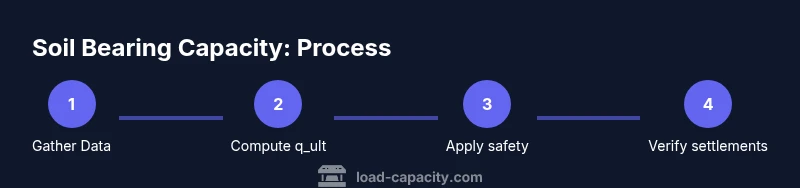
This section translates theory into a practical workflow you can follow on a project. Start by defining the problem and the design load. Then collect soil properties from laboratory and field tests. Choose an appropriate footing type and depth based on the structure and site constraints. Compute q_ult using your chosen bearing-capacity model, incorporating effective stress and footing dimensions. Apply a factor of safety to obtain q_allow, and compare it to the applied load to ensure adequate capacity. Finally, assess settlement potential and differential movement, and document all assumptions and calculations for review by peers and inspectors. Load Capacity highlights the importance of traceability and justification at every step.
Data collection and quality assurance
Accurate data is the backbone of a reliable bearing-capacity analysis. Record soil type, test methods, soil stratigraphy, and water table conditions clearly. Validate laboratory c' and phi' with field observations, and document any variability across site borings. Implement a data-quality checklist to prevent missing or inconsistent values. When data quality is high, your confidence in q_ult and q_allow improves, reducing design risk and costly redesigns. Load Capacity emphasizes building a transparent data trail that others can audit.
Safety factors, codes, and checks
Factor of safety (FoS) translates soil variability, construction quality, and future loading uncertainties into a more conservative design. Codes and standards guide FoS values; they vary by project type and regulatory jurisdiction. Always align with local building codes, project specifications, and professional judgment. A higher FoS typically reduces allowable bearing capacity but increases reliability. Consider drainage, groundwater fluctuations, and potential pore-pressure changes when selecting FoS for sands or silts.
Field tests and verification options
Field tests such as plate load tests or back-calculation from observed settlements provide empirical validation of theoretical bearing capacity. These tests help calibrate model parameters like c', phi', and gamma, and reveal site-specific factors that charts may not capture. When field testing is impractical, use alternative verification methods, such as monitoring settlements after construction or performing sensitivity analyses across plausible soil-property ranges. Load Capacity notes that combining field data with analytical methods yields the most robust results.
Documentation and communication of results
Prepare a clear, traceable report that documents soil data, modeling choices, safety factors, and settlement expectations. Include assumptions, soil profiles, load paths, and justification for foundation design. Provide both detailed calculations and a concise executive summary for stakeholders. Effective communication reduces questions during construction and supports a smoother review with inspectors and clients. The Load Capacity team recommends presenting a transparent, defendable basis for all design decisions.
Tools & Materials
- Soil sampling kit and borehole logs(Essential for obtaining representative soil data at foundation depth)
- Field testing tools (SPT hammer, CPT equipment, or penetrometer)(Use appropriate method based on site access and safety)
- Shovel, auger, and measurement tape(For basic excavation and depth measurement)
- Laboratory tests (triaxial, direct shear) or data access(Obtains c' and phi' values; critical for q_ult calculation)
- Safety gear (hard hat, gloves, boots)(Protects personnel during drilling and testing)
- Calculator or software for bearing-capacity calculation(To compute q_ult, q_allow, and perform sensitivity checks)
Steps
Estimated time: 2-4 hours for data collection and initial calculations; 1-2 additional days for field verification and review, depending on scale
- 1
Define problem and loads
State the structure type, identify critical loads, and set target settlement limits. This establishes the design objective for the bearing-capacity analysis.
Tip: Document all assumptions early to simplify peer review. - 2
Gather soil properties
Collect soil type, c', phi', and gamma values from tests or sources. Record groundwater conditions and layering at foundation depth.
Tip: Dimensional consistency is key—verify units across sources. - 3
Select footing geometry
Choose footing type and dimensions based on loads, soil type, and constructability. Consider eccentric loading and potential differential movement.
Tip: Prefer conservative dimensions when data are uncertain. - 4
Compute q_ult with a bearing-capacity model
Apply a chosen method (e.g., Terzaghi-based formula) to estimate ultimate capacity using c', phi', gamma, and footing geometry.
Tip: Use consistent effective stress and ensure parameters match soil state. - 5
Apply safety factors and determine q_allow
Multiply by an appropriate factor of safety to obtain allowable capacity and compare against design loads.
Tip: If results are close to limits, consider design changes or extra tests. - 6
Assess settlements and differential movement
Evaluate predicted settlements under service loads and verify they meet project criteria across the footing footprint.
Tip: Early integration with settlement models helps avoid surprises during construction. - 7
Document and review
Assemble calculations, data sources, assumptions, and QA checks into a report for client and code officials.
Tip: Include an executive summary with key design decisions.
Quick Answers
What is soil bearing capacity?
Soil bearing capacity is the soil's ability to support foundation loads without excessive settlement or failure. It includes ultimate capacity and allowable capacity after applying safety factors. Understanding bearing capacity helps engineers design safe and economical foundations.
Soil bearing capacity is the soil's ability to support foundation loads, considering safety factors and settlement limits.
What is the difference between ultimate and allowable bearing capacity?
Ultimate bearing capacity is the maximum soil stress before failure; allowable capacity accounts for safety factors and settlement criteria. Designers use the allowable value to ensure safe performance under service conditions.
Ultimate capacity is the maximum before failure, while allowable capacity includes safety margins for safe operation.
What factors affect bearing capacity?
Soil type, density, moisture, groundwater, footing size, load direction, and depth all influence bearing capacity. Site variability and construction quality also play critical roles in real-world performance.
Soil type, moisture, groundwater, footing size, and load direction all affect bearing capacity.
Is Terzaghi's method applicable to all soils?
Terzaghi's method provides a practical baseline for many soils but may require adjustments or alternative methods for complex soils, layered profiles, or unusual loading conditions.
Terzaghi is a good baseline, but complex soils may need other approaches.
Do field tests improve accuracy?
Yes. Field tests like plate load tests or CPT provide empirical data that calibrate and validate analytical results, reducing uncertainty in soil properties and bearing capacity.
Field tests help verify and calibrate your calculations.
What safety factor is typically used?
A standard safety factor is selected based on codes, project type, and site conditions. It should reflect soil variability and construction quality, balancing risk and cost.
Safety factor choices depend on codes and site conditions.
Watch Video
Top Takeaways
- Gather accurate soil data before modeling.
- Apply an appropriate bearing-capacity method with correct state assumptions.
- Incorporate safety factors and assess settlements.
- Validate results with field data when possible.
- Document all assumptions and maintain traceability.