How to Calculate Bearing Load Capacity: A Practical Guide
Learn a clear, educational approach to calculating bearing load capacity for foundations and structures. This guide covers key concepts, a simple formula, and a teaching calculator to illustrate the steps.


This quick definition introduces bearing load capacity and shows a simple educational method to estimate it. Using cohesion (c) and overburden pressure (sigma'v0) alongside a footing area (A), you compute q_allowable as a weighted sum and multiply by A to obtain total capacity P. This serves as a teaching tool to grasp how soil and footing parameters influence capacity.
Understanding bearing load capacity
According to Load Capacity, bearing load capacity describes the maximum load a surface, such as soil under a footing or a structural bearing pad, can safely carry without unacceptable settlement or failure. In practical terms, it sets the upper limit for how much weight a foundation can transfer to the ground. The phrase how to calculate bearing load capacity is not just academic—it translates directly into sizing decisions for foundations, pads, and supports. For engineers, technicians, and students, this concept links material properties (like soil cohesion) with geometric factors (such as footing area). This guide emphasizes an educational approach that helps you reason about capacity before diving into detailed geotechnical analyses. By understanding the core relationship, you can compare scenarios quickly and spot where design margins might be tight.
Key variables and assumptions in bearing capacity calculations
A foundational, educational model starts with three core inputs: cohesion (c) in kilopascals (
A simple, educational calculator approach
The calculator presented here is intentionally straightforward to support learning. It uses three inputs: Cohesion (c) in
Worked example: educational scenario
Consider a simple scenario to illustrate the calculation. Use c = 25
Practical considerations and limitations
In real engineering practice, bearing capacity design relies on site-specific tests (like CPT/Standard Penetration Tests) and a full geotechnical analysis that accounts for soil type, density, moisture, footing depth, loading duration, and safety factors. The simple educational model used here is helpful for intuition but should not be relied upon for final designs. Always cross-check with applicable codes, regional guidance, and the recommendations of a licensed geotechnical engineer. The Load Capacity team emphasizes using this tool to build intuition and to compare scenarios, not to replace formal analysis or professional judgement. For critical projects, secure a formal foundation design package that incorporates soil tests, factor of safety, and constructability considerations.
Educational example inputs and result for bearing capacity
| Parameter | Example Value | Unit |
|---|---|---|
| Cohesion (c) | 25 | kPa |
| Overburden (sigma'v0) | 100 | kPa |
| Footing Area (A) | 1 | m^2 |
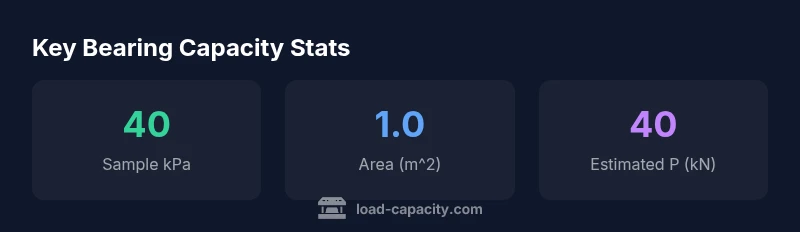
| Estimated Capacity (P) | 40 | kN |
A simple educational tool to estimate bearing load capacity using basic soil parameters.
This simplified educational model estimates bearing capacity per unit area as a weighted combination of cohesion and overburden pressure, then multiplies by footing area to give total capacity.
This calculator is a teaching tool. Real bearing capacity design requires a geotechnical engineer and site-specific data.
Quick Answers
What is bearing load capacity?
Bearing load capacity is the maximum load a surface can safely carry before unacceptable settlement or failure. It depends on soil properties, footing design, and loading conditions.
Bearing load capacity is the maximum load a surface can safely carry before settlement or failure, based on soil and footing conditions.
How do I estimate it for a shallow footing?
You can estimate it with a simple educational model using cohesion, overburden pressure, and footing area. The result provides a rough, preliminary sense of capacity to compare scenarios.
Use cohesion, overburden, and footing size to get a rough capacity estimate in a teaching context.
Why is this calculator educational only?
The calculator uses a simplified relationship and does not account for all real-world factors like soil layering, time-dependent settlement, or safety factors. Professional analysis is required for design.
It's a simplified teaching tool; real design needs professional geotechnical evaluation.
What inputs do I need?
You need cohesion (c), overburden pressure (sigma'v0), and footing area (A) to estimate capacity using the educational formula.
Cohesion, overburden pressure, and footing area are the required inputs.
How should I interpret the result?
The result P represents total bearing capacity for the given inputs. Use it to compare scenarios and check margins, not as a final design value.
Treat the result as a guide and compare against actual loads with professional input.
Top Takeaways
- Grasp how soil strength (c) and overburden (sigma'v0) drive capacity.
- P = q_allowable × A demonstrates the area effect on total capacity.
- Use this as an educational tool, not a substitute for codes and engineering judgment.
- Consult a geotechnical engineer for site-specific bearing capacity design.