Difference Between Allowable and Ultimate Bearing Capacity
Learn the difference between allowable bearing capacity and ultimate bearing capacity, how engineers calculate each, and how safety factors shape soil design. This Load Capacity guide explains definitions, methods, and practical steps for stable foundations.


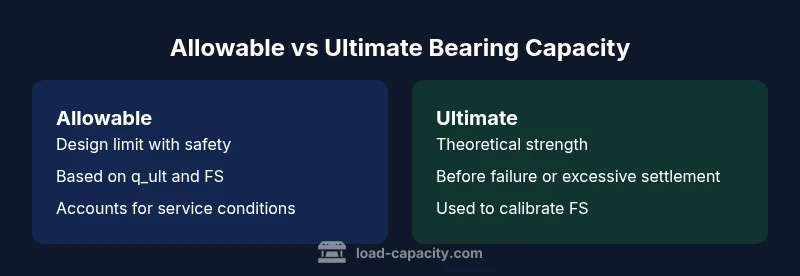
The difference between allowable bearing capacity and ultimate bearing capacity is that the allowable value is the safe design limit used in engineering practice, incorporating a factor of safety, while the ultimate value represents the soil’s theoretical strength limit before failure or excessive settlement. Designers relate the two with a safety factor and ensure service conditions stay well within q_allow, not near q_ult.
What is the difference between allowable bearing capacity and ultimate bearing capacity?
At its core, the difference between allowable bearing capacity and ultimate bearing capacity is about safety vs strength. The allowable bearing capacity q_allow is the pressure the soil foundation system is permitted to carry under service conditions, incorporating a factor of safety. The ultimate bearing capacity q_ult is the maximum soil pressure the soil can withstand before failure or excessive settlement. Understanding their distinction is essential for safe foundation design, settlement control, and code compliance. According to Load Capacity, engineers treat q_allow as the practical design ceiling, while q_ult defines the soil’s theoretical limit state. The Load Capacity team emphasizes that the margin between q_allow and q_ult is where prudent design lives, balancing safety with economy.
Theoretical foundations: bearing capacity theory
Bearing capacity theory originates from limit state concepts in soil mechanics. The goal is to relate soil shear resistance and stress distribution under a footing to the risk of shear failure or excessive deformation. Key ideas include effective stress, soil strength parameters, and the influence of footing geometry. In this view, the soil’s capacity is not a single number but a function of cohesion, friction angle, unit weights, groundwater effects, and loading configuration. Engineers use these ideas to predict whether a footing will remain stable under a given load and to plan appropriate mitigation if needed. The Load Capacity team notes that soil behavior near the bearing capacity limit is highly sensitive to small changes in moisture, density, and layering.
The standard bearing capacity calculation: ultimate capacity formula
The classical bearing capacity expression for a shallow foundation combines soil strength terms and stress terms to estimate q_ult. In symbolic form, q_ult = cNc + sigma_v'Nq + 0.5gammaNgamma, where c is cohesion, sigma_v' is effective vertical stress, gamma is unit weight, B is footing width, and Nc, Nq, Ngamma are bearing capacity factors dependent on soil state. This equation captures how different soil regimes contribute to ultimate capacity: cohesion provides inherent shear resistance, while friction and surcharge add to the total. In practice, these factors are calibrated through soil tests and field observations. The Load Capacity team emphasizes keeping reliance on these factors proportional to data quality and site conditions.
How ultimate bearing capacity is determined in practice
Determining q_ult involves integrating soil properties, loading geometry, and potential failure modes. Engineers consider rigid and flexible footing behaviors, passive soil resistance, and depth effects. Field tests, laboratory tests, and empirical correlations inform the parameters, but the general principle remains: q_ult is the theoretical peak before failure or unacceptable settlement occurs. The result guides safety-critical decisions, such as whether additional ground improvement or deeper foundations are required. The Load Capacity analysis underscores that q_ult is not a design value but a reference point used to calibrate safety margins and design choices.
How allowable bearing capacity is derived from q_ult
Once q_ult is established, allowable bearing capacity q_allow is obtained by applying a factor of safety, typically expressed as q_allow = q_ult / FS. This reflects uncertainties in soil behavior, variability in materials, and long-term performance under service loads. The chosen FS reflects risk tolerance, serviceability targets, and applicable codes. In design practice, q_allow is the working limit that the structure must not exceed to prevent excessive settlement or failure. The Load Capacity team notes that selecting an appropriate FS is as important as calculating q_ult, as it influences both safety and economy.
Factors affecting both capacities: soil properties and groundwater
Soil type, moisture content, density, and layering directly influence both ultimate and allowable bearing capacities. Clayey soils with cohesive strength respond differently from sandy or silty soils where friction plays a larger role. Groundwater conditions alter effective stress and can reduce shear strength through pore pressures. Seasonal variations, loading history, and partial saturation further complicate capacity estimates. In practice, engineers integrate these factors through soils reports, in-situ tests, and conservative assumptions to avoid underestimating risk. The Load Capacity team reminds readers that accurate soil data is the foundation of reliable capacity estimates.
Footing geometry, depth, and loading patterns
Footing depth, width, and load distribution impact the conversion from soil strength to bearing performance. Shallow, widely distributed loads may rely more on footing-soil interaction, while eccentric or concentrated loads demand stronger resistance in one region of the footing perimeter. As footing size grows, the stress concentration around the base changes, affecting both q_ult and q_allow. Depth also matters because deeper footings engage different soil layers and effective stress regimes. The Load Capacity guidance highlights modeling both uniform and non-uniform loads to ensure the design accounts for real-world conditions.
Practical design workflow: from theory to practice
A practical workflow begins with a clear problem statement and data collection: soil properties, groundwater, and foundation type. Next, estimate q_ult using bearing capacity theory or field tests, then select an appropriate safety factor to compute q_allow. Validate results with settlement criteria and serviceability checks, and choose remediation or alternative footing strategies if needed. Documentation should tie the capacity estimates to design codes and project-specific constraints. The Load Capacity team emphasizes iterative checks—update soil data as new information becomes available and revise q_allow accordingly.
Testing and verification: field and laboratory tools
Verification of bearing capacity outcomes relies on coordinated field and lab efforts. Plate load tests on shallow foundations directly measure bearing response and settlement behavior, while in-situ tests such as standard penetration tests or cone penetration tests provide soil strength indicators. Lab tests on soil samples yield c and phi parameters that feed bearing capacity calculations. In complex soils, combining multiple data sources improves confidence. The Load Capacity guidance encourages validating theoretical predictions with measured performance, particularly for critical structures or unusual loading scenarios.
Codes, standards, and design philosophy
Bearing capacity design is governed by general geotechnical principles and codes that translate theory into practice. While specific equations may vary, the underlying philosophy centers on safety, reliability, and economical use of materials. Engineers select q_allow based on project demands, reliability targets, and local code requirements. The Load Capacity team notes that ongoing professional judgment, conservative assumptions, and rigorous documentation are essential parts of compliant, responsible design.
Key insights for engineering practice
Engineers must consistently distinguish q_allow from q_ult, recognizing that design decisions operate within the safety margin. Emphasize high-quality soils data, account for water effects, and verify assumptions with field performance. Use a transparent, auditable process for choosing FS and validating settlements. Finally, integrate bearing capacity considerations into broader foundation design, including tenure of care, maintenance plans, and potential upgrades as soils or loads change.
mainTopicQuery":"bearing capacity"],
Comparison
| Feature | Allowable bearing capacity | Ultimate bearing capacity |
|---|---|---|
| Definition | The safe pressure used for design under service conditions with a safety margin. | The theoretical maximum pressure the soil can sustain before failure or excessive settlement. |
| Calculation approach | Derived from q_ult divided by a chosen factor of safety (FS). | Derived from soil properties and footing characteristics using bearing-capacity theory (c, N_c, N_q, N_gamma). |
| Influencing factors | Soil properties, water table, load configuration | Soil properties, groundwater, footing geometry, and depth |
| Usage in design | Serviceability and safety-driven design limits | Limit-state reference guiding conservative design and validation |
Positives
- Provides clear safety margins for design
- Helps prevent excessive settlement and failure
- Supports compliance with engineering codes
- Facilitates communication among stakeholders
- Guides conservative, reliable foundation design
Cons
- May lead to conservative designs and higher costs
- Requires accurate, up-to-date soil data and tests
- Subjectivity in choosing the safety factor FS
- Complex soils may require more advanced analysis
Use q_allow as the primary design limit and q_ult as the theoretical reference for safety margins.
The allowable bearing capacity sets the practical design ceiling with safety kickers; the ultimate bearing capacity defines the soil’s theoretical limit. Correctly applying safety factors ensures stability and economy in foundation design, while acknowledging the limits of soil behavior and data quality.
Quick Answers
What is the ultimate bearing capacity?
The ultimate bearing capacity is the theoretical maximum soil pressure that a foundation can transfer before failure or unacceptable settlement. It is a limit-state value used to calibrate safety margins and inform design decisions.
The ultimate bearing capacity is the soil’s theoretical peak strength before failure, used to set safe design margins.
What is the allowable bearing capacity?
The allowable bearing capacity is the design-friendly pressure the soil is permitted to carry under service conditions, obtained by applying a safety factor to the ultimate capacity. It governs safe performance during the structure’s life.
The allowable bearing capacity is the safe, service-ready limit obtained by applying safety factors to the ultimate capacity.
How is q_allow derived from q_ult?
Typically, q_allow = q_ult / FS, where FS is the chosen factor of safety. The exact FS depends on risk, importance, and local codes. This relationship translates theoretical strength into a practical design limit.
You divide the ultimate capacity by a safety factor to get the allowable capacity.
Why do q_allow and q_ult differ?
They differ because q_ult is a limit-state value representing physical soil strength, while q_allow is a design value that includes safety margins to ensure serviceability and long-term performance.
One is the theoretical limit, the other is the safe design limit.
Do codes govern bearing capacity calculations?
Yes, codes and guidelines shape how bearing capacities are estimated, tested, and applied. They specify procedures, permissible safety factors, and verification methods to ensure consistency and safety.
Codes guide how we estimate and apply bearing capacity in design.
What tests help verify bearing capacity?
Field tests like plate bearing tests, together with in-situ tests and lab soil tests, help verify soil strength and inform c, phi, and bearing capacity factors. These data support reliable q_ult estimates.
Field tests and lab tests help confirm soil strength and capacity estimates.
Top Takeaways
- Define q_ult and q_allow clearly before design
- Apply an appropriate factor of safety to convert q_ult to q_allow
- Account for groundwater and soil layering in capacity estimates
- Validate predictions with field tests and settlement checks
- Document assumptions and maintain auditable design records