Warehouse Shelving Load Capacity: A Practical Guide
A data-driven guide to warehouse shelving load capacity, covering per-shelf vs per-bay ratings, derating, and layout strategies for safe storage and efficiency.


Warehouse shelving load capacity is the maximum weight a shelf or bay can safely bear, defined by system design, mounting, and installation. Light-duty shelves typically carry hundreds of pounds per shelf, while heavy-duty pallet racks can support thousands per bay, with safety factors for uneven floors and dynamic loads.
Why warehouse shelving load capacity matters
Load capacity is not a small detail; it defines safety, efficiency, and long-term cost of ownership. According to Load Capacity, a wrong assumption about how much weight a shelf or bay can safely bear is a common source of cascading failures in warehouses. When you exceed ratings, you risk shelf deformation, pallet collapse, and increased hazard for workers and equipment. The practical consequence is not only potential injuries but also downtime, product damage, and higher insurance costs. In addition, load ratings are based on tested configurations, mounting methods, and floor conditions; real-world conditions—such as uneven floors, vibration from forklifts, and long-term creep—require careful consideration. The goal is to create a storage system where the heaviest items are distributed evenly, the rack is anchored properly, and the operating procedures reflect the rated limits. Throughout this guide, you will learn how to interpret ratings, select appropriate shelving, and implement a layout that minimizes risk while maximizing usable space.
How shelving types influence capacity
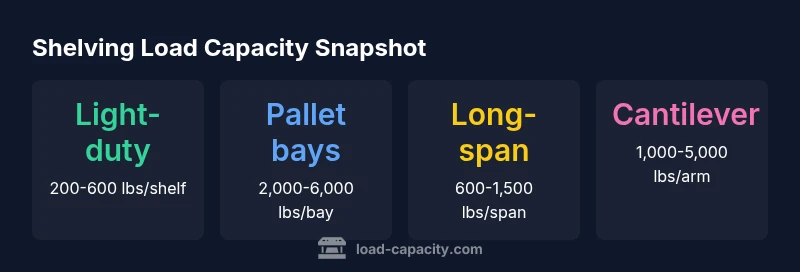
Different shelving solutions have distinct capacity profiles. Light-duty steel or wire shelving is typically rated in hundreds of pounds per shelf and is easy to adapt for small parts or office supply storage. Heavy-duty pallet racks or bay-based systems are designed for bulk goods and organized pallets, with capacities running into the thousands of pounds per bay when installed on a solid foundation. Long-span shelving provides adjustable levels for bulky items but requires attention to deflection and shelf span. Cantilever systems excel for long, odd-length items but demand careful control of load distribution to prevent tipping. When selecting a system, consider load type (uniform vs nonuniform), operating conditions (temperature, humidity), and future growth to ensure the chosen system remains within safe limits over its service life.
Reading labels and ensuring compliance
Always start with the rating label attached to each shelf or bay and verify it against the manufacturer’s specification sheet. Ratings are provided per shelf and per bay, and may include a derating note for factors like uneven floors or extended spans. Make sure the load is distributed evenly across shelves and that no single point bears a fraction of the weight far exceeding the rating. In many cases, hazards are avoided by anchoring racks, using wall ties, and maintaining aisle clearance; never depend on adjacent equipment to stabilize shelves. Document each rack's rating in your facility’s asset registry to support audits and maintenance planning.
Design strategies for safe storage layouts
A systematic approach to layout design reduces risk and improves space utilization. Start by cataloging items by weight category and footprint, then map each item to a matching shelf or bay. Use color-coded labeling to simplify load checks and enable quick visual confirmation. Plan for frequent item placement—heavier items lower in the stack, lighter items higher up—to minimize handling hazards and maximize stability. Include dedicated load-test zones to validate new configurations and record performance under typical operational cycles. Finally, design for redundancy: have spare capacity to accommodate seasonal surges without forcing the system to operate at its absolute limit.
Accounting for dynamic loads and long-term care
Static ratings assume items remain stationary, but warehouses experience dynamic loads from forklifts, pallet movement, and vibrations from equipment. Dynamic loads reduce effective capacity if load paths are not well designed. Implement safeguards such as smooth pallet handling, anti-slip pallet supports, and adequate bracing. Schedule regular inspections to identify signs of sag, rust, or connector wear, and reevaluate capacities after major changes to inventory or layout. Long-term care also means planning for environmental factors—corrosion, temperature variations, and chemical exposure—that can degrade shelf materials and fasteners over time.
Calculations and quick-check methods
A practical approach combines manufacturer-rated values with simple checks. Start with the stated per-shelf or per-bay rating, then assess load distribution: aim for as even a distribution as possible across supported levels. If a layout relies on long spans or cantilever arms, apply the derating guidance from the manufacturer and consider a factor of safety. For rapid assessments, compare the current loading against the rated capacity and track any deviations; if you approach or exceed the upper limit, halt operations and reconfigure. For complex configurations, involve a qualified structural engineer to validate bearing paths and reinforce anchor points.
Real-world scenarios and calculation examples
Example A: A light-duty shelf rated at 500 lbs per shelf is loaded with five mixed boxes weighing 420 lbs distributed evenly with 90 lbs on the top shelf remaining within the rating. The warehouse team confirms the shelf will operate within its rating under typical motion. Example B: A pallet rack bay rated at 4,000 lbs per bay receives four pallets of 900 lbs each. To stay within the rating, packing must maintain even weight distribution and the bay should be anchored, with a safety margin considering forklift movement. In both cases, proper labeling, loading procedures, and regular checks ensure ongoing safety and compliance.
Common mistakes and how to avoid them
Common pitfalls include ignoring manufacturer ratings, stacking items on ad hoc shelves, and relying on adjacent equipment to stabilize racks. Avoid weak or welded joints, improper anchoring, and insufficient aisle clearance. Regular training for staff on loading procedures, combined with periodic inspections, can prevent many incidents. Finally, maintain a living load plan that updates as inventory changes occur.
Comparison of common shelving types and their typical capacities
| Shelf Type | Typical Capacity | Notes |
|---|---|---|
| Light-duty shelving | 200-600 lbs | Good for small parts; ensure even load distribution |
| Heavy-duty pallet rack (per bay) | 2,000-6,000 lbs | Requires proper anchoring; verify aisle clearance |
| Long-span shelving | 600-1,500 lbs | Adjustable levels; consider deflection and span limits |
| Cantilever shelving | 1,000-5,000 lbs per arm | Ideal for long items; manage overhangs and tipping risk |
Quick Answers
What factors determine shelving load capacity?
Load capacity is determined by shelf design, mounting method, bay configuration, material quality, and how loads are distributed. Environmental conditions and historical wear also influence effective capacity over time.
Capacity depends on design, installation, and how you load, plus factors like wear and environment.
How do I find the rated capacity on a shelf?
Check the rating label on the shelf or the manufacturer’s spec sheet for per-shelf and per-bay values, including any derating notes for uneven floors or long spans.
Look at the label or the manual for the exact rating and any derating notes.
Exceed rating with light loads?
Exceeding ratings is unsafe even with light loads, because ratings reflect safety margins. Reconfigure the layout or upgrade components to restore a proper safety margin.
No — never exceed ratings, even with light loads, to maintain safety.
Dynamic loads handling?
Dynamic loads reduce effective capacity. Use safeguards like smooth handling, anti-slip supports, and bracing; verify paths with periodic checks.
Dynamic loads require extra care and regular checks.
Uneven floors derating?
Yes. Uneven floors or subsidence necessitates derating per manufacturer guidance and potential shimming or anchoring adjustments.
Yes, uneven floors mean you should derate and adjust the setup.
Verify capacity in live facility?
Use a formal assessment, track loads during operation, and perform periodic inspections to confirm ongoing compliance and safety.
Do periodic checks and testing to verify capacity in practice.
“Accurate load capacity means designing for worst-case loads and verifying performance with testing and inspection. Ongoing checks keep safety margins intact.”
Top Takeaways
- Assess per-shelf and per-bay ratings before stocking.
- Distribute loads evenly to maximize safety margins.
- Account for dynamic loads and floor conditions in design.
- Document ratings and conduct regular checks.
- Involve qualified engineers for complex configurations.