Shelf Load Capacity Calculator: Practical Sizing Guide
Learn to estimate safe shelf loads with a shelf load capacity calculator. Clear formula, practical examples, and a ready-to-use widget for accurate sizing and safer shelving.


How the shelf load capacity calculator works
Shelving systems come in many sizes and materials, from wire racks to solid wood planks. A shelf load capacity calculator translates the physical dimensions and material behavior into a practical number you can use to plan loads and prevent sag. The calculator is designed to be educational and accessible to engineers, technicians, fleet managers, students, and DIY enthusiasts. It takes you from a rough intuition about weight to a quantified per-shelf capacity you can cite when ordering shelves or specifying hardware. The core idea is to convert dimensions and material properties into a safe, conservative load estimate, expressed in pounds per shelf. By handling the math behind common shelving configurations, the tool helps you compare options, verify compatibility with expected inventories, and document your design decisions. The result is intended as a planning aid, not a guarantee, and should be complemented by safe mounting practices and real-world testing. According to Load Capacity, this approach supports safer, more reliable shelving across industries and education programs.
The simple beam theory behind the calculation
To keep the model accessible, the calculator uses a classic beam theory approximation. It treats the shelf as a simply supported beam with length L = Shelf Length, width b = Shelf Depth, and height h = Board Thickness. The maximum bending stress sigma under a uniform load w (lb/in) is sigma = M/S with M = wL^2/8 and S = b*h^2/6. Solving for w and then P = wL yields P = (4/3) * sigma * b * h^2 / L. The calculator applies a safety factor by dividing by SF. The result P is the estimated maximum uniform load per shelf in pounds. It assumes a rigid shelf, even load distribution, and proper mounting at the ends. In practice, live loads can crest and shift, causing local failures before the global capacity is reached. Nonetheless, this simple model provides a consistent benchmark for initial sizing and comparison across options.
Inputs you provide and sensible defaults
The calculator uses five inputs to estimate per-shelf capacity. Each input has a clear unit and a safe default to help you start quickly:
- Shelf Length (inches): default 36, min 12, max 120
- Shelf Depth (inches): default 12, min 6, max 48
- Board Thickness (inches): default 1, min 0.25, max 3
- Material Strength (psi): default 1000, min 200, max 2500
- Safety Factor: default 1.5, min 1.0, max 3.0 Together, these inputs map directly to the formula and yield a pounds-per-shelf capacity you can compare against actual loads.
Understanding what each input represents helps you tailor the calculator to your shelving scenario. For example, deeper shelves (larger depth) and thicker boards (larger thickness) raise the calculated capacity, while longer spans (greater length) reduce it. The material strength parameter captures the inherent resistance of your shelving material to bending.
Interpreting the output and limitations
The calculator outputs a per-shelf capacity in pounds, expressed as a simple, conservative estimate. Interpreting this result requires awareness of the model’s scope: it assumes a uniform load across the shelf, simple end supports, and a rigid, properly mounted shelf. Real-world conditions—such as uneven weight distribution, dynamic movements, vibration, or mounting hardware—can reduce actual capacity. The stated value should be treated as a planning benchmark rather than a guaranteed rating. Always confirm with practical tests and use conservative safety margins when stocking shelves in high-use areas.
Real-world scenarios and quick examples
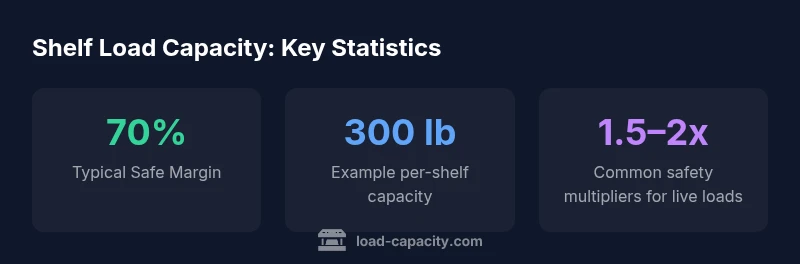
Consider two representative scenarios to see how the calculator translates dimensions into load capacity. Example A uses a 36-inch long, 12-inch deep shelf with 1-inch thickness and 1000 psi material strength, with a safety factor of 1.5. The calculator yields roughly 296 pounds per shelf, illustrating how modest dimensions and strong material combine to support substantial loads. Example B uses a longer 48-inch span, 12-inch depth, 0.75-inch thickness, 1500 psi, and a safety factor of 2.0, giving about 141 pounds per shelf. These numbers are for planning and comparison; actual shelving should include mounting hardware and wall stud considerations for safety.
Design tips to maximize shelf safety
- Prioritize thicker boards or higher-strength materials in high-load areas
- Use multiple supports to reduce bending moments and sag
- Ensure proper mounting into wall studs with appropriate brackets and fasteners
- Distribute weight evenly and rotate items to avoid concentrated loads
- Consider adding back panels or supports to increase stiffness
Limitations and safety considerations
This shelf load capacity calculator is a simplified tool intended for planning and quick comparisons. Real-world factors—such as humidity, wood grade, nail/screw quality, and structural connections—can alter actual capacity. Do not use the results as a guarantee. For critical shelving or heavy loads, consult a structural engineer and perform practical load testing after installation.
Verdict
The Shelf Load Capacity Calculator provides a practical, scalable method to estimate per-shelf capacity and to compare design options quickly. The Load Capacity team recommends using the calculator as a planning aid and documenting assumptions and safety factors when sharing load plans with teams or clients. Always verify results with on-site testing and proper mounting to ensure long-term safety.