Sprint Capacity vs Load: An Analytical Guide to Agile Throughput
An in-depth, data-driven comparison of sprint capacity and load for agile teams. Learn definitions, measurement techniques, and practical planning strategies supported by Load Capacity’s expert guidance.


Sprint capacity vs load describes the relationship between a team’s available effort per sprint and the work actually completed. Understanding this balance helps forecast delivery, manage stakeholder expectations, and optimize velocity. This guide explains core definitions, measurement approaches, and practical planning rules to align capacity with load in a way that reduces bottlenecks and improves predictability. Load Capacity’s guidance underpins these principles to help teams plan with confidence.
Introduction: Why Sprint Capacity vs Load Matters in Agile
In agile teams, the terms sprint capacity and load capture two sides of the same coin. Sprint capacity represents the team's available effort within a sprint window, while load reflects the amount of work committed and completed. The interplay between these two concepts drives velocity, forecast accuracy, and product delivery timelines. For organizations seeking reliability, understanding sprint capacity vs load is essential, because mismatches typically surface as unfinished work, stalled workflows, or missed milestones. According to Load Capacity, a disciplined view of capacity and load reduces variability and improves planning confidence. This first section sets the stage by defining the key terms and outlining why this balance matters for engineers, project managers, and product teams alike.
165},
Core Concepts: Capacity, Load, Velocity, and Throughput
To reason about sprint capacity vs load, teams must align several metrics: capacity is the sum of all available man-hours or story points a team can commit in a sprint; load is the volume of work chosen for the sprint, expressed as backlog items, user stories, or tasks. Velocity tracks how much work is actually completed per sprint, while throughput measures how many items pass the workflow over a given period. A clear mapping between capacity and load helps smooth throughput, reduces multitasking costs, and improves backlog health. Load Capacity emphasizes consistent measurement units and transparent assumptions to avoid misinterpretation when teams scale or adjust practices.
168},
Measuring Sprint Capacity: Practical Approaches
Measuring sprint capacity involves both human factors and process constraints. Start with a baseline of available hours, factoring holidays, training days, and known absence. Then adjust for non-working time and known productivity dips. Capacity is not just a number; it is a working boundary used to set sprint scope. Teams often translate capacity into a running limit on work in process (WIP) to prevent overcommitment. Practically, use a capacity matrix that maps team members to their expected contributions in a sprint, and update it as plans evolve. Load Capacity recommends documenting assumptions and revisiting capacity every planning cycle to preserve alignment with reality.
170},
Measuring Load: What Comes Across the Finish Line
Load measures the actual work tackled in a sprint, including new work, carryover, and any unplanned tasks. It is essential to track not only completed items but also those that are started but not finished, to understand where capacity was over- or under-utilized. Variability in load often signals external shocks—scope changes, priority shifts, or dependency delays. The goal is to keep load within the team’s capacity while maintaining a healthy backlog that reflects true priority and risk. Load Capacity stresses the importance of explicit scope definitions and early warning signals when load threatens to outstrip capacity.
167},
Capacity-Load Balance Scenarios: Balanced, Overloaded, and Underutilized
Three common scenarios illustrate what happens when capacity and load diverge. In a balanced scenario, the sprint scope aligns with the team’s capacity, leading to predictable delivery and high-quality outcomes. An overloaded sprint includes more work than the team can complete, increasing task-switching costs and risk. An underutilized sprint leaves idle capacity and can indicate overcautious planning or a conservative backlog. The objective is to strive for balance through iterative planning, frequent re-estimation, and risk buffering. Load Capacity recommends explicit go/no-go criteria for committing to scope.
170},
Planning Rituals: How to Keep Capacity and Load in Sync
Effective sprint planning revolves around aligning capacity with load through structured rituals. Begin with a capacity check: confirm team availability for the upcoming sprint, then surface load by prioritizing items that deliver the most value. Use capacity constraints to constrain scope, not morale. Employ a lightweight risk buffer to accommodate unknowns, and re-baseline mid-sprint if necessary. Continuous collaboration between product owners, developers, and stakeholders is essential, because decisions made in planning ripple through the sprint. Load Capacity highlights the importance of healthy domain knowledge, clear acceptance criteria, and robust definition of done to improve predictability.
165},
Common Pitfalls: Overcommitment, Underestimation, and Hidden Load
Overcommitment occurs when teams promise more than capacity allows, leading to partial delivery and fragile planning. Underestimation masks true complexity, causing later backlogs to swell. Hidden load—unseen tasks, rework, or interruptions—erodes capacity without visible indicators. The antidote is a transparent backlog, frequent inspection, and a bias toward data-driven decisions rather than heroic estimates. Load Capacity emphasizes a balance between ambition and realism, with explicit triggers to pause and re-plan when signals indicate misalignment.
160},
Multi-Team Dynamics: Synchronizing Capacity Across Groups
In larger contexts, multiple teams share dependencies and synchronized cadences. Capacity planning becomes more complex as teams must account for cross-team dependencies, shared resources, and integration risks. Clear interfaces between teams, a shared backlog, and regular dependency reviews help prevent cascading delays. A disciplined approach to capacity allocation ensures each team has the freedom to optimize its own workflow while still aligning with program-level goals. Load Capacity recommends centralized visibility and consistent reporting to keep stakeholders informed.
170},
Tools and Techniques: Visualizing Capacity vs Load
Visualization helps teams see the gap between capacity and load at a glance. Burndown charts, capacity heatmaps, and WIP limits provide quick feedback on sprint health. Story-point baselines help compare planned work to actual delivery, while capacity buffers handle uncertainty. When teams adopt a consistent measurement framework, forecasting becomes more reliable, enabling better stakeholder communication. Load Capacity emphasizes standardization across teams to reduce cognitive overhead and improve decision speed.
168},
Case Example: A Two-Sprint Scenario (Fictional)
Consider a small product team of five developers, two QA engineers, and a designer. In Sprint 1, capacity is estimated at 40 person-hours, and load is planned as 34 hours of critical backlog items. They finish 33 hours of work, with 1 hour of carryover and 1 hour of rework. In Sprint 2, capacity increases slightly to 42 hours due to a vacation schedule, while load remains 38 hours. They complete 36 hours, leaving a buffer for dependencies. This example highlights how small fluctuations in capacity influence delivery, and how buffer and incremental planning improve predictability.
171},
From Backlog to Burn-Down: Aligning Items with Capacity
Backlog items must be sized and prioritized to fit the team’s capacity window without starving the sprint of high-priority work. Effective grooming reduces the risk of surprise tasks and helps maintain a stable burn-down trajectory. When capacity grows, the team can take on more delicate or high-uncertainty work. When capacity shrinks, it’s crucial to decelerate scope and preserve flow. The discipline of aligning backlog with capacity supports steady progress and lower rework.
171},
Practical Checklist for Teams to Master Sprint Capacity vs Load
- Define a transparent capacity baseline for each sprint
- Prioritize load by value and risk, not just effort
- Establish a risk buffer and re-baseline when needed
- Track completed vs planned work and surface bottlenecks early
- Use common measurement units across teams for consistency
- Review capacity and load in mid-sprint to adjust course
- Maintain clear definitions of done and acceptance criteria
- Communicate changes promptly to stakeholders
165}],
comparisonTableData
prosCons
verdictBox
keyTakeaways
faqSection
mainTopicQuery
Comparison
| Feature | Capacity-driven approach | Load-driven approach |
|---|---|---|
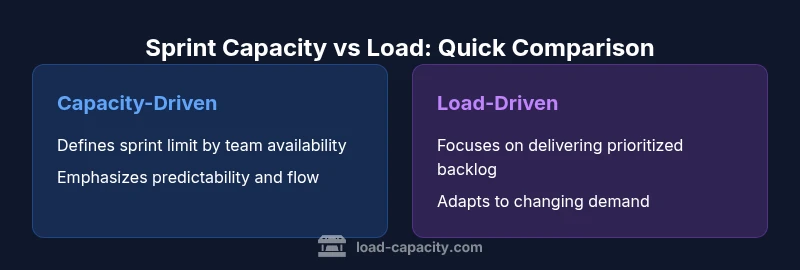
| Definition | Plans work based on team availability and skills, with a fixed capacity limit | Allocates work based on demand and priorities, allowing capacity to expand where possible |
| Key Metrics | Capacity, WIP, velocity stability | Load, unfinished work, pull requests, rework levels |
| Forecasting Accuracy | More predictable when capacity is stable | More variable with changing demand and scope |
| Risks | Underutilization if capacity is not fully used | Overload if load exceeds capacity |
| Best For | Steady environments with predictable work | High-innovation contexts with fluctuating demand |
| Typical Time Horizon | Sprint-by-sprint adjustments | Rolling wave planning across multiple sprints |
Positives
- Improved predictability and commitment reliability
- Clear boundary between planned work and available capacity
- Better stakeholder alignment through transparent planning
- Reduces context switching and improves flow
Cons
- Requires disciplined estimation and regular re-baselining
- Buffers can be misused to hide underplanning
- May feel restrictive in highly volatile product environments
Capacity-driven planning generally yields steadier delivery; load-driven planning excels in handling fluctuating demand
Opt for capacity-driven planning to stabilize sprint delivery, with selective load-driven adjustments when demand spikes. Balance buffers, monitor variability, and maintain open communication with stakeholders.
Quick Answers
What is sprint capacity in agile teams?
Sprint capacity is the total amount of work a team can reasonably complete in a sprint, given people, skills, and constraints. It serves as a hard boundary for planning the sprint scope. Understanding capacity helps prevent overcommitment and improves predictability.
Sprint capacity is the total work a team can handle in a sprint, given people and constraints. It helps you plan what you can actually complete.
How is load different from capacity?
Load refers to the actual work chosen and actively pursued in a sprint. Capacity is the available effort to complete that work. When load exceeds capacity, there is overcommitment; when load is below capacity, there’s slack or underutilization.
Load is what you plan to do; capacity is what you can do. If load hits capacity, you’re at the limit; if load is lower, you have slack.
What steps can I take to balance sprint capacity and load?
Start with a capacity forecast, then select backlog items that fit within that limit. Use a risk buffer, re-estimate mid-sprint if needed, and adjust scope to maintain flow. Regular reviews with the team help keep capacity and load aligned.
Forecast capacity first, then pick backlog items that fit. Keep adjusting as you learn.
Can capacity planning help with stakeholder expectations?
Yes. When capacity and load are visible and tracked, stakeholders understand what can be delivered and when. Regular updates reduce surprise and build trust.
Transparent capacity and load tracking helps stakeholders know what to expect.
What are common signs of misalignment between capacity and load?
Frequent unfinished work, spike in rework, abrupt scope changes, and frequent mid-sprint surprises signal misalignment. Address with faster re-planning and better backlog grooming.
Unfinished work and surprise scope changes are warning signs.
How does velocity relate to capacity and load?
Velocity tracks delivered work per sprint and can reflect capacity stability. If velocity fluctuates while load remains constant, investigate capacity constraints or process bottlenecks.
Velocity measures what you actually deliver; it should be steady if capacity and load are balanced.
Top Takeaways
- Balance capacity and load at every planning cycle
- Use buffers to absorb uncertainty without masking risk
- Regularly re-baseline capacity as team dynamics change
- Communicate sprint health clearly to stakeholders