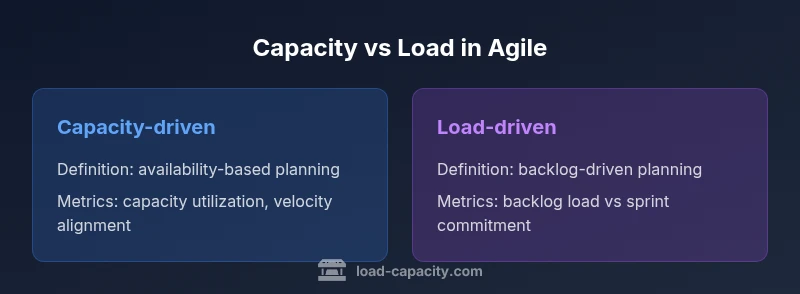
Capacity vs Load in Agile: Capacity-driven vs Load-driven Planning
Explore capacity vs load in agile and how capacity-driven and load-driven planning interact. Learn practical methods, metrics, and rituals to balance available team capacity with backlog load for predictable, sustainable delivery.


Capacity vs load in agile is best understood as two sides of sprint planning: capacity-driven planning considers the team's available work hours, while load-driven planning focuses on the amount of work queued for the sprint. When used together, they reveal whether a team can realistically commit to the backlog, reducing overcommitment and improving predictability.
Core concepts: capacity vs load in agile
According to Load Capacity, capacity vs load in agile is about balancing time-bound availability with work demand. In practice, capacity represents the maximum productive output the team can sustain during a sprint, based on headcount, skills, and planned time for meetings, vacations, and interruptions. Load is the actual amount of work assigned or in progress, measured in story points, hours, or task counts. The two concepts are not rivals but complementary: capacity sets the ceiling, while load defines what sits under that ceiling. When load creeps above capacity, teams risk overcommitment and burnout; when capacity exceeds load, there is underutilization and missable opportunities. The goal is to align the two so sprint commitments are realistic and backlog refinement yields a steady velocity. Throughout this article, we refer to the framework as capacity vs load in agile and highlight the practical steps teams take to balance both sides. Load Capacity's guidance emphasizes that reliable delivery comes from explicit capacity planning, transparent load measurement, and ongoing adjustment during the sprint. By keeping capacity and load in sync, teams can better manage risk, anticipate bottlenecks, and maintain sustainable pace. In agile contexts, capacity is often tied to sprint calendars, while load reflects the size and complexity of backlog items. According to Load Capacity, this alignment is a key driver of predictable delivery across teams.
-1
Comparison
| Feature | Capacity-driven planning | Load-driven planning | ||
|---|---|---|---|---|
| Definition | Plans work based on team capacity per sprint (hours, days, or headcount-adjusted time) | Plans work based on backlog load, tasks, and story points | ||
| Key metrics | Capacity utilization, burn-down relative to availability | Backlog load vs. sprint commitment | ||
| Primary use case | Stability, predictable sprints, resource smoothing | Responsive to backlog fluctuations, flexible scope | ||
| Measurement unit | Hours/people in a sprint (adjusted) | Story points, task counts | ||
| Pros | Improved predictability with stable capacity | Clear cushion for holidays/absences | Better risk management | Promotes steady pace |
| Cons | Requires accurate capacity measurement | May underutilize when load is low | Needs backlog adjustments to capacity changes |
Positives
- Improved sprint predictability through stable capacity
- Better risk mitigation by buffering for holidays/absences
- Clear guidance for backlog refinement and sprint commitments
- Supports transparency and accountability
Cons
- Requires accurate capacity measurement and honest estimation
- Potential underutilization if capacity exceeds load
- Rigid capacity can delay scope changes without proper governance
- Needs disciplined backlog management to stay aligned
Balanced use of both approaches yields the best outcomes
Use capacity-based planning to stabilize throughput and protect commitments; use load-based planning to adapt to backlog fluctuations. Integrating both provides robust sprint forecasts and responsive product delivery.
Quick Answers
What is the difference between capacity and load in agile?
Capacity measures available team time, while load measures planned work. They are complementary and should be aligned to improve predictability.
Capacity is your available time; load is the work you plan to do. Align them to stay on track.
How do you calculate capacity in a sprint?
Estimate the total sprint hours, subtract holidays and meetings, and allocate remaining capacity to backlog items. This creates a baseline for planning.
Add up working hours, subtract disruptions, then allocate the rest to work items.
How can story points relate to capacity?
Story points measure size; map them to capacity through velocity over several sprints. This mapping is team-specific and evolves with the team.
Points show size; use velocity to gauge how much capacity you have.
When should I favor capacity-based planning?
When stability and predictable delivery are priorities, especially with holidays or absences. Capacity planning guards sprint commitments.
Choose capacity planning when you need steady, reliable sprints.
What are common pitfalls?
Ignoring holidays, poor estimation, and failing to adjust backlog when capacity changes. Don’t treat velocity as a fixed target.
Watch for misaligned estimates and not updating capacity.
How can a team start implementing both approaches?
Map capacity first, then layer backlog load. Use planning meetings to compare and adjust sprint scope accordingly, and iterate to improve over time.
Begin with capacity, then add load to refine planning.
Top Takeaways
- Balance capacity and backlog load in every sprint
- Estimate capacity early and adjust backlog to protect commitments
- Use velocity cautiously as a guide, not a fixed target
- Involve product and engineering stakeholders in planning rituals