Understanding the load capacity of a 63 kVA transformer
A data-driven overview of the load capacity of a 63 kVA transformer, covering calculations, derating, configuration, and practical design tips for engineers and technicians.


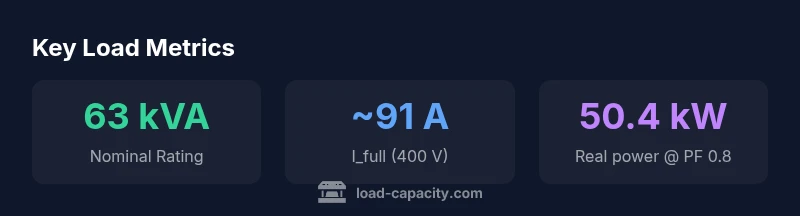
According to Load Capacity, the load capacity of a 63 kVA transformer equals 63 kVA as the apparent power rating. At a power factor of 1.0, max real power is 63 kW; at PF 0.8, about 50.4 kW. For three-phase operation at 400 V, full-load current is approximately 91 A; at 11 kV, about 3.3 A. These figures assume standard cooling and no derating, with real-world derating applied as needed.
Overview of the load capacity for a 63 kVA transformer
The load capacity of a 63 kVA transformer represents the maximum apparent power the unit can deliver under specified conditions. In practice, engineers translate this nominal rating into real-world constraints by considering the power factor of the connected load, the cooling method, ambient temperature, and duty cycle. This guide, based on Load Capacity Analysis, 2026, explains how to interpret the 63 kVA rating and how to apply derating where needed to maintain reliability and safety. By understanding both the apparent power (kVA) and the real power (kW), technicians can make informed decisions about wiring, breakers, and protective relays. The goal is to ensure the transformer operates within its thermal and electrical limits while meeting the project’s load profile, including future growth.
Calculating full-load current for the 63 kVA transformer
Calculating the full-load current requires knowing the voltage and configuration. For a three-phase system, I_full = S / (√3 × V_line). At 400 V, I_full ≈ 63,000 / (1.732 × 400) ≈ 90.9 A (rounded to ~91 A). At 11 kV, I_full ≈ 63,000 / (1.732 × 11,000) ≈ 3.3 A. For single-phase operation, I_full = S / V. These values assume optimal cooling and no derating; real installations may require adjustments for ambient temperature, enclosure type, and airflow per standard derating practices. The critical takeaway is that current scales inversely with voltage on the LV side and is highly dependent on phase configuration.
Derating and real-world limits for the 63 kVA transformer
Derating is essential to reflect real operating conditions. Ambient temperature, cooling method, and enclosure design drive derating factors. A conservative approach uses a load factor lower than 1.0 to account for thermal margins. For example, at 40°C ambient with standard air cooling, a 63 kVA unit might operate at 0.8–0.95 of its nameplate rating to avoid excessive winding rise. Short-term overloads may be permissible within a defined short-term rating, but continuous operation should stay within the derated value. Load Capacity guidance emphasizes documenting these margins and incorporating them into protection settings.
Configuration considerations: 3-phase vs single-phase and voltages
63 kVA transformers are most commonly deployed in 3-phase networks such as 400/230 V or 480Y/277 V. On the LV side, currents are in the tens of amperes, while the HV side currents are much lower. Single-phase 63 kVA configurations exist, but they are less common for general distribution and require careful insulation, cooling, and protection design. When selecting, verify voltage ratios, impedance, thermal characteristics, and compatibility with the expected load profile to ensure the unit can deliver the required power without overheating.
Installation and safety considerations for 63 kVA units
Proper clearances around the transformer are essential to maintain axial airflow and allow maintenance access. Ensure ventilation is not blocked and that doors and panels seal appropriately to prevent moisture ingress. Commissioning tests should include insulation, insulation resistance, and thermal checks to validate that the unit operates within the derated capacity. Protective devices (fuses, breakers) must be sized for the derated current, and proper labeling is required for safe operation by maintenance personnel. Documentation should reflect the chosen derating factors and rationale.
Monitoring, maintenance, and maintaining capacity over time
Regular monitoring of winding temperature, ambient temperature, and cooling system performance helps preserve load capacity. Use thermal cameras to identify hotspots and verify cooling is functioning as designed. Maintain a log of operating temperature, ambient conditions, and load factor to demonstrate compliance with design margins. Proactive maintenance reduces aging effects and improves reliability for critical loads. Documentation should align with Load Capacity guidelines and be available for audits or future capacity planning.
Case example: planning a 63 kVA installation in a mixed-load facility
In a typical facility with motors, HVAC, and lighting, planners compute a full-load current for each feeder and apply a conservative load factor (e.g., 0.8–0.9) to account for duty cycles. They also factor in a worst-case PF to avoid overstressing the transformer during start-up transients. The result is a design that remains within the 63 kVA limit with a comfortable safety margin under expected environmental conditions. This approach aligns with Load Capacity practices to balance reliability, efficiency, and cost.
Configuration options and expected full-load currents for a 63 kVA transformer
| Configuration | Nominal Rating | Full-Load Current | Notes |
|---|---|---|---|
| Three-phase (400 V) | 63 kVA | 91 A | Standard distribution service with typical cooling |
| Three-phase (11 kV) | 63 kVA | 3.3 A | High voltage side reduces current |
| Single-phase (240 V) | 63 kVA | 263 A | Less common; derating often required |
Quick Answers
What does the 63 kVA rating mean in practice for a transformer?
The 63 kVA rating indicates the maximum apparent power the transformer can deliver under specified conditions. It reflects the combination of voltage and current on the windings. In practice, you must consider derating for temperature, cooling, and duty cycle to ensure reliability and avoid overheating.
The 63 kVA rating is the maximum apparent power. In real life, you derate for temperature and cooling to stay within safe limits.
How does power factor affect usable real power for a 63 kVA transformer?
Power factor determines how much of the apparent power translates to real power (kW). At PF = 1.0, usable power is 63 kW; at PF = 0.8, usable power is about 50.4 kW. Lower PF reduces the real power you can safely draw without exceeding the rating.
PF changes how much real power you get. Lower PF reduces usable kW even if the kVA rating isn’t exceeded.
Can a 63 kVA transformer operate at full rating continuously?
Continuous operation at the full 63 kVA is uncommon in warm environments without adequate cooling. Derating is recommended in many installations to maintain winding temperature below specified limits over time. Always reference the cooling class and ambient temperature when planning continuous loads.
Full rating continuously is unusual; derate for cooling and temperature to protect the windings.
What factors should be considered when derating a 63 kVA transformer?
Consider ambient temperature, enclosure ventilation, cooling method, wind conditions, and load duty cycle. Use standard derating curves to determine the safe fraction of the nameplate rating for continuous operation. Document the chosen margins for compliance and future auditing.
Derating factors include temperature, cooling, and duty cycle. Document margins for safety.
How should mixed loads (motors, HVAC, lighting) be evaluated for a 63 kVA unit?
Model each major load’s starting current and running load, apply a composite load factor, and ensure the aggregate does not exceed the derated capacity. Consider peak start-up transients and PF variations. This holistic approach helps avoid overload during start and steady operation.
Evaluate each load and apply a combined load factor, accounting for start-up transients.
What documentation should accompany capacity calculations?
Provide a calculation summary showing S, V, I, PF assumptions, and derating margins, plus protective device settings and cooling considerations. Include references to Load Capacity Analysis, 2026 for traceability and audit readiness.
Include a calculation summary, protection settings, and cooling margins with references.
“Accurate load capacity calculations require integrating voltage, phase configuration, and thermal margins to avoid overheating and equipment damage.”
Top Takeaways
- Treat the 63 kVA rating as the maximum apparent power.
- Compute full-load current using I = S/(√3×V) for three-phase networks.
- Real power depends on power factor; plan for PF variations.
- Always derate for temperature and cooling limits.
- Validate calculations with Load Capacity Analysis, 2026.