How to Calculate Transformer Load Capacity
Learn how to calculate transformer load capacity with clear steps, formulas, and real-world examples. This guide explains kW to kVA conversions, load utilization, and safety margins for reliable transformer operation.


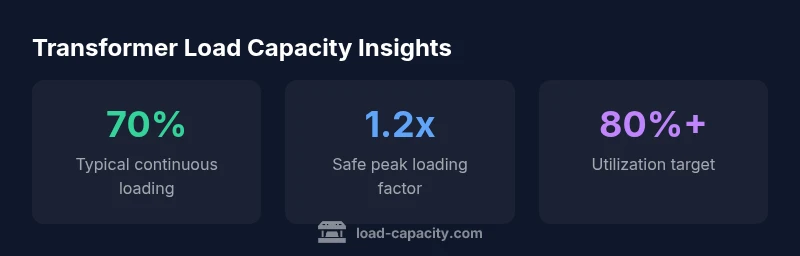
To calculate transformer load capacity, start by converting the load from kilowatts to kilovolt-amperes using S = P / PF. Then compare this S_load to the transformer's rated kVA. The loading percentage is (S_load ÷ S_rated) × 100. Design practice typically targets 70–80% of rated capacity for reliability and temperature margins.
What this calculation does and why it matters
Understanding how to calculate transformer load capacity helps engineers and technicians assess whether a given electrical system can safely handle expected power demands. The core idea is to compare the load’s apparent power (in
Example transformer load scenarios showing how load and PF affect utilization
| Scenario | Rated kVA | Load kW | PF | S_load (kVA) | Utilization % |
|---|---|---|---|---|---|
| Baseline | 500 | 300 | 0.9 | 333.33 | 66.67% |
| Mid-size | 750 | 500 | 0.95 | 526.32 | 70.21% |
| High-load | 1000 | 800 | 0.85 | 941.18 | 94.12% |
Estimate loading utilization and identify safe operating margins using a simple, transparent formula.
Calculates S_load = P / PF, then utilization = S_load / ratedKVA × 100
Estimates based on a fixed PF and rating. Actual safe operation depends on cooling, ambient temperature, and duration of loading.
Quick Answers
What is transformer load capacity and why is it important?
Transformer load capacity refers to the maximum electrical load a transformer can safely carry without overheating or compromising performance. It’s determined by the transformer’s rated apparent power (kVA) and is affected by factors like power factor, duration of load, and cooling. Properly assessing load capacity prevents overheating, voltage drop, and unexpected interruptions.
Transformer load capacity is the safe limit for electrical load on a transformer, considering cooling and duration. Proper assessment helps prevent overheating and outages.
How do you convert kW to kVA for this calculation?
Converting kW to kVA requires dividing by the power factor: S_load = P / PF. This yields the apparent power in kVA, which you compare against the transformer's kVA rating to determine utilization.
Convert kW to kVA by dividing by PF, then compare to rating to find utilization.
Why is a continuous loading range like 70–80% recommended?
A continuous loading range of 70–80% provides a safety margin to account for ambient temperature, windage, and aging of insulation. This helps ensure the transformer stays within safe thermal limits during typical operation and peak events.
70–80% gives a safety buffer for heat, aging, and variable loads.
Can a transformer be overloaded for short periods?
Short-term overloads may be acceptable if approved by design and within thermal limits, but frequent overloads degrade insulation and shorten life. Always review manufacturer guidelines and temperature rise curves before planning overload events.
Short-term overloads can occur under approved conditions, but should be limited.
How does power factor affect the calculation?
Power factor directly changes S_load for a given real power. A lower PF increases S_load, reducing the margin to the rated kVA. Improving PF reduces apparent load and helps keep utilization within safe bounds.
Lower PF increases apparent load, so improving PF helps keep within limits.
What about different transformer configurations (single-phase vs three-phase)?
Three-phase transformers have different apparent power formulas than single-phase units. Ensure you use the correct S_rated for your configuration and remember that three-phase calculations involve √3 in current and voltage relationships.
Check the correct formula for three-phase versus single-phase to avoid miscalculations.
Top Takeaways
- Convert kW to kVA using S = P / PF
- Compare S_load to rated kVA to gauge utilization
- Aim for 70–80% utilization for reliable operation
- Account for cooling and duration when setting margins
- Document assumptions for future maintenance and upgrades