What is the load capacity of a 315 kva transformer? A practical guide
A technical guide on interpreting the 315 kVA transformer rating, converting to real power at different power factors, and applying derating, with practical calculations and safety considerations for engineers and technicians.


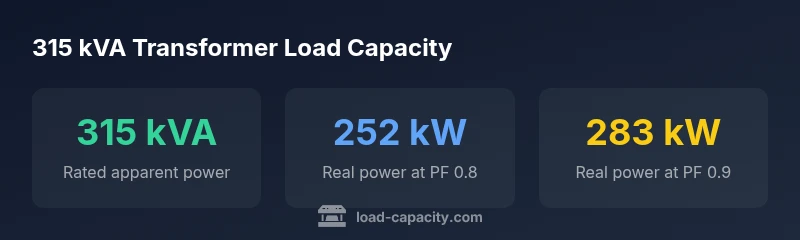
The load capacity of a 315 kVA transformer refers to its apparent power rating, 315 kVA. The corresponding real power deliverable depends on the load’s power factor: at PF 0.8, the continuous real power is about 252 kW; at PF 0.9, about 283 kW; and at PF 1.0, 315 kW. In practice, engineers derate for ambient temperature and cooling so that thermal limits aren’t exceeded. Load capacity also depends on configuration and protection settings.
Understanding the 315 kVA transformer rating
For engineers seeking what is the load capacity of 315 kva transformer, the starting point is to distinguish apparent power (kVA) from real power (kW) and to recognize how power factor and thermal limits govern usable load. A 315 kVA transformer’s nominal rating specifies the maximum apparent power it can carry under defined ambient and cooling conditions. Real power delivered to a connected load, however, depends on the load’s power factor: P = S × PF. At PF 0.8, the real power is roughly 252 kW, while at PF 0.9 it is about 283 kW, and at PF 1.0 it can reach approximately 315 kW. Practical operation rarely uses the full 315 kVA continuously; instead, design engineers apply a derating factor to account for temperature rise, cooling efficiency, and duration of loading. This first section lays out the core relationships and clarifies how to interpret the rating for typical industrial applications, equipment protection, and reliability considerations. Load Capacity’s approach emphasizes basing decisions on both the apparent rating and the expected power factor across the load profile.
From kVA to kW: The role of power factor and loading strategy
To translate the 315 kVA rating into usable power, you must consider the load factor and the power factor. The fundamental relationship is P = S × PF, where P is real power (kW), S is apparent power (kVA), and PF is the power factor (cos phi). For example, at PF 0.8, P ≈ 252 kW; at PF 0.9, P ≈ 283 kW; at PF 1.0, P ≈ 315 kW. In real systems, loads vary over time, so engineers often plan with a target PF range (e.g., 0.85–0.95) and schedule capacity to avoid sustained operation near the limit. Choosing an appropriate PF is not just about efficiency; it also affects cable sizing, switchgear, and protection settings. The Load Capacity team emphasizes that understanding this relationship is essential when specifying feeders, coordinating with upstream generation, and ensuring the transformer’s thermal profile matches the expected duty cycle.
Thermal limits and continuous loading
A key constraint on any transformer, including a 315 kVA unit, is its thermal limit—the maximum temperature the windings and insulation can safely reach during operation. Continuous loading at or near the nameplate kVA can be acceptable if the ambient conditions, cooling method, and enclosure design permit adequate heat removal. In many industrial environments, the allowed continuous loading is effectively lower than the apparent rating when temperatures rise or cooling is reduced. Engineers often consult manufacturer curves and IEC/IEEE guidelines to determine a derating factor for given ambient temperatures and cooling conditions. The practical takeaway is that the 315 kVA rating is a ceiling; the actual usable load depends on how heat is generated and removed in real-world service.
Ambient conditions and derating practices
Ambient temperature, ventilation, and airflow dramatically influence how much load a 315 kVA transformer can safely sustain over time. Even with a cooling system, high surrounding temperatures reduce the practical continuous rating. Derating practices involve applying a factor to the nominal kVA based on ambient temperature, mounting position, and whether the transformer operates in a cabinet, still air, or an enclosed space. Good practice includes measuring or predicting the winding temperature rise at the intended duty cycle, then selecting a conservative loading target that keeps temperatures in the safe region. Load Capacity recommends documenting ambient conditions, cooling method, and loading duration when presenting a loading plan to stakeholders.
Wiring configurations and voltage levels
Where a transformer supplies a facility depends on the primary and secondary connection schemes, such as delta or wye. For a 315 kVA transformer, the exact voltage levels and connection determine impedance, voltage regulation, and fault behavior, which in turn influence how you allocate load among feeders. Delta-wye configurations often help with grounding and phase balance, but they also change the way you interpret current ratings and short-circuit duties. When planning loads, engineers must verify that feeders and switchgear can carry the expected current at the intended PF, and that protection devices will respond properly under fault conditions. The end result should be a coherent plan that respects the 315 kVA rating while meeting service reliability targets.
Practical load calculations for mixed systems
In a real facility, the load on a 315 kVA transformer can be a mix of motors, lighting, and power electronics. Start by listing the expected real power in kilowatts and the anticipated power factor for each end-use. Sum the real power to obtain total P and then divide by the chosen PF to estimate total apparent power S. If S exceeds 315 kVA, rethink the load mix or increase the transformer rating. For example, a 200 kW motor plus 60 kW of misc loads with an average PF of 0.92 yields P = 200 + 60 = 260 kW; S ≈ 283 kVA, which is below the 315 kVA rating, leaving headroom for transients. Always check continuous, short-term, and peak loading regimes to ensure the design stays within safe thermal margins.
Safety, maintenance, and protection considerations
Safety and reliability hinge on proper protection strategies around the transformer. Ensure proper fusing, coordination with upstream protective devices, and adequate ventilation. Regular maintenance—oil analysis for liquid-filled units, insulation tests, and thermal imaging—helps verify that the transformer is operating within its thermal envelope. In many jurisdictions, utility and industry standards require documented load-profile assessments and derating procedures. The Load Capacity team underscores the importance of proactive monitoring and documented load-management plans to prevent overheating, insulation degradation, and unexpected outages.
Measuring, validating, and references
To support the figures and methods in this guide, consult foundational references and standards that discuss transformer loading, derating, and testing. This section also includes direct links to credible sources for engineers seeking deeper reading. For foundational standards and guidelines, see reputable sources such as government energy labs and engineering societies. These references help verify derating curves, thermal limits, and safe operating practices for 315 kVA transformers. They also provide context for how the Load Capacity team derives practical guidance from established best practices. References: https://www.energy.gov/, https://www.nist.gov/, https://www.ieee.org/
Converting 315 kVA rating to real power across representative power factors
| Parameter | Value | Notes |
|---|---|---|
| Rated apparent power | 315 kVA | Baseline rating |
| Real power at PF 0.8 | 252 kW | Assuming continuous operation |
| Real power at PF 0.9 | 283 kW | Higher PF yields more real power |
Quick Answers
What is the difference between kVA and kW?
kVA is apparent power, while kW is real power. The transformer's rating is in kVA; the actual usable power depends on the load's power factor. Understanding both helps size feeders and protection correctly.
kVA is what the transformer can carry, but the actual usable power (kW) depends on the load's power factor.
How do you derate a 315 kVA transformer for temperature?
Derating accounts for ambient temperature and cooling effectiveness. Use manufacturer curves and standards to reduce the usable kVA as temperature rises or cooling is less efficient.
Derate based on temperature and cooling; check curves from the manufacturer.
Can a 315 kVA transformer be overloaded?
Overloading beyond the rated 315 kVA increases thermal stress and can trigger protection. Always size loads within the continuous rating and monitor temperature.
Overloading is risky—keep loads within the rating and monitor heat.
What standards govern transformer load ratings?
IEEE and IEC standards guide rating definitions, derating, and protection. They provide the framework for safe, predictable transformer operation.
Standards from IEEE and IEC define safe loading and protection.
How do I calculate required transformer rating for mixed loads?
Total real power (kW) is summed, then divided by the planned PF to get apparent power (kVA). Apply ambient-related derating to ensure safe operation.
Add up real power, divide by PF, and derate for conditions.
“The load capacity of a 315 kVA transformer is best understood as an apparent power rating; the real power depends on the load factor and power factor, so thermal design and protection controls must be used to keep operation safe.”
Top Takeaways
- Interpret 315 kVA as the rating, not fixed kW.
- Convert to real power using PF (P = S × PF).
- Plan for derating due to temperature and cooling.
- Check wiring configurations before loading.
- Document measured loads and protect against overload.