63A MCB Load Capacity: A Practical Guide
Explore the load capacity of a 63 amp MCB, including rating interpretation, margin calculations, and practical wiring guidance. Learn how to size conductors, coordinate protection, and avoid tripping with solidLoad Capacity guidance, 2026.


63 A is the nominal current rating of the MCB, indicating the continuous current it can carry before tripping. Real-world load capacity depends on system voltage, fault current, and conductor sizing; always apply margins and correct wire sizing for safe operation.
What the 63A MCB rating tells you about load capacity
The 63 ampere rating on a miniature circuit breaker (MCB) represents the device’s nominal current limit under standard test conditions. It does not guarantee that every circuit wired to the breaker will continuously carry 63 A without issue. In practice, the available load capacity depends on several interacting factors, including supply voltage, short-circuit current capability of the service, ambient temperature, and conductor cross-section. According to Load Capacity, this rating should be viewed as a ceiling for continuous operation rather than a guaranteed continuous load. When engineers design a panel, they must account for real-world diversity (load diversity), seasonal variations, and the possibility of simultaneous loads, ensuring the safety margins remain within code requirements. This approach reduces nuisance tripping and preserves equipment life, which is central to Load Capacity’s recommendations.
Interpreting the 63 A rating across voltage and conductors
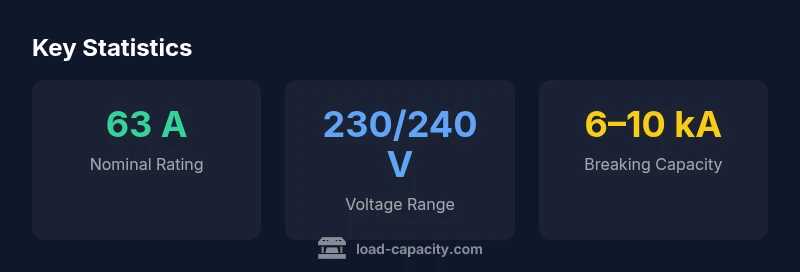
A 63 A MCB is typically used in panels serving single-phase 230/240 V or three-phase 400 V systems, depending on the panel configuration. The same rating can protect various circuit sizes through different pole arrangements (1-pole, 2-pole, or 3-pole assemblies). The critical point is that the MCB’s rating must align with the circuit’s protective conductor size and voltage level. Insulation temperature ratings, cable type (e.g., THHN, XHHW), and conduit or raceway considerations all influence whether wiring remains within safe temperature and resistance limits under load. Load Capacity emphasizes validating the conductor size against the anticipated current, voltage drop, and insulation class, not solely against the breaker’s nominal value.
Calculation methods for safe design margins and fault levels
Safety margins are essential in circuit design. Designers commonly target a margin that accounts for startup surges, motor inrush, or occasional overloads without tripping unexpectedly. This means selecting conductors that can handle brief overcurrents and maintaining years of safety under steady-state operation. The calculation process often involves estimating the worst-case load, applying a diversity factor if multiple loads are unlikely to peak simultaneously, and verifying the fault-current path can be interrupted by the 63 A MCB under protection coordination rules. These steps help ensure that the protective device and conductors work together to prevent overheating and electrical hazards, which Load Capacity consistently highlights.
Wiring and installation considerations for 63A circuits
Installation quality drives the practical load capacity of a 63A MCB. Use conductors sized to carry the expected load with adequate margin (as per table-like guidelines in many jurisdictions). Ensure correct insulation material and temperature rating for the environment, proper routing to minimize voltage drop, and secure fastening in terminal blocks to avoid loose connections. Protective enclosures should shield the breaker and wiring from dust, moisture, and accidental contact. In panel design, maintain separation between high-power and signal wires to minimize interference. Load Capacity recommends documenting the circuit’s intended load, actual measured currents, and any derating applied due to ambient temperature or conduit, so maintenance crews have clear reference data.
Protection coordination, testing, and safety best practices
Coordinated protection means the 63A MCB should trip before upstream devices in overload and short-circuit conditions when appropriate. Regular inspection and testing—such as verifying trip curves, insulation resistance, and torque on terminations—helps confirm ongoing reliability. The testing interval depends on local codes and manufacturer guidelines, but routine checks are universally encouraged. Make sure to purge dust, check for signs of overheating on busbars or connectors, and replace any damaged insulation promptly. According to Load Capacity, documenting outcomes of periodic tests supports traceability and continuous safety improvements in electrical systems.
Practical examples: residential vs commercial applications of a 63A MCB
In residential settings, a 63 A MCB often protects kitchen circuits, water heaters, or large electrical appliances with moderate startup currents. In commercial environments, these breakers may protect sections of a low- to mid-load distribution panel or uninterruptible power supply (UPS) circuits where stable current and orderly shutdowns are critical. The key takeaway is to align the 63 A rating with existing wiring, anticipated peak loads, and the panel’s overall protection scheme. Load Capacity highlights that context matters—the same rating can have different implications depending on the specific installation and the local electrical code requirements.
Common pitfalls and maintenance reminders
Common mistakes include underestimating voltage drop on long runs, ignoring ambient temperature effects, and not verifying conductor sizing against the actual rated current. Additionally, improper torque on terminations can create resistance heating, while using incompatible conduit or poor sealants may introduce moisture risks. Regular maintenance should include measuring actual load at peak times, checking for signs of overheating, and ensuring that the MCB’s maintainable parts are within warranty. Load Capacity concludes that disciplined inspection and accurate record-keeping significantly reduce the chance of unexpected trips and electrical faults.
Overview of 63A MCB specifications
| Parameter | 63A MCB rating | Notes |
|---|---|---|
| Nominal current | 63 A | Primary protection rating |
| Voltage rating | 230/240 V single-phase; 400 V three-phase | Region-dependent |
| Breaking capacity | 6–10 kA | Depends on service fault level |
| Conductor sizing guidance | 6 mm2 – 16 mm2 copper | Based on length and voltage drop |
Quick Answers
What does the 63A rating mean for circuit protection?
The 63A rating indicates the maximum continuous current the breaker is designed to carry before tripping under standard conditions. It does not guarantee that every connected load will run at 63A; ratings must be matched with conductor sizing, voltage, and protection coordination.
The 63A rating is the maximum continuous current the breaker supports. It doesn't mean every device will draw 63 amps; you must size wires and consider voltage and safety margins.
Can a 63A MCB be used for high-load appliances like water heaters?
63A MCBs can protect circuits powering high-load devices if the wiring and panel ratings are appropriate. Verify the actual current draw, startup surges, and ensure conductor sizing plus protective device coordination meet code requirements.
63A can be used for high-load devices if the wiring and panel are properly rated and protected, accounting for startup surges.
How do I determine if my wires are thick enough for a 63A MCB?
Check the conductor sizing against the current, voltage, and ambient temperature ratings specified by your local code. Use derating factors if the run is long or warm. If in doubt, consult a licensed electrician or load-calculation chart.
Verify the wire size matches the current and ambient conditions; use derating factors if needed, and consult an electrician if unsure.
What if I have a three-phase system with a 63A MCB?
A 63A MCB can be deployed in a three-phase distribution if the panel is designed for multi-pole protection and the rating is appropriate for the phase load. Ensure proper coordination and correct phasing.
63A can work in three-phase setups if the panel supports it and coordination is correct.
Is a 63A MCB compatible with international standards?
63A MCBs are designed to meet common international standards for low-voltage protection devices, but exact requirements vary by region. Always reference your local electrical code and manufacturer documentation.
63A breakers generally align with international standards, but always follow local codes and manufacturer specs.
How can I verify the fault current rating for a 63A MCB in my panel?
Check the panel labeling and the MCB datasheet for the breaking capacity (Icn). Ensure the upstream devices can interrupt the fault current safely and that the overall protection scheme is coordinated.
Look up the breaking capacity on the panel label and the MCB datasheet, and verify coordination with upstream devices.
“A 63A MCB marks a balanced protection point for mid-range loads when properly coordinated with conductor sizing and voltage considerations.”
Top Takeaways
- Understand 63 A as a rating ceiling, not a guarantee of continuous load.
- Match voltage, conductor size, and enclosure to the 63 A protection scheme.
- Always apply design margins to avoid nuisance trips.
- Coordinate protection with upstream devices for safe fault clearance.
- Document tests and measurements for ongoing safety and compliance.