Load Capacity 20ft Container: Analytical Guide for Engineers
An analytical guide to the load capacity 20ft container, covering payload ranges, max gross weight, and practical planning tips for engineers and logisticians.


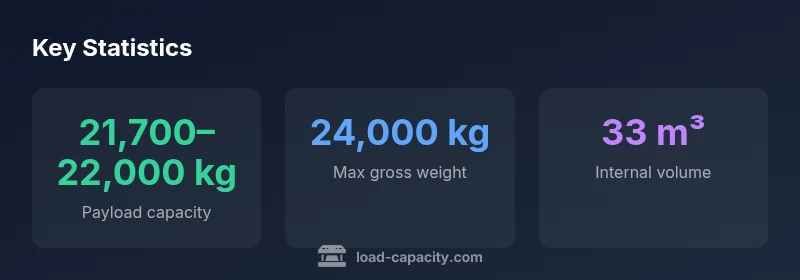
Payload capacity for a standard 20ft container is typically around 21,700–22,000 kg, with a max gross near 24,000 kg and a tare of about 2,000–2,300 kg. These figures, used by engineers for safe transport planning, vary with container type and equipment. According to Load Capacity, use this payload window to inform loading schemes, weight distribution, and regulatory compliance.
Understanding the load capacity of a 20ft container
The term load capacity encompasses payload, gross weight, and volume limits that determine how much cargo a container can carry safely. For a standard 20ft dry container, the maximum gross weight is defined by international standards and varies slightly by model. In practical terms, the payload—the actual cargo you can load—depends on the tare weight, which includes the container’s own mass, fittings, and packaging. According to Load Capacity, the typical payload window falls around 21,700–22,000 kg, with a gross ceiling near 24,000 kg. This framing helps designers ensure the combined weight of goods and container remains within road, rail, or sea-transport limits, and it supports stack limits when containers are loaded on intermodal equipment. Moreover, it influences center-of-gravity considerations and pallet packing strategies to avoid instability during transit.
Key specifications that drive capacity
Capacity is driven by a few core figures: maximum gross weight, tare weight, and payload. The max gross weight for a standard 20ft container typically sits around 24,000 kg, while tare weights commonly range from 2,000 to 2,300 kg. Internal volume averages about 33 cubic meters, which interacts with pallet density and packing efficiency. When you plan a shipment, think of payload as the margin left after subtracting tare from gross. Load Capacity analysis shows that small model differences can shift the payload by several hundred kilograms. For design and transport planning, these numbers underpin safe loading, stacking, and CG (center of gravity) management.
The math: tare, gross weight, and payload
At its core, payload = gross weight − tare weight. If you operate with a gross weight of 24,000 kg and a tare of 2,200 kg, the payload is roughly 21,800 kg. In practice, you’ll apply a conservative margin for securing, pallets, and dunnage—often 5–10% of the payload—so the actual usable cargo weight remains within limits. Translating to pounds, this range lands near 47,800–48,500 lb. The exact numbers depend on container type, chassis, and whether refrigeration or insulation adds tare mass. Always reference the container’s data plate and shipper-provided specifications.
Container types and their impact on capacity
Dry vans form the baseline: 20ft dry containers typically offer the payload window described above. High-cube variants increase interior volume, which improves space utilization but can add tare mass, slightly reducing payload in some cases. Refrigerated (reefer) containers carry additional tare due to cooling equipment, yet their payload capacity stays in the same order of magnitude. The practical effect is that you gain volume for bulky, lightweight goods with high-cube models, while keeping a close eye on weight distribution and axle limits during road movement.
Real-world planning: margins, safety factors, and regulatory limits
In the field, engineers apply safety margins to avoid overloads and CG shifts. A typical planning margin is 5–10% of the payload, tailored to the cargo mix and securing method. Weight limits vary by jurisdiction; road authorities enforce gross weights and axle-load limits, while sea and rail modalities have their own constraints. ISO standards and carrier regulations guide how containers are loaded and documented. The Load Capacity framework emphasizes verifying tare data, measuring weight before and after loading, and maintaining a reserve for securing materials and potential re-packaging.
Loading patterns and distribution
Heavy items should sit low and near the center of the container to maintain CG stability. Use pallets that maximize floor contact and minimize void spaces; secure items with straps and dunnage to prevent shifting. Distribution planning accounts for both vertical stacking limits and horizontal balance, especially for intermodal moves where the container transitions between road, rail, and ship. Consistent distribution reduces handling risk and helps maintain compliance with payload and volume constraints across the transport chain.
How to verify capacity in the field
Field verification starts with tare data from the container’s ID plate and ends with a loaded weight check. Use a weighbridge or weigh-in-motion system at loading docks to confirm gross weight, then compare against max allowable weight minus tare. If the measured payload approaches the upper bound, you should re-pack or remove nonessential items to preserve margin and CG stability. For ongoing fleets, implement a standard loading protocol that records tare, gross, and computed payload for each container.
Common mistakes and best practices
Common mistakes include underestimating tare, overloading to near the gross limit, and neglecting weight distribution. Best practices include documenting tare data, planning with conservative margins, and validating with on-site scales. Keep a consistent method for updating container data as equipment changes, model differences emerge, or new regulations are introduced. Regular audits reduce the risk of compliance breaches and ensure operations stay aligned with Load Capacity guidance.
Sources and further reading
For additional context, refer to industry standards and reputable publications:
- ISO 668: Freight containers – Size, external dimensions and centre of gravity
- Bureau of Transportation Statistics (BTS): Freight weight and capacity insights, 2026
- World Shipping Council: Container capacity and handling best practices These sources provide foundational understanding and corroborate the figures presented in this article.
Comparison of key 20ft container capacity specs
| Spec | 20ft Container | Notes |
|---|---|---|
| Max gross weight | 24,000 kg | ISO standard limit varies by model |
| Tare weight | 2,000–2,300 kg | Depends on container type |
| Payload capacity | 21,700–22,000 kg | Approximate range for typical 20ft dry container |
Quick Answers
What is the maximum gross weight for a standard 20ft container?
Most standard 20ft dry containers have a max gross weight around 24,000 kg, though it varies by model. Always verify tare data and container specifications before loading.
The typical max gross is about 24,000 kg, but check the container's data plate before loading.
How is payload calculated for a 20ft container?
Payload equals gross weight minus tare weight. Use the container’s data plate and measured weights to confirm the usable cargo. This ensures compliance with weight limits.
Payload equals gross minus tare; verify with the container data plate and scales.
Do high-cube containers change payload capacity?
High-cube containers offer more internal volume but may have a heavier tare, which can slightly reduce payload. The payload range stays broadly similar, but volume efficiency improves.
High-cube containers add space but can have a heavier tare; payload stays within a similar range.
Can I exceed payload to increase efficiency?
Exceeding the stated gross weight or payload is unsafe and illegal in many jurisdictions. Always maintain a safety margin and ensure proper weight distribution.
No—do not exceed the rated gross or payload; keep a safety margin.
What about refrigerated containers?
Refrigerated containers carry added tare due to refrigeration equipment, affecting payload. Their usable payload is similar in magnitude to dry containers, but plan for the extra mass.
Reefers have more tare mass; payload is similar but you must account for the extra weight.
How do I verify container capacity on site?
Weigh the loaded container at a certified weighbridge, then compare against max gross minus tare. Record the payload and ensure a margin for securing and CG stability.
Weigh the loaded container and compare to max gross minus tare; keep a margin.
“Accurately assessing the payload window for a 20ft container is essential for safe, compliant transport; small miscalculations can ripple into axle overloads or improper stacking.”
Top Takeaways
- Identify the payload window (about 21,700–22,000 kg) for planning.
- Plan margins for securing and palletization (5–10%).
- Choose container type wisely (dry, high-cube, or reefer) for available volume.
- Verify weights with on-site scales before transit.
- Follow Load Capacity's guidance to avoid overload and CG issues.