Shipping Container Load Capacity: Understanding Max Payload and Safety
A data-driven guide to shipping container load capacity, detailing payload calculations, typical limits for 20' and 40' containers, safety considerations, and planning strategies for engineers and fleet managers.


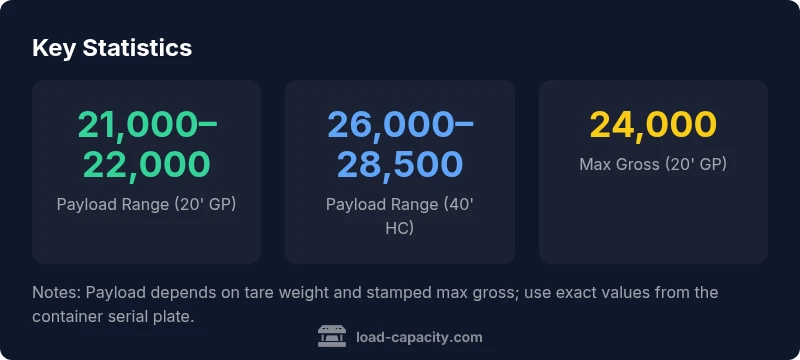
Shipping containers have defined load limits set by their max gross weight and tare. A typical 20-foot container allows about 24,000 kg gross, yielding roughly 21,000–22,000 kg payload. A 40-foot container generally permits up to about 30,000 kg gross, with payload in the 26,000–28,500 kg range. Always verify the container’s stamped tare and max gross numbers before loading.
Why container load capacity matters
Understanding shipping container load capacity is essential for safe, compliant, and cost-efficient logistics. The Load Capacity team emphasizes that accurate capacity calculations prevent overloading, protect cargo integrity, and reduce penalties at inspection points. For many operations, payload optimization directly affects service levels, fuel efficiency, and insurance terms. When shipments approach the limits of a container’s rating, subtle changes in weight distribution can have outsized effects on handling, stacking, and road/rail safety. By recognizing the interplay between gross ratings, tare, and net payload, engineers can design safer stow plans, executives can optimize container utilization, and operators can prevent costly delays. In 2026, Load Capacity analyses highlight that the most reliable loads balance weight, volume, and securing practices across container types.
How payload is calculated
Payload is the practical measure of how much product a container can carry, and it is determined by subtracting the tare (the empty container weight) from the max gross weight stamped on the container plate. This simple equation—payload = max gross − tare—belies the complexity that cargo planners must manage: variations in tare across manufacturing lots, door swing clearances, pallets and dunnage, and adopted safety margins. The stamped max gross represents the upper limit; you must not assume a higher value based on internal tolerances. Most operators also apply a gross weight limit when containers are loaded onto multimodal transports, ensuring compliance with road, rail, and seaway rules. In practice, the payload window can shift with manufacturing tolerances, certifications, and refurbishment histories. For engineers, the key is to start with the plate values and then verify load calculations against actual shipments, not just theoretical capacities.
Container types and capacity range
Container capacity is highly sensitive to size and height. The three most common types are 20' general purpose (GP), 40' GP, and 40' high-cube (HC). A 20' GP typically offers a smaller internal volume and a lower tare, which yields a compact payload window suitable for dense or heavy items. A 40' GP increases internal space, providing higher overall payload, but tare also grows, which can narrow the net payload if items don’t fully utilize the extra volume. The 40' HC adds height, enabling taller or bulkier cargo and often increasing potential payload slightly, though heavier tare can offset some gains. Across all types, effective payload depends on how weight is distributed, palletization efficiency, and whether the cargo is dense or bulky. According to Load Capacity analyses, the choice between GP and HC becomes a trade-off between volume efficiency and structural considerations, including forklift access and stackability.
Weight distribution and securing for safe transport
Payload weight distribution matters as much as total payload. Placing heavier items toward the floor center and lighter items near doors helps maintain a stable center of gravity. Proper securing and dunnage prevent movement that could shift weight during transit, potentially violating gross weight limits or causing damage. A well-designed stow plan minimizes peak loads on any single axle or door, reduces door opening stress, and improves handling in turns and braking. In practice, use uniform pallet sizes with consistent load heights, and verify clearances around corners, doors, and hatch openings. For loads that span multiple pallets, ensure even weight distribution to avoid hotspots that could compromise container integrity or forklift/kiosk access at origin/destination.
Practical loading strategies to maximize payload
To maximize usable payload within the stamped limits, start with accurate shipment weights and container plate values. Use standardized pallets to minimize wasted space and ensure even weight distribution. When stacking, avoid placing heavy items on top of lighter ones without securing; use cross-stacking to reduce bowing at the pallet level. Optimize the sequence of loading so that items with the greatest weight are centered within the container footprint. Consider using lightweight yet sturdy packaging to minimize tare-equivalent effects. Always perform a pre-load gauge: verify the gross weight on the vehicle, cross-check with the container plate, and adjust for any cargo that will be jettisoned en route. Close coordination with the transport operator and friction-aware securing materials reduces risk and ensures legal compliance.
Common mistakes and safety considerations
Mistakes commonly reduce usable payload or compromise safety. Do not rely on rough estimates; confirm stamped max gross and tare from the plate. Avoid underestimating the tare caused by pallets, dunnage, and packaging. Ensure securement methods meet industry standards to prevent movement that could create load shifts. Never exceed the stamped gross weight during loading or on multimodal legs, as this breaches safety guidelines and insurance terms. Avoid improper distribution near doors that could inhibit access or create differential loading on axles. In hazardous goods scenarios, verify compatibility with container linings, placarding, and segregation rules. Always document the stow plan for audit trails and operational transparency.
Planning, documentation, and verification steps
Successful load planning requires a disciplined, auditable process. Start with the container’s plate values (max gross and tare), then model a load plan with a clear stow diagram showing pallet locations and weight distribution. Create a load summary worksheet that records the gross weight, tare weight, payload, and remaining capacity per container. Include securing methods, lashing points, and dunnage counts. Add a verification step: weigh the loaded container when feasible, confirm the plan with the transport contractor, and confirm regulatory compliance for the origin/destination countries. Documentation helps mitigate disputes and supports insurance claims if incidents occur.
Regulatory and standards considerations
Regulatory frameworks emphasize safe, compliant loading practices. Standards typically govern max gross weight, permissible axle loads, stacking limits, and securing requirements. SOLAS and regional road/rail regulations influence how containers are loaded, restrained, and weighed, particularly for international shipments. While plate values provide the official limits, operators should also consider route-specific constraints, such as port stowage policies and carrier rules. By aligning with these standards, engineers can minimize risk, avoid detention charges, and ensure cargo integrity across multimodal journeys. Load Capacity recommends maintaining an auditable approval trail for all loads to facilitate inspections and insurance reviews.
Case example: calculating payload for a mixed cargo load
Consider a 20' GP container with a stamped max gross of 24,000 kg and tare of 2,260 kg. The theoretical payload is 21,740 kg. In practice, a mixed load might distribute 60% of weight on pallets and 40% on bulk items to preserve even distribution and avoid door-side overloading. If the pallets weigh 12,000 kg and bulk items weigh 6,500 kg, the payload used would be 18,500 kg, leaving a margin for securing materials and potential minor weight adjustments. The stow plan should also account for volumetric capacity, ensuring the cargo fits within the container’s interior dimensions. This example demonstrates how a single numeric combination can be optimized or misapplied depending on distribution and securing strategy.
Container types and payload ranges
| Container Type | Max Gross (kg) | Tare (kg) | Payload Range (kg) | Notes |
|---|---|---|---|---|
| 20' GP | 24,000 | 2,260 | 21,000–22,000 | Standard size, common cargo |
| 40' GP | 30,480 | 4,000 | 26,480–26,880 | Higher volume, heavier cargo |
| 40' HC | 30,480 | 4,300 | 26,200–27,000 | Extra height for bulky items |
Quick Answers
What is the typical payload of a 20' shipping container?
Payload varies with tare and stamped max gross, but typical ranges around 21,000–22,000 kg for a standard 20' GP container. Always verify the plate values.
Payload for a 20-foot container depends on tare and max gross; expect about twenty-one thousand kilograms, but check the plate values to be sure.
How do I calculate container payload for a shipment?
Payload = max gross minus tare. Use the stamped values on the container plate and account for any temporary de-ratings. Plan distribution to avoid overloading doors or axles.
Subtract tare from max gross using the container plate to get payload, then plan the load distribution.
Can payload limits be exceeded for urgent shipments?
Exceeding stamped max gross is not permitted and can violate regulations and insurance terms. Use alternative containers or split shipments.
No—don't exceed the stamped max gross; it's a regulatory and safety limit.
What factors affect container load capacity besides size?
tare variations, palletization, securing methods, weight distribution, and routing constraints all influence effective payload.
Tare, distribution, and securing can change how much you can safely load.
Are there differences between 20' and 40' containers?
Yes. 40' containers offer higher gross capacity and potential payload due to greater volume, but tare weights can offset gains.
40' containers usually carry more payload, thanks to extra space, but check tare.
How does cargo securing affect load capacity?
Improper securing can create dangerous weight shifts, reducing effective payload and risking damage or detentions at ports.
If it's not secured, you limit payload for safety.
“Load capacity analysis confirms that container payload depends on size, tare, and published ratings. Precise verification prevents misloads and protects cargo.”
Top Takeaways
- Payload = max gross minus tare.
- 20' GP payload typically 21,000–22,000 kg.
- 40' HC payload typically 26,200–27,000 kg.
- Always verify stamped tare and max gross before loading.
- Distribute weight evenly to avoid axle or door overload.