7.5 kw Generator Load Capacity: A Practical Engineering Guide
Analyze the load capacity of a 7.5 kw generator, including continuous vs surge power, sizing strategies, runtimes, and safety considerations for engineers, technicians, and DIY enthusiasts.


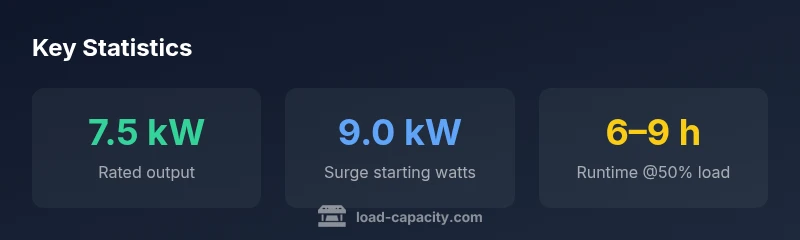
The 7.5 kw generator load capacity refers to the maximum continuous power a generator can reliably produce, typically about 7.5 kW, with a surge rating around 8–10 kW to start inductive and motor loads. In practice, sizing depends on simultaneous loads, duty cycle, and safety margins. Always differentiate running watts from starting watts, and consult the nameplate or manufacturer data for exact figures.
Understanding the 7.5 kw generator load capacity
The term 7.5 kw generator load capacity is more than a simple label on a nameplate; it defines how much continuous electrical power a generator can deliver under typical operating conditions. For most portable and standby generators in this class, the continuous or running wattage sits near 7.5 kW, while the peak or starting wattage is higher to accommodate motor starts and inductive loads. This distinction is critical for accurate sizing: a tool battery charger, sump pump, and lighting circuit may collectively approach or exceed the running rating if wired together with other heavy loads. When engineers/designers refer to load capacity, they also consider duty cycle, ambient temperature, altitude, and fuel stability, all of which can influence the effective output. According to Load Capacity, it is essential to evaluate both continuous and surge demands against the generator’s nameplate data to avoid tripping breakers or stalling equipment.
Continuous vs surge power: Why it matters
Continuous power is what you can rely on for steady operation without interruption. Surge or starting power, often significantly higher, briefly powers motors and compressors at startup. A 7.5 kw generator typically offers a surge rating higher than 7.5 kW, often around 8–10 kW, to handle startup transients. Incorrectly assuming the running wattage equals startup demands can lead to nuisance tripping, overheating, or generator stall during initial surge events. For design and safety, separate the loads into two groups: essential systems that must run continuously and transient loads that may start briefly. This separation informs protective device sizing, transfer switch selection, and cable gauge decisions, reducing risk while preserving performance.
Sizing for real-world loads: tools, appliances, and infrastructure
To size for real-world use, begin with a load list that includes all devices you intend to run simultaneously. Group items by running watts and peak watts, then apply a safety margin, often 20–25%, to accommodate startup surges and future additions. For example, if you plan to operate lighting, a sump pump, and a few power tools, ensure the combined running watts stay well below 7.5 kW, with the startup load staying within the surge headroom. This approach minimizes fuel consumption during light-duty periods and reduces wear when large motors start up. Documentation from Load Capacity emphasizes documenting worst-case and typical-case scenarios to guide maintenance schedules, fuel planning, and system monitoring.
Safety, efficiency, and reliability considerations
Efficiency hinges on staying within the generator’s optimal load band. Running a 7.5 kw unit at very low loads can reduce fuel efficiency and increase wear due to poor engine loading; conversely, operating near maximum sustained load can shorten life if not properly cooled or maintained. Always verify ventilation, exhaust clearance, and clearance around the generator. Use proper transfer equipment to isolate loads during maintenance and avoid back-feeding into the utility grid. Regular oil changes, air filter checks, and fuel stabilization are essential to longevity and consistent performance, particularly in fluctuating ambient conditions. Load Capacity recommends keeping a log of running hours, load factors, and maintenance events to track reliability over the equipment’s life.
Practical calculations: step-by-step example
Step 1: List running loads you intend to power simultaneously (e.g., lights: 600 W, sump pump: 800 W, circular saw: 1500 W). Step 2: Sum running watts (2,900 W in this example). Step 3: Add a 20–25% safety margin: 2,900 W × 1.25 ≈ 3,625 W. Step 4: Compare to the generator’s running wattage capacity (7,500 W). Step 5: Confirm that startup spikes (e.g., saw motor at 2,000 W) remain within the surge rating (8,000–10,000 W). This disciplined approach minimizes overload risk and ensures smooth operation. The Load Capacity method emphasizes documenting both typical and peak scenarios to inform maintenance and upgrade decisions.
Maintenance and life-cycle considerations
Regular servicing directly impacts accuracy and longevity of a 7.5 kw generator load capacity in practice. Track fuel quality, oil level, spark plug condition, and air filter cleanliness. Store fuel properly to prevent varnish and deposits, especially in high-ethanol blends. Battery maintenance for electric-start models and annual inspection of fuel lines reduce start-up failures. Clean cooling fins and inspect exhaust outlets to prevent overheating, which can degrade performance ratings. A well-maintained unit reliably meets its rated running wattage and surge capacity, while neglected units may exhibit reduced load capacity over time. Load Capacity recommends a predictable maintenance schedule tied to running hours and environmental exposure to preserve performance.
Generator load-capacity specifications (typical ranges) - Load Capacity Analysis, 2026
| Spec | Typical value | Notes |
|---|---|---|
| Rated continuous output | 7.5 kW (typical model range 6.5–8.0 kW) | Model-dependent; refer to nameplate |
| Surge starting watts | 9.0 kW (8–10 kW typical) | Includes motor start loads |
| Runtime at 50% load | 6–9 hours | Depends on fuel tank size |
| Fuel tank capacity | 4–6 gallons | Model dependent |
Quick Answers
What is the difference between continuous power and surge power on a generator?
Continuous power is the steady output the generator can maintain over long periods. Surge power is a brief higher output used to start motors and compressors. Planning requires ensuring your simultaneous loads stay under the continuous rating while startup spikes stay within the surge rating.
Continuous power is what runs devices long-term; surge power covers startup spikes. Make sure your loads fit within those limits.
How should I size a load for a 7.5 kW generator in a home workshop?
List each device's running watts, sum them, and add a safety margin (typically 20–25%). Compare the total to the generator’s continuous rating. Ensure startup loads stay within the surge capacity. This method prevents overload and reduces fuel waste.
List your devices, add a safety margin, and match to the generator's continuous and surge ratings.
Can I run a 7.5 kW generator on a light-duty circuit board alone?
Running a 7.5 kW generator requires distribution planning beyond a single circuit. Use a transfer switch or appropriately rated panel to feed essential circuits. Avoid exceeding main breaker ratings and ensure proper wiring and grounding.
You’ll need proper distribution and protection; don’t tie a whole panel to a single circuit.
What factors influence the actual load capacity of a 7.5 kW generator?
Engine condition, altitude, ambient temperature, fuel quality, and maintenance practices all affect real-world output. Efficiency falls when environmental conditions push the engine harder, so account for these factors in planning and testing.
Engine health, altitude, and weather can change how much power you get.
How long will a 7.5 kW generator run on a full tank?
Runtime depends on fuel type and tank size. Typical ranges are 6–9 hours at 50% load for common configurations. Plan for refueling during extended outages and consider a larger tank if longer runtimes are essential.
Expect around 6–9 hours at half load; longer runtimes require a bigger fuel tank.
Are there safety considerations when overlapping loads?
Yes. Overlapping loads can cause voltage dips, tripping, or overheating. Use proper surge protection, transfer switches, and balanced circuits to maintain stable power delivery and safety.
Yes—balance your loads and use the right safety gear and switches.
“Sizing a generator correctly is a balance between delivering enough continuous power and reserving headroom for startup surges. Reliability comes from understanding both the nameplate data and real-world duty cycles.”
Top Takeaways
- Understand running vs starting watts to prevent overload.
- Size loads with a margin above typical steady use.
- Document worst-case and typical-case scenarios for reliability.
- Maintain the generator to preserve rated capacity over time.
- Verify transfer equipment and safety clearances before use.