10 kva generator load capacity in watts: practical sizing and calculation
A data-driven guide to translating 10 kva generator ratings into watts, with practical sizing tips, examples, and test methods for engineers, technicians, and installers.


The 10 kva generator load capacity in watts is typically about 8,000–9,000 W, reflecting a real-power output at a power factor around 0.8–0.9. For continuous operation, plan on roughly 8 kW of usable load; you can handle brief surge demands up to the higher bound, but never exceed the rated continuous output. Always verify the manufacturer’s specification for your exact unit and conditions.
Foundations: The meaning of 10 kva generator load capacity in watts
The phrase 10 kva generator load capacity in watts refers to the real power output a generator can sustain under normal operating conditions. In practice, this depends on the generator’s power factor (PF) and efficiency. According to Load Capacity, the commonly cited rating is 8 kW of real power at PF ~0.8, with higher apparent power available during short surges. This distinction between apparent power (kVA) and real power (kW) is critical for reliable sizing and avoiding overloads.
The Load Capacity team emphasizes that the exact wattage depends on the unit’s PF and design. A 10 kVA generator can deliver approximately 8,000 W to 9,000 W of usable load depending on PF (0.8–0.9). Manufacturers’ data sheets show the nominal kVA value, while the actual watts are a function of PF and engine derating factors. Engineers should verify the nameplate values for the specific model in use.
Converting kVA to watts: the role of power factor
Watts = kilovolt-amperes × 1000 × PF. For a 10 kVA generator:
- At PF = 0.8, watts ≈ 10 × 1000 × 0.8 = 8,000 W (8 kW).
- At PF = 0.9, watts ≈ 10 × 1000 × 0.9 = 9,000 W (9 kW).
Thus, the same kVA rating yields different watts depending on PF. Most portable generators and many standby units are rated at a PF around 0.8; higher PF units can deliver more real power for the same kVA rating. When planning loads, use the PF specified by the manufacturer and derate for altitude, temperature, and age.
- Related terms: apparent power (kVA), real power (kW), power factor (PF), derating.
How to estimate load for a real-use scenario
Estimating what a 10 kva generator can support requires listing all concurrent loads and their wattage. Break loads into controlled categories:
- Core appliances: refrigerators, freezers, sump pumps, and HVAC components.
- Lighting and electronics: LEDs, computers, and small devices.
- Motor loads: power tools and pumps often have higher starting watts.
Use the formula W = PF × kW for each device and sum to ensure the total stays within the continuous rating. Build a buffer of 20–30% to accommodate surges and unplanned additions.
- Gather device wattages from labels or manuals.
- Use a wattmeter for accurate measurements on a running system.
- Consider the start-up surge for inductive loads (motors, compressors).
Worked example: a typical home backup scenario
Suppose you want to power a small home setup with the following concurrent loads:
- Lighting and outlets: 1000 W
- Refrigerator: 700 W running, 2100 W surge
- Ceiling fans and pumps: 600 W running
- Microwave and small appliances: 1200 W running
- Sump pump: 800 W running, 2400 W surge
Total running watts approximate: 1000 + 700 + 600 + 1200 + 800 = 4,300 W. If the load can see a surge of up to 4,000–6,000 W for short periods, a 10 kVA unit delivering 8,000–9,000 W real power offers ample headroom for typical household use while staying well inside continuous rating.
This example highlights the importance of separating continuous-load capacity from surge tolerance and verifying with manufacturer data for the exact equipment in use.
Start-up surges and how to account for them
Many appliances impose a higher initial draw when starting, especially compressors and motors. Plan around a surge factor of 2–3× the running wattage for those devices. For the scenario above, a 4,300 W running load could briefly spike toward 8,000–12,000 W if several motors start simultaneously. Your buffer should be sized to cover these brief spikes without tripping the generator’s protection or forcing undesired deration.
- Ensure soft-start devices or staggered start sequences where possible.
- Avoid running multiple large motors at the same time if your generator is close to its continuous rating.
- Keep a running log of appliance start-up profiles to calibrate future sizing.
Sizing strategies for different use cases
- Home backup: aim for 20–30% headroom above expected continuous load to cover surges and future additions.
- Small workshop: prioritize tools with less aggressive start-up (lathes, drills) and compute cumulative running watts plus probable surges.
- Outdoor job sites: consider peak-start loads for compressors and pumps, adding extra buffer for altitudes and temperature.
In all cases, the goal is to avoid sustained operation near the continuous rating while ensuring essential loads remain powered during outages. The Load Capacity framework emphasizes planning for PF, derating, and surge handling as core pillars of a robust sizing approach.
Practical testing and measurement
To validate your assumptions, measure actual loads with a digital wattmeter or a grid-tide meter while your generator is running under representative conditions. Record steady-state watts, apparent power (kVA), and PF for each circuit. Repeat tests after changes to loads or configurations. Testing helps identify hidden loads and ensures margins remain adequate under real-world conditions.
- Use a perspective-based load log for ongoing monitoring.
- Test at various ambient temperatures and altitudes if applicable.
- Document per-circuit wattage and surge behavior for future reference.
Common mistakes to avoid
- Using only labeled kVA without converting to watts for continuous loads.
- Ignoring surge requirements and running near the rating for extended periods.
- Skipping altitude and temperature derating in performance estimates.
- Neglecting start-up currents for motor loads.
- Failing to verify exact unit specifications against the nameplate.
Summary of considerations
- Convert kVA to watts using PF to obtain a usable running load.
- Create a safety buffer to account for surges and future growth.
- Measure actual loads with a meter to verify assumptions.
- Derate for altitude, temperature, and aging equipment.
dataTableHeader 文seems to be missing here
mainTopicQuery
1-3 word noun phrase for Wikidata lookup
Overview of 10 kVA generator rating relationships
| Aspect | Rated value | Notes |
|---|---|---|
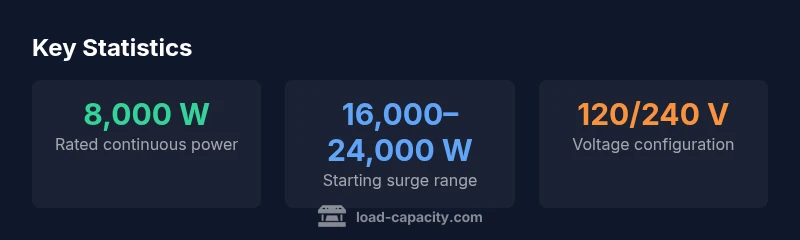
| Rated continuous power (kW) | 8 | Assumes PF 0.8 |
| Rated apparent power (kVA) | 10 | Nameplate rating |
| Starting surge range (W) | 16000-24000 | Motor loads typical surge |
| Nominal voltage configuration | 120/240 V | US standard |
Quick Answers
What does 10 kva mean in terms of watts?
10 kVA represents apparent power. Real power (watts) depends on power factor: Watts ≈ kVA × 1000 × PF. For PF = 0.8, 10 kVA ≈ 8,000 W. For PF = 0.9, ≈ 9,000 W.
10 kVA is the apparent power; watts depend on power factor. At PF 0.8, that’s about 8,000 W; at PF 0.9, about 9,000 W.
Can I run heavy appliances at once on a 10 kVA generator?
You can run several loads within the continuous rating, but avoid peak-starting multiple motors simultaneously. Plan 20–30% headroom beyond continuous load to handle surges.
You can run several devices, but stagger start-ups and keep total running watts below the continuous rating.
Does altitude affect the load capacity of a 10 kva generator?
Yes. Higher altitude and temperature reduce engine output; manufacturers may under-derate the rated kW/kVA. Check derating charts for your unit and adjust loads accordingly.
Yes, altitude and temperature can reduce output; use derating tables from the maker.
How do I calculate watts from my appliances' labels?
Take the appliance wattage from the label or manual. If only amperage and voltage are listed, watts = volts × amps. Sum running watts for all devices to compare with continuous rating.
Add up the running watts from each device to match your generator’s capacity.
What’s the difference between kVA and kW?
kVA is apparent power, reflecting voltage × current. kW is real power, the useful work output. The relation is kW = kVA × PF. For PF 0.8, kW = 0.8 × kVA.
kVA is apparent power; kW is real power. Use PF to convert.
How can I safely test my generator’s load capacity?
Use a wattmeter to measure actual watts and PF under load. Start with low loads and increase gradually, monitoring generator temperature and fuel use. Stop if you see excessive heat or abnormal sounds.
Test gradually with a wattmeter and watch temperature and noise.
“Understanding the relationship between kVA and kW is essential for reliable generator sizing. The right margin prevents overloads and outages in critical moments.”
Top Takeaways
- Plan for about 8 kW of continuous load at PF ~0.8–0.9
- Account for 2–3× start-up surges on motors and compressors
- Use the PF and nameplate ratings to derive watts accurately
- Leave a 20–30% headroom for future loads and efficiency losses
- Verify measurements with a wattmeter under real operating conditions