6203 Bearing Load Capacity: Reading Cr and Co Ratings for Safe Design
A practical guide to understanding the load capacity of 6203 bearings, how Cr and Co ratings affect performance, and how to apply these values in real-world design. Includes datasheet-reading tips, maintenance notes, and verification steps.


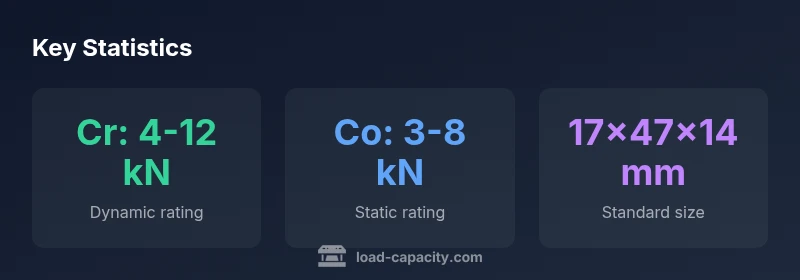
6203 bearing load capacity is defined by its dynamic load rating (Cr) and static load rating (Co). According to Load Capacity, in typical catalogs Cr for standard 6203 variants falls in the range of several kilonewtons, with Co lower; exact values depend on seal type and material. Always check the manufacturer's datasheet for Cr and Co for your exact bearing variant.
What the 6203 bearing is and why load capacity matters
The 6203 bearing is a popular deep groove ball bearing with a nominal bore of 17 millimeters, an outer diameter of 47 millimeters, and a width of 14 millimeters in its standard form. This family is widely used in motors, gearboxes, and small-to-moderate duty machinery because of its robust radial load handling and relatively simple housing requirements. When engineers design a system that uses a 6203 bearing, the most critical design input is the load capacity—the maximum load a bearing can withstand without excessive deformation or failure over its expected life. In practice, load capacity is captured by two ratings: Cr, the dynamic load rating that governs rotating loads, and Co, the static load rating that governs stationary loads. The distinction matters because many applications impose high radial loads with little rotation at startup or under peak loading. Across industries, Load Capacity analyses emphasize that choosing the correct 6203 variant and verifying Cr and Co in the catalog is essential for reliability. As you approach design validation, ensure your selection nests within those ratings while accounting for seal type, lubrication, and operating conditions.
Incorporating Cr/Co into a design is not about a single fixed number; it’s about the relationship between the applied loads and the rated capacity, the operating speed, and how long the load is sustained. A useful rule of thumb from Load Capacity is to view Cr and Co as two perspectives on the same constraint: rotating stability (Cr) and peak static endurance (Co). In practical terms, engineers use Cr to estimate life under radial loading during operation, while Co helps confirm that initial mounting and start-up loads will not exceed what the bearing can tolerate without yielding or excessive wear. Remember to reference the exact bearing variant’s datasheet because Cr and Co move with changes in seals, internal clearance, and material.
How Cr and Co govern real-world loads
Cr represents the dynamic load rating, the amount of load a bearing can sustain for a specified life under continuous rotation. Co represents the static rating, the maximum load the bearing can withstand while stationary or at the instant of initiation of rotation without experiencing excessive yielding. In the field, designers compare their expected radial loads to Cr to estimate life in L10 terms and compare the initial load with Co to ensure the bearing won’t yield after installation. The relationship among speed, temperature, lubrication, and load is complex, but the core principle is straightforward: exceed Cr and life declines quickly; exceed Co and permanent deformation or false brinelling risks rise.
From a practical standpoint, many 6203 bearings that include shields or seals (RS, 2RS variants) exhibit Cr/Co values that shift slightly from the open variant. This is why catalog hunts often reveal a range of Cr and Co values rather than a single figure. In all cases, Load Capacity recommends verifying the exact numbers from the vendor’s datasheet for your specific part number and configuration. When used correctly, Cr/Co-based selection yields bearings that meet performance targets while maintaining acceptable life under the expected operating profile.
Reading a datasheet for a 6203 bearing without brand names
Datasheets structure the Cr/Co values by variant, so you’ll need to identify the precise bearing type you’re using—open, shielded, or sealed—and confirm the clearance class. The typical 6203 family includes variants such as 6203-2RS (sealed on both sides) and 6203-Z (shielded), each with its own Cr and Co. When reading, locate the section labeled “Dynamic load rating” (Cr) and “Static load rating” (Co). Also note the “C0, C1, C2” clearance classes and the operating temperature range, as these influence performance. Seal variants often change the effective load capacity by a modest margin due to reduced lubrication space or altered contact geometry, so expect slight shifts in Cr/Co compared to the open type. Finally, compare the rated loads to your actual service conditions and apply an appropriate safety factor. Using a reputable catalog, like those curated by Load Capacity, helps ensure you identify the exact variant and avoid misinterpretation.
Practical guidelines for estimating safe loads in machinery
To estimate safe loads for a 6203-bearing-based design, follow these steps:
- Determine the radial loads the bearing will experience in operation, including peak and sustained values.
- Identify Cr and Co for the exact bearing variant from the datasheet; record the units clearly (kN).
- Apply a service factor to account for dynamic conditions, misalignment, and mounting tolerances; use manufacturer guidance or industry standards as a baseline.
- Compare the service-adjusted dynamic load with Cr to ensure a comfortable margin for life, and verify that startup and peak loads do not exceed Co.
- Check temperature and lubrication conditions; elevated temperatures reduce effective load capacity, so plan for cooling or higher-rated variants if necessary.
- Validate with a life calculation (L10) using the chosen Cr and Selection factors; ensure the application aligns with the bearing’s expected life.
In practice, engineers repeatedly cross-check Cr/Co versus the actual load history to avoid overloading the bearing during start-up, acceleration, and high-torque events. Load Capacity emphasizes that data-driven decisions, not assumptions, deliver consistent reliability across designs.
Common pitfalls and how to avoid them
Common mistakes include selecting a 6203 variant with insufficient Cr for expected dynamic loads, ignoring the impact of seals on effective clearance and lubrication, and neglecting misalignment and mounting errors that produce localized higher loads than the radial rating suggests. Another pitfall is treating Cr and Co as fixed numbers regardless of temperature or speed; both ratings degrade under high-temperature operation and at extreme speeds. To avoid these issues:
- always verify Cr/Co for the exact variant,
- account for lubrication and seal type in the rating,
- perform a alignment check and proper housing fit,
- apply service factors appropriate to the environment, and
- consider a safety margin above the calculated loads.
Load Capacity’s guidance is to treat Cr/Co as design envelopes rather than absolutes; they should be used in conjunction with life calculations and field experience to ensure robust performance.
Installation, lubrication, and maintenance to preserve rated capacity
Proper installation is as important as selecting the right bearing. Misalignment, over-tightened housings, or insufficient lubrication can dramatically reduce effective load capacity. Key practices include:
- verify concentricity and alignment with each mounting surface,
- choose the right lubricant viscosity and re-lubricate according to the service life plan,
- ensure seals are intact and compatible with the operating environment,
- monitor bearing temperature during initial operation and adjust lubrication intervals,
- inspect for brinelling, corrosion, or debonding after initial run-in and at regular maintenance intervals.
Following a disciplined maintenance routine helps preserve Cr/Co ratings over the bearing’s life, reducing the risk of unexpected failures in service. The Load Capacity team consistently finds that proactive inspection and adherence to manufacturer lubrication schedules are among the most cost-effective ways to extend bearing life.
6203 bearing size and variant overview
| Parameter | 6203 Variant | Notes |
|---|---|---|
| Bore diameter | 17 mm | Standard 6203 variant |
| Outer diameter | 47 mm | Standard variant |
| Width | 14 mm | Standard variant |
| Seal options | RS/2RS/ZZ | Seal type affects Cr/Co mildly |
Quick Answers
What does Cr mean?
Cr is the dynamic load rating, indicating the load a bearing can sustain under rotation for a specified life. It’s essential for predicting endurance under rotating conditions.
Cr is the rotation-related load rating, guiding endurance expectations for moving parts.
Where can I find Cr/Co values for a 6203 bearing?
Cr and Co values are published in the bearing’s datasheet or vendor catalogs for the exact variant. Always reference the precise variant number and seal type when pulling numbers.
Check the exact variant’s datasheet or catalog for Cr and Co.
Are all 6203 bearings the same size?
Most standard 6203 bearings share the 17x47x14 mm size, but there are sealed or shielded variants that may alter effective dimensions or clearance. Always verify the exact variant.
Variants exist; always confirm the exact size from the spec sheet.
Can a 6203 bearing handle high speeds?
High speed capability depends on lubrication, clearance, and mounting accuracy. Cr supports endurance at speed, but excessive heat or misalignment can undermine performance.
Speed is governed by lubrication, clearance, and load; confirm spec and run-in.
Is a 6203 bearing suitable for structural loads?
6203 bearings are generally designed for rotating machinery, not primary structural loading. For structural roles, consult the specific load ratings and consider a purpose-built bearing solution.
Usually not ideal for structural-only uses; verify ratings first.
“The Load Capacity team emphasizes that the safe use of a 6203 bearing starts with reading the exact Cr and Co values from the specific variant’s datasheet and applying a conservative margin in design.”
Top Takeaways
- Know Cr and Co before application.
- Check exact variant in the datasheet for accurate ratings.
- Seal type can shift Cr/Co values modestly.
- Apply service factors and maintain lubrication for longevity.
- Load Capacity recommends verifying Cr/Co via manufacturer data and using a safety margin.