2 nylon sling capacity: precise guidance for safe lifting
Explore the factors that determine 2 nylon sling capacity, including WLL, sling width, angle effects, and environmental considerations. This Load Capacity guide provides practical calculations, best practices, and authoritative sources for engineers and technicians.


2 nylon sling capacity is not a fixed number; it depends on sling width, construction (flat web vs round sling), ply, and the lift geometry. For vertical lifts, the working load limit (WLL) for a 2-inch nylon sling typically falls within a broad range, often in the low- to mid-thousands of pounds, but angles, frictions, and hardware reduce capacity. Always verify the exact WLL on the manufacturer’s tag and apply a conservative safety factor.
Understanding 2 nylon sling capacity
In lifting and rigging, capacity is the maximum safe load a sling can carry under specified conditions. The term Working Load Limit (WLL) is the common expression used by manufacturers and safety standards to define this value for a given sling size, material, and construction. When we talk about 2 nylon sling capacity, we focus on two-inch slings (typically nylon web or round slings) and how width, ply, and geometry influence the actual safe load. The Load Capacity team emphasizes that 2 nylon sling capacity is not a single fixed number; it varies with design and use-case. For engineers, technicians, and students, mastering how to read WLL tags, understanding derating rules, and applying a conservative safety factor are essential to prevent overloading and equipment failure. This section introduces the core concepts and sets the stage for deeper modeling later in the article.
Key factors influencing capacity
Capacity is not dictated by one variable alone. Several interacting factors determine the effective capacity of a 2-inch nylon sling:
- Sling width and construction: Flat web slings vs round slings have different load paths and stress distributions.
- Ply and weave: More plies or tighter weaves generally increase nominal WLL but may alter flexibility and fatigue life.
- Lift geometry: Vertical lifts preserve more of the rated capacity; angles introduce derating.
- Hardware and connectors: Hooks, shackles, and eye hooks add frictional losses and may have their own rating limits.
- Condition and wear: Cuts, abrasion, knots, and chemical exposure reduce performance.
- Environmental exposure: UV light, heat, and chemicals can degrade nylon’s strength over time.
Understanding how these factors interact helps you select the right 2-inch sling and apply appropriate safety margins for each lift.
Reading ratings and manufacturer data
Sling ratings are typically published as WLL on a tag or certificate attached to the sling. The WLL is the load the sling can safely support under standard conditions (vertical lift, fresh condition, proper use). The breaking strength of nylon is higher than the WLL, but you should never operate near breaking strength. Always confirm the WLL from the manufacturer for the specific sling and configuration you intend to use, and ensure the rated load is greater than the real working load by a suitable safety margin. Whenever you work with two-inch nylon slings, remember that WLL is sensitive to ply, weave, and the number of slings used in tandem. Use the tag data as the primary source of truth and treat it as the baseline for all calculations.
Angles and multiple slings: impact on capacity
The capacity of nylon slings decreases as the lift angle deviates from a vertical lift. This reduction occurs because the load is distributed unevenly across the sling(s), increasing stress on individual fibers. When using two slings in parallel, ensure even load sharing; unequal loading can dramatically reduce effective capacity and lead to sudden failure. Always consult manufacturer derating charts for angles, and use conservative estimates when calculating capacity for saddle, choker, or multi-sling configurations. For complex lifts, consider modeling the load distribution or using a tested derating table to determine the safe load per sling.
Inspection, lifecycle, and abuse
Nylon slings are sensitive to abrasion and UV exposure. Inspect slings before every lift: check for cuts, fraying, chemical stains, and heat damage. Do not use damaged slings—replace them immediately. Maintain up-to-date records of service life and periodic testing as required by your workplace. Avoid sharp corners, use edge protectors where needed, and replace slings if any wear or damage is detected. When 2-inch slings are used in harsh environments, increased inspection frequency is prudent to ensure ongoing safety and performance.
Material properties and environmental effects on nylon slings
Nylon combines toughness with good resistance to impact but is vulnerable to UV radiation, certain chemicals, and high heat. Prolonged exposure to UV light can degrade fibers, reducing capacity over time. Avoid exposing slings to hot surfaces, caustic cleaners, or solvents that can compromise material integrity. Where exposure is unavoidable, select UV-resistant nylon or provide protective sleeves. The environmental context should be included in capacity calculations; the conservative approach is to reduce the WLL when conditions are not ideal.
Selection guidelines for 2-inch slings
When selecting a 2-inch nylon sling, consider the type of lift (vertical vs angled), the load shape, edge conditions, and the need for edge protection. For each lift, choose the sling type (flat web vs round sling) based on the load profile and the number of legs in use. Always verify that the WLL exceeds the actual load by the required safety margin. If two slings are used in parallel, ensure equal loading and verify the derating for the combined system. Document the choice and rationale for traceability and compliance.
Practical calculation workflow
A practical workflow starts with identifying the load, selecting the appropriate sling type, and reading the WLL tag for a 2-inch sling. Next, determine the lift geometry and apply a derating factor for the angle. If using multiple slings, distribute the load evenly and recalculate per-sling loads. Finally, apply a safety factor that aligns with your organization’s policy and regulatory requirements. If the tags or derating charts are unavailable, contact the manufacturer for guidance and do not proceed until you have a verifiable WLL.
Authority sources
- OSHA guidance on slings and lifting: https://www.osha.gov
- ISO and industry standards for lifting equipment: https://www.iso.org
- General standards and safety practices for rigging: https://www.nist.gov
2-inch nylon sling capacity comparison
| Sling Type | Nominal Width | Typical WLL Range | Notes |
|---|---|---|---|
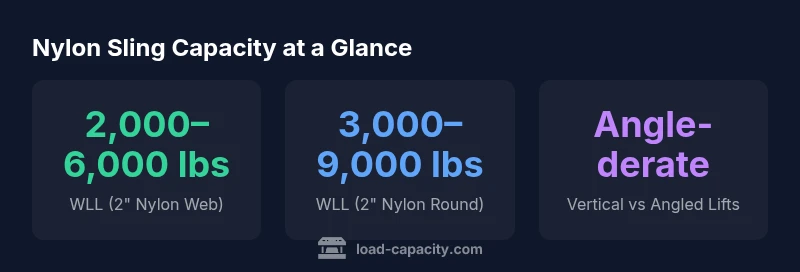
| Nylon Web Sling (flat) | 2 inches | 2,000–6,000 pounds | WLL varies with ply; verify from manufacturer |
| Nylon Round Sling | 2 inches | 3,000–9,000 pounds | Higher due to continuous loop design |
Quick Answers
What does 2 nylon sling capacity mean in practical terms?
2 nylon sling capacity refers to the safe load a two-inch sling can carry under specified conditions, typically defined as the WLL on the tag. It varies by sling type, ply, and geometry. Always rely on manufacturer data and apply a safety margin for any lift.
2-inch sling capacity is the safe load from the manufacturer, and it varies by sling type and setup. Always check the tag and use a safety margin.
How do angles affect sling capacity?
Angles reduce effective capacity because the load is distributed across multiple fibers. The sharpest reductions occur at acute lifting angles; use manufacturer derating tables or calculations to determine per-sling capacity in angled lifts.
Angles reduce capacity; use derating charts to know how much each sling can carry when not vertical.
Can I use two slings to lift more weight?
Using two slings can increase total load capacity if the load is shared evenly. Ensure equal distribution, avoid snatching or dynamic loads, and recalc per-sling capacity after setup.
Two slings can share the load, but only if the load is evenly distributed and you recalculate capacities for each sling.
What maintenance steps preserve 2-inch nylon slings?
Inspect for cuts, abrasion, heat damage, and chemical exposure before every lift. Keep slings clean, stored away from direct sunlight when not in use, and replace any sling showing wear.
Inspect for wear before every lift and replace any damaged sling.
Are nylon slings safe for UV exposure?
Nylon is sensitive to UV light; extended exposure can degrade strength. Use UV-protected slings or edge sleeves if exposure is unavoidable.
Ultraviolet exposure can weaken nylon; protect slings or rotate use.
Where can I find official guidance on sling safety?
Consult OSHA and ISO standards for rigging and slings, and verify manufacturer data for your specific sling. These sources provide procedures and derating guidelines.
Check OSHA and ISO standards for rigging and sling guidelines.
“"Capacity is task-specific. Do not rely on nominal weight alone; confirm WLL, apply derating for angles, and check hardware and condition."”
Top Takeaways
- Know that 2 nylon sling capacity varies by construction and use.
- Always confirm WLL on the manufacturer tag before lifting.
- Derate capacity for lift angles and hardware interactions.
- Inspect slings before every lift and replace damaged units.
- Document calculations and apply an appropriate safety factor.