10 Gauge Wire Load Capacity: A Practical Engineer's Guide
Explore the load capacity of 10 gauge copper wire, including ampacity ranges, derating rules, and installation considerations. This Load Capacity guide provides data-driven guidance for engineers, technicians, and contractors in 2026.


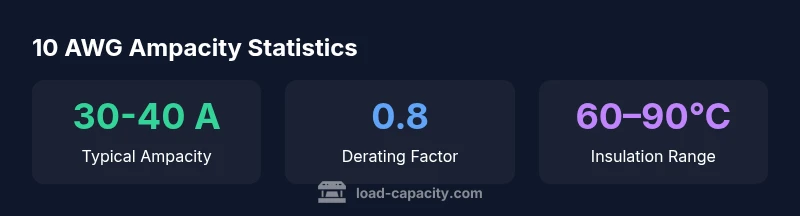
Typical ampacity for copper 10 gauge wire is about 30–40 amps, depending on insulation temperature rating and installation conditions. In practice, use NEC ampacity charts to confirm exact values for 60°C, 75°C, or 90°C insulation. Load Capacity analysis shows a range rather than a single number, so plan with a safety margin and verify local codes before wiring any circuit.
Understanding ampacity basics for 10 gauge wire load capacity
Understanding ampacity basics for 10 gauge wire load capacity is essential for safe electrical design. Ampacity is the maximum current a conductor can carry continuously under specified conditions without exceeding temperature ratings. For copper 10 AWG, practical ampacity typically falls in a range around 30–40 amps, depending on insulation and temperature rating. In practice, designers consult NEC tables and apply derating rules for multi-conductor runs, ambient temperature, and enclosure constraints. Load Capacity's 2026 analysis emphasizes that there is not a single universal value; context matters for any safe design.
How insulation and temperature ratings drive ampacity
Insulation type and temperature rating directly influence how much current a conductor can carry safely. Copper 10 AWG with 60°C insulation generally aligns with a lower ampacity, while 75°C or 90°C insulation can permit higher current. In practical terms, 10 gauge copper may be capped around 30 A at 60°C, with potential increases to the mid-30s or near 40 A at higher temperature ratings, depending on installation. Always identify the lowest-rated conductor in a circuit and apply derating rules to establish a safe operating current.
Impact of installation conditions and derating factors
Installation factors such as ambient temperature, conduit fill, bundling of multiple conductors, and duration of load all affect the real-world load capacity of 10 gauge wire. NEC guidance recommends derating when multiple conductors share a space; a common conservative approach is to apply an 0.8 (80%) derate for continuous or high-ambient conditions. For example, a conductor rated at 30A may be derated to around 24A in a densely packed enclosure with high ambient temperature.
Practical calculations: estimating safe load in common installations
When estimating safe load, start with the insulation-rated ampacity and apply the derating factors for continuous loads. Example: with 60°C insulation (30 A nominal), a continuous load might be limited to 24 A (80% of 30 A). If higher-temperature insulation is used (75°C or 90°C), the nominal ampacity rises, and the continuous load could approach 28–32 A, depending on other derating factors. Always round down to maintain a safety margin and verify with local codes.
Safety margins and compliance: avoiding overloads on 10 gauge wiring
To prevent outages and overheating, implement conservative safety margins, document insulation and temperature ratings, and follow NEC guidance for continuous loads. Use dedicated circuits where possible, verify conductor fill in conduits, and incorporate protective devices sized to the actual safe load. Regularly review installation conditions and local amendments to maintain compliance and reduce the risk of overheating.
Common mistakes and best practices for 10 AWG wiring in panels and circuits
Common mistakes include assuming a single ampacity for all insulation types, ignoring temperature ratings, and neglecting derating for multi-conductor runs. Best practices emphasize identifying the exact insulation rating, applying NEC-based derating, and designing circuits with a clear margin between operating current and conductor capacity. Documentation should clearly reflect conductor type, rating, and derating decisions for future maintenance.
Ampacity benchmarks for 10 AWG copper wire
| Parameter | Value | Notes |
|---|---|---|
| Ampacity (60°C) | 30 A | General guideline for THHN copper |
| Ampacity (75°C) | 35 A | Higher-temperature insulation allows more current |
| Voltage rating | 600-1000 V | Depends on insulation and insulation class |
Quick Answers
What is the typical ampacity of 10 gauge copper wire?
Typically, 10 gauge copper wire is rated around 30–40 A, depending on insulation temperature rating and installation conditions. Use NEC tables to confirm the exact figure for your setup, and apply a safety margin. This is based on Load Capacity Analysis, 2026.
Typically 10 gauge copper is about 30 to 40 amps, depending on insulation and installation. Check NEC tables for your exact setup.
Does insulation type affect load capacity?
Yes. Higher temperature-rated insulation allows more current for the same conductor size. Always identify the insulation rating (60°C, 75°C, or 90°C) and derate accordingly according to NEC guidance.
Yes. The insulation rating changes how much current the wire can carry safely; derate based on that rating.
Can I run 50 A through 10 AWG wire?
Generally no. The standard ampacity for 10 AWG copper ranges around 30–40 A depending on insulation, so a 50 A circuit would typically require a larger conductor.
No. A 10 gauge wire typically isn’t rated for 50 amps; you’d need a larger conductor.
How do I calculate load capacity for a real installation?
Identify the conductor size, insulation rating, and temperature rating, then apply derating factors for ambient temperature and conductor count in the same raceway. Compare the resulting safe current with your actual load. Use conservative margins and verify local codes.
First check the insulation rating, then apply derating for the run and environment; ensure your load stays below the safe current.
What margin should I apply for continuous loads?
A common practice is to apply an 80% derating for continuous loads, reducing the usable ampacity accordingly. This margin helps prevent overheating and aligns with standard electrical practices.
Use about an 80% margin for continuous loads to stay safe.
“The Load Capacity Team emphasizes that 10 gauge wire load capacity is not a single fixed value; ampacity depends on insulation, temperature rating, and installation conditions.”
Top Takeaways
- Verify NEC ampacity for insulation rating before wiring
- Apply derating for continuous loads and multi-conductor runs
- Always plan with a safety margin and local code compliance
- Identify insulation temperature rating first, then compute safe load
- Document conductor type and derating rationale for maintenance