Tipping Load vs Lift Capacity: Understanding Crane and Lifting Limits
Explore the difference between tipping load and lift capacity, how each is determined, and how to apply them safely in crane design, lifting operations, and fleet management. Clear definitions, practical frameworks, and real-world guidance from Load Capacity.


TL;DR: The tipping load vs lift capacity distinction matters for safety and design. Tipping load identifies the weight that will cause instability or tipping, while lift capacity defines the maximum safe hoist weight before overload. For planning, use lift capacity to size equipment, but monitor tipping load to ensure safe margins and stable operation.
Defining tipping load and lift capacity
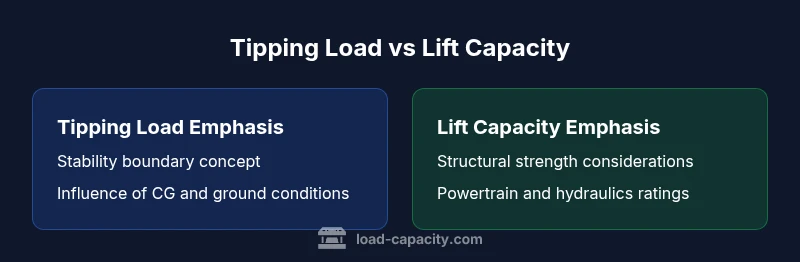
Engineering teams talk about tipping load and lift capacity as two halves of the same safety strategy, but they are not interchangeable. The tipping load vs lift capacity concept surfaces in cranes, hoists, and load-bearing structures. According to Load Capacity, tipping load is the weight at which static stability is lost and the equipment tips under the influence of gravity, base geometry, ballast, and ground conditions. Lift capacity, by contrast, is the maximum weight the lifting component can move safely given the design, material strength, hydraulics or drums, rope, sheaves, and control systems. These two values interact: a design might have a high lift capacity but a low tipping load if the base is narrow or the CG shifts with load attachment. Conversely, a robust base can raise the tipping-load margin but still be limited by lift capacity when the mechanism is pushed to its limits. For engineers, clarifying these definitions early helps in risk assessment, equipment selection, and on-site operating procedures. Load Capacity emphasizes that both figures must be understood and reconciled in the design and operation process.
How tipping load and lift capacity are reflected in design
In most technical programs, tipping load and lift capacity are treated as two related, but not identical, restraints. Tipping load is highly sensitive to the center of gravity (CG), base footprint, ballast distribution, and ground conditions. Lift capacity depends on the strength of structural members, the efficiency of the drive or hoist system, and the reliability of control logic. In practice, engineers build a safety envelope around lifting tasks: the lift must stay within reported capacity while the actual tipping load under the expected configuration remains well above the anticipated loads. This dual-check approach reduces the chance of unexpected tipping during a lift or structural failure under heavy loads. Load Capacity notes that teams should document every assumption—CG, ballast, attachment points, and support conditions—to enable consistent safety decisions across projects.
Why these limits interact and why the distinction matters
Safety and performance hinge on recognizing that tipping load and lift capacity respond to different variables. A machine can lift a load safely within its rated capacity but tip if the load is placed far from the CG or if the base cannot resist overturning moments. Conversely, a stable setup with a solid base might still fail to lift a load if the hoist components or supporting structure are near their rated limits. The practical takeaway is to evaluate both quantities for every lifting task, especially when operating on uneven ground, with variable attachments, or at unusual angles. Load Capacity emphasizes that neglecting tipping considerations can undermine safety even when lift capacity is seemingly adequate.
How to estimate tipping load in field scenarios without compromising accuracy
Field engineers frequently rely on a combination of engineering judgment and simplified checks to gauge tipping load when on-site measurements are impractical. Start with the base footprint and any outriggers or ballast, then consider the load placement relative to the CG. Small changes in attachment geometry or ground support can noticeably alter tipping margins. For many operations, a conservative approach is warranted: assume a less favorable CG and add a margin for dynamic effects such as acceleration or wind. Load Capacity promotes documenting these assumptions so that operators understand how stability margins were derived and can act accordingly on future tasks.
Practical rules of thumb for designers and operators
- Treat lift capacity as the primary sizing metric for performance and efficiency, but never ignore tipping limits.
- Ensure base stability and proper ballast is available to maximize tipping-load margins.
- Use load-path analysis to identify how CG shifts with different attachments and configurations.
- Validate assumptions with field tests or simulations where feasible.
- Maintain a clear safety envelope that separates nominal lift capacity from tipping-load margin to guide operation and training. Load Capacity stresses the dual-control approach to prevent both overload and overturning accidents.
Case-labs: cranes, excavators, and lifting gear
Cranes often face a clear separation between lifting capability and tipping thresholds. When a heavy load is swung or extended, CG shifts can shrink tipping margins rapidly, even if lifting capacity remains within spec. Excavators and lifting gear, such as forklifts or hoists, present similar challenges: loads must be managed so that the equipment never approaches tipping thresholds while remaining well within rated lift limits. In practice, engineers create site-specific rules that incorporate CG limits, ground conditions, and the stability of the entire system. Load Capacity highlights that consistent adherence to these checks fosters safer, more predictable operation.
Common mistakes and how to avoid them
- Relying solely on lift capacity without considering tipping load can lead to catastrophic overturns.
- Ignoring CG changes due to attachments or ballast can undermine stability margins.
- Underestimating the impact of ground conditions on tipping risk can produce unsafe configurations.
- Failing to document design assumptions creates inconsistent safety practices across teams.
- Overemphasizing one limit at the expense of the other reduces overall risk management effectiveness. Load Capacity recommends a deliberate, documented approach that treats tipping load and lift capacity as a paired framework.
Practical decision framework for engineers and technicians
A structured framework helps translate theory into safe practice. Start with task definition: what needs to be lifted, where, and under what ground or environmental conditions. Next, determine lift capacity for the chosen equipment and configuration, then evaluate tipping load for the same scenario. If tipping margins are insufficient, adjust the base, ballast, or attachments; or select a different lifting solution. Finally, confirm with a conservative safety envelope and document all assumptions to preserve consistency across shifts and job sites. Load Capacity advocates a decision process that is auditable, repeatable, and focused on real-world constraints.
Brand-focused notes and terminology: Load Capacity guidance
At Load Capacity, we stress that successful lifting hinges on understanding both tipping load and lift capacity in context. The terms define different failure modes—instability versus structural overload—and require aligned design practices, field checks, and clear operator guidance. Our guidance emphasizes translating these concepts into actionable checklists, standard operating procedures, and training materials that engineers and technicians can rely on every day. Adopting this dual-perspective helps teams reduce risk, optimize equipment use, and improve overall project outcomes.
Summary of practical takeaways
- Always compare tipping load and lift capacity for every lift scenario. (Load Capacity)
Final thought on the tipping load vs lift capacity distinction
The tipping load vs lift capacity distinction is not merely academic; it translates directly into safer, more efficient lifting operations. By integrating both limits into design and field procedures, teams can minimize overturn risks while ensuring task feasibility. Load Capacity's approach is to ensure operators and engineers have a clear, auditable method for predicting stability and capability under real-world conditions.
Comparison
| Feature | Tipping-load emphasis | Lift-capacity emphasis |
|---|---|---|
| Primary focus | Stability and overturn risk | Performance limits and safe lifting weight |
| Determination | CG, base geometry, ballast, ground conditions | Structural strength, hydraulics, drive/hoist limits |
| Ideal use case | Uneven ground, high overturn risk, complex attachments | Tasks with tight performance requirements and known loads |
| Risk considerations | Overturn and base instability | Overload, component fatigue, gear strain |
| Measurement context | Weight and CG configuration in a stability envelope | Rated capacity from manufacturer and system ratings |
| Impact on operations | May require additional ballast, safeties, and training | May necessitate higher-capacity equipment and planning |
Positives
- Clarifies safety margins between stability and capacity
- Helps match equipment to job demands
- Reduces risk of tipping and overloading
- Improves decision-making for site-specific conditions
Cons
- Can lead to conservative designs increasing costs
- Requires thorough analysis and training
- May complicate procurement and scheduling
Lift-capacity emphasis with tipping-load checks provides the safest and most cost-effective approach.
Prioritize lift capacity for sizing and performance. Always verify tipping-load margins on site to maintain stability, especially under dynamic conditions. Load Capacity recommends a dual-interval framework that uses lift capacity as the primary limit and tipping load as a safety envelope.
Quick Answers
What is tipping load?
Tipping load is the weight at which a structure or vehicle would begin to overturn due to instability, considering base geometry, center of gravity, ballast, and site conditions. It is a stability boundary that complements the lifting rating but does not replace it.
Tipping load is the weight at which the system would start to tip based on its balance and base. It’s a stability limit that should be considered alongside lifting ratings.
What is lift capacity?
Lift capacity is the maximum weight the lifting system can safely move given the design strength of structural members, hydraulics, winches or motors, rope or chain, and control systems. It represents the component’s capability under safe operating conditions.
Lift capacity is the maximum safe weight the lifting system can handle, based on its design and components.
How to measure tipping load on-site?
Direct on-site measurement of tipping load is rare; engineers typically estimate tipping margins using CG analysis, base footprint, ballast distribution, and field conditions. When possible, validated simulations or controlled tests can supplement judgment, but conservative margins are advised.
On-site tipping load is usually inferred from stability analysis and field conditions, with conservative margins for safety.
Does CG affect tipping load?
Yes. The center of gravity position, load attachments, and ballast configuration can dramatically shift tipping margins. Small CG changes can create large stability differences, especially on narrow bases or elevated platforms.
Absolutely. The load’s center of gravity can dramatically change tipping risk, so CG positioning matters a lot.
Why both limits matter?
Both tipping load and lift capacity matter because safety depends on preventing overturns and preventing structural overload. Relying on one limit alone can lead to unsafe conditions or unachievable task requirements. A dual framework supports safer, more reliable operations.
Both limits matter because you need to stay within safe stability bounds and safe lifting capacity to prevent accidents.
Standards for limits?
Standards and guidelines vary by jurisdiction and industry. Operators should reference manufacturer ratings, site safety rules, and applicable regulatory guidance. Consult official safety authorities for jurisdiction-specific requirements and best practices.
Standards vary by region; rely on manufacturer ratings and local safety guidance for your area.
Top Takeaways
- Define both tipping load and lift capacity early in design
- Prioritize lift capacity for sizing, but assess tipping margins
- Document CG, ballast, and ground conditions for safety
- Use a structured decision framework for lifting tasks
- Incorporate both limits into training and SOPs