Lift Capacity Calculator: Learn to Estimate Safe Lifting Loads
Explore how a lift capacity calculator helps engineers and operators estimate safe lifting loads for cranes, forklifts, and hoists. Learn inputs, interpretation, and practical steps to apply results safely.


How the calculator computes Safe Lift Capacity
A lift capacity calculator uses a simple, transparent formula that engineers rely on to translate equipment ratings into practical, safe loads for on-site lifts. The core idea is to apply two adjustment factors to the device's nominal capacity: Duty Cycle, which accounts for how aggressively the lift is used, and Safety Factor, which provides a margin for uncertainties such as rope stretch, rigging, and operator variability. The final result—Safe Lift Capacity—is expressed in kilonewtons (kN) and can be compared directly across equipment types when the same units and factors are used. This method aligns with standard engineering approaches, making the calculator easy to audit, explain, and justify in project reviews or safety meetings.
Key inputs and definitions
- Rated Capacity: the maximum load the lifting device is designed to handle under standard conditions, typically specified by the manufacturer and expressed in kN.
- Duty Cycle: the proportion of time during a lift cycle that the device actually carries a load; this value captures operational intensity and influences wear and peak forces.
- Safety Factor: a multiplier below 1.0 that buffers against uncertainties, such as dynamic effects, misjudgments, and environmental factors. When in doubt, choose a slightly lower safety factor for high-risk operations.
- Units and consistency: choose a single unit system across inputs (preferably kN for force) to avoid conversion errors and to facilitate clear reporting.
Interpreting results and limitations
The calculator provides a practical guideline, not a guarantee. Real lifts involve dynamics—accelerations, decelerations, wind, and rigging motions—that can temporarily exceed the computed Safe Lift Capacity. Always incorporate equipment-specific procedures, environmental checks, and a formal lift plan. The results should be reviewed by qualified personnel, particularly for critical lifts or unusual load geometries. With that in mind, use the Safe Lift Capacity as a ceiling, not an invitation to push the limits.
Real-world scenarios and examples
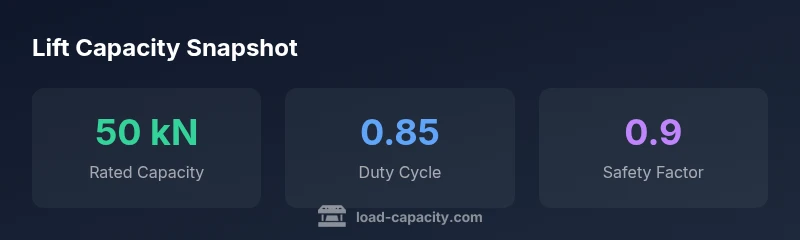
Example A: A mobile crane with a Rated Capacity of 50 kN, a Duty Cycle of 0.85, and a Safety Factor of 0.9 yields Safe Lift Capacity = 50 × 0.85 × 0.9 = 38.25 kN. This means the practical lifting load should not exceed about 38 kN under the configured conditions. Example B: A forklift rated at 120 kN with a Duty Cycle of 0.75 and Safety Factor of 0.95 gives 120 × 0.75 × 0.95 = 85.5 kN. In both cases, the calculator’s output should be used to define rigging plans, with allowances for dynamic effects and contingency margins.
These examples illustrate how the same formula adapts to equipment class and operating context. Always document the inputs used (rated capacity, duty cycle, safety factor) and the resulting Safe Lift Capacity in your lifting plan.
Limitations and assumptions
- Assumes static loads during calculation; dynamic effects are introduced via the Safety Factor and Duty Cycle but not fully modeled.
- Assumes manufacturer-rated capacity is accurate for the intended geometry and load path.
- May not account for temporary factors like wind, slope, or uneven ground.
- The calculator is a learning tool and a starting point; professional verification is essential for any critical lift.
Practical tips for engineers and technicians
- Keep input units consistent and document the units used in safety records.
- Use conservative Duty Cycle and Safety Factor values for new operations or uncertain conditions.
- Validate calculator outputs with hands-on checks, rigging diagrams, and manufacturer guidelines.
- Integrate the calculator into your lift planning workflow and store results with the lifting plan for auditability.
- Periodically review inputs and factors to reflect equipment aging and retrofit updates.