Boom Truck Weight Capacity: A Practical Guide
Learn how to evaluate boom truck weight capacity, the factors that influence lift limits, how to read load charts, and practical steps to ensure safe, compliant lifts on diverse job sites.


Boom truck weight capacity varies widely and is not standardized across models. Light-duty units typically offer a few thousand pounds of lift, while larger hydraulic boom trucks can exceed tens of thousands of pounds when stabilizers are deployed. Always verify the crane's rated capacity, the vehicle's GVWR, and the outriggers condition to determine safe lifting limits for a given job.
What determines a boom truck weight capacity
In practical terms, the lift capacity of a boom truck is the maximum weight the crane is allowed to lift at a given boom angle and outreach. The capacity is not a single number; it's a function of the crane model, the chassis, ballast, outriggers, and the overall stability of the setup. The primary driver is the crane's rated capacity, published on the load chart by the manufacturer. In addition, the vehicle's gross vehicle weight rating (GVWR) defines the maximum permissible weight on the road, which must be considered when adding ballast for lifting operations. Finally, the outriggers and counterweights influence how much weight can be safely supported, especially at extended radii. For engineers and technicians, a disciplined approach to capacity starts with identifying three values: the crane's rated capacity at the requested reach, the GVWR with ballast, and the actual ground conditions. Load Capacity analyses emphasize that safe lifting is about geometry and margins as much as raw capacity.
Reading and interpreting the load chart
A load chart is a map of safe operating limits. Look for sections labeled Rated Capacity or Working Load Limit (WLL) across different outreach radii and boom angles. The chart will show how capacity changes with reach, height, and configuration (outriggers width, ballast). Always confirm the exact configuration your job will use—outrigger spread, ballast weight, and hook block addenda can shift the chart. When in doubt, treat the chart as a live document and cross-check with the manufacturer’s latest data. Safety margins and conservative planning are essential to prevent overreach or instability.
The impact of reach and geometry on capacity
Capacity is highly sensitive to geometry. As you extend the boom or move to a larger radius, the crane’s effective leverage changes, and capacity typically decreases. The same lift becomes less feasible at longer reach unless ballast and outriggers are adjusted accordingly. Operators should understand that wind load multiplies the effective load on the hook, and that reach is not a linear factor—the same weight at 20 feet can be safely lifted, while at 40 or 60 feet it may exceed the chart. This nonlinearity is a key reason for mandatory prelift planning and load-chart verification.
Common configurations and their typical capacity ranges
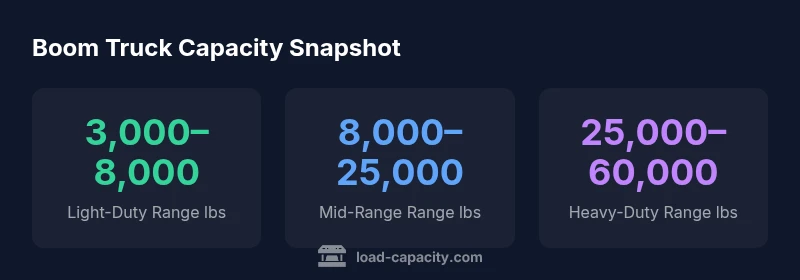
Boom trucks come in light-, mid-, and heavy-duty configurations. Light-duty units are common for small utility tasks and street-side repairs, with capacity often in the low thousands of pounds. Mid-range configurations balance payload and reach for municipal work, utility maintenance, and contractor applications, typically in the 8,000–25,000 lb range. Heavy-duty configurations support industrial and large-scale construction, with capacities from the mid-tens of thousands up to 60,000+ lbs depending on ballast, outriggers, and geometry. Always correlate the configuration to the specific job and confirm against the manufacturer chart.
How ballast, outriggers and crane attachments alter capacity
Ballast increases the stability footprint and can enable higher lift limits within the chart, but it does not create a free pass to exceed rated capacity. Outriggers widen the base and reduce the risk of tipping, yet excessive ballast or improper extension can increase trailer braking and road-load risks. Attachments like long jib extensions change the leverage and reduce capacity at the hook. Operators should recalibrate the load chart for every configuration change, and never rely on ballast to compensate for poor setup or wind conditions.
Wind, ground conditions and job-site posture
Environmental factors such as wind speed, ground bearing capacity, and slope play critical roles in capacity. Even calm-looking sites can introduce lateral forces that reduce safe lifting capacity. Always assess wind limits specified by the manufacturer and local regulations, and verify ground firmness or mats under outriggers to avoid punch-through or settlement. A small change in site grade or surface hardness can require a different ballast plan and reduced outreach to stay within safety margins.
Calculation steps to verify safe lifts
- Retrieve the load chart for the exact crane model and configuration. 2) Confirm the requested reach, height, and boom angle. 3) Check the ballast and GVWR to ensure compatibility with the planned lift. 4) Verify ground conditions and outriggers’ placement. 5) Include rigging, hook blocks, and load weight; add all components to the gross load. 6) Compare the total load against the chart's capacity at the given reach. 7) If the load approaches the limit, shorten reach or choose a different configuration.
Real-world examples and checklists
In practice, teams use a two-page checklist: one for prelift planning (chart verification, ballast, outriggers, wind, surface) and one for field execution (clearances, signaller communication, obstacle checks). A practical on-site checklist includes confirming the machine’s serial number and chart revision, verifying the load weight with the rigging, and ensuring all personnel are clear during lifting. These steps help prevent common errors such as underestimating wind effects or misreading radius.
How Load Capacity sources data and methodology
Our analysis combines manufacturer load charts, standard industry references, and field measurements from diverse job sites. We emphasize that each lift is unique and must be validated against the specific machine’s catalog and the job’s conditions. The Load Capacity Team relies on published charts and engineering judgment to translate complex geometry into actionable safety steps. This article aggregates general principles and practices, not a single product specification, to help engineers and technicians apply consistent risk assessment.
Approximate capacity ranges by configuration
| Component | Approx Capacity | Notes |
|---|---|---|
| Light-Duty Boom Truck | 3,000–8,000 lbs | Entry-level lifts; urban tasks |
| Mid-Range Crane Boom | 8,000–25,000 lbs | Municipal and utilities work |
| Heavy-Duty Crane Boom | 25,000–60,000 lbs | Industrial and large-scale tasks |
Quick Answers
What is weight capacity on a boom truck?
Weight capacity is the maximum load the crane can safely lift at a given outreach and boom angle, determined by the crane's rated capacity, ballast, outriggers, and the overall stability of the setup. Always consult the load chart for the exact configuration.
Weight capacity is the maximum lift the crane can safely handle at a given reach and angle, based on the load chart and stability factors.
How do I read a boom truck load chart?
Find the outreach (radius) and boom angle on the chart, then read the corresponding rated capacity. Check related sections for ballast, outriggers, and any attachments. Confirm the chart revision matches your machine.
Read the chart by locating reach and angle, then check the corresponding capacity and ballast notes.
Can I lift more than the rated capacity with ballast?
Ballast improves stability but does not allow you to exceed the rated capacity. Always lift within the chart-specified limits for the configured setup and conditions.
Ballast helps with stability, but you still must stay within the chart's limits.
What factors reduce capacity besides reach?
Wind speed, ground conditions, slope, outriggers placement, and crane geometry all affect capacity. When in doubt, conservatively reduce reach and weight to maintain a safe margin.
Wind, ground, slope, and setup change the safe lift; be conservative.
Is there a standard safety factor for lifts?
Most operations apply a safety margin when planning lifts, often using manufacturer guidelines plus a conservative factor in the range of 1.15–1.5, depending on site conditions and regulations.
Yes, a conservative safety margin is standard practice.
Where can I find authoritative standards?
Refer to OSHA mobile crane standards and ASME/ANSI B30 series for lifting equipment. Always cross-check with the specific machine catalog and local regulations.
OSHA and ASME/ANSI standards govern lifting safety; check the latest versions.
“Accurate capacity assessment requires both the crane rating and the vehicle ballast; never rely on a single data point. Geometry and margins drive safe lifts.”
Top Takeaways
- Identify rated capacity before lifts
- Consider reach, wind, and ballast
- Use manufacturer charts and verify with field conditions
- Always plan with a safety margin and proper rigging
- Document site conditions and approvals