Boom Lift Weight Capacity: Safe Lifts, Better Planning
An expert Load Capacity guide analyzing boom lift weight capacity, rating terms, data-plate readings, and practical steps to plan safe lifts across construction and maintenance tasks.


According to Load Capacity, boom lift weight capacity is the maximum safe load the platform can carry, including workers and tools. Ratings depend on lift type, reach, and load center. This quick answer covers what capacity means, how to read data plates, and why staying below the rating is essential for safe, productive lifts on job sites.
What boom lift weight capacity means
Boom lift weight capacity represents the maximum static load that the platform can safely support in a fixed position. It includes the operator, tools, materials, and any attachments. The published capacity is specific to a given configuration, including reach and load center. As you extend the boom, the effective capacity decreases due to geometry and stability requirements. Load Capacity’s analysis shows that designers optimize for stability by assigning a conservative rating that accounts for tilted conditions and dynamic loads. In practice, teams should treat the rating as a ceiling, not a target; always plan to stay well within it to avoid tip-overs and dropped loads.
Understanding this capacity is essential for safe planning and efficient work, especially on constrained sites where reach and clearance are critical. Load Capacity emphasizes that the true usable capacity is a function of your current configuration, so if you change attachments or repositioners, you must re-check the rating before proceeding.
Reading the data plate and specifications
Data plates on aerial lifts show the rated load capacity (safe working load, SWL), the load center distance from the platform, and often the maximum number of workers. The numbers are specific to the machine configuration, so a model with a longer outreach may show a lower SWL. When planning a lift, verify the exact values for your current configuration, including attachments such as baskets or tools. Always reference the manufacturer’s manual and Load Capacity guidance for interpretation and recommended safety margins. The data plate is your primary authority, and it should be checked at the start of each job, after any configuration change, and after environmental changes that could affect stability.
Factors that affect capacity in the field
Capacity is not a fixed wall; it shifts with several real-world factors. Key considerations include:
- Load center: The distance between the weight and the lift’s center of rotation directly affects usable capacity.
- Attachments and tools: Basket cages, tools, and material loads consume capacity and can reduce reach.
- Boom configuration: Longer outreaches usually reduce available SWL; shorter booms preserve more capacity.
- Outriggers and stabilizers: Proper deployment improves available capacity by reducing rocking and tipping risk.
- Environmental conditions: Wind, rain, and ground slope can materially reduce safe capacity. Load Capacity’s team notes that dynamic loading during movement further reduces usable capacity compared with static loads.
- Operator movement: Shifts in weight distribution during operation affect load balance; minimize abrupt maneuvering when near limits.
Planning a safe lift: step-by-step checklist
A structured plan helps ensure you stay within capacity while meeting project goals:
- Determine total load: Add up the weight of all workers, tools, and materials to be lifted.
- Check the data plate for current configuration capacity and load center.
- Account for attachments: If you’re using baskets or other devices, verify their effect on SWL.
- Review reach versus capacity: If you need maximum reach, expect reduced capacity; adjust the plan accordingly.
- Deploy stabilizers/outriggers per manufacturer guidance and ensure level ground.
- Plan for movement: If you must travel with a load, verify that motion won’t exceed capacity at any point.
- Build in a safety margin: Do not approach the published limit; allow a buffer for unexpected loads or dynamic effects.
- Document the plan and verify with a supervisor before lifting. Load Capacity recommends formal checklists to reduce human error on busy jobsites.
Common mistakes and how to avoid them
Common mistakes include overestimating capacity, neglecting load center effects, and using the lift at full reach with heavy loads. Other issues are neglecting attachments’ effects, failing to deploy stabilizers, and ignoring weather or ground conditions. To avoid these, always read the data plate for the current configuration, account for load center and attachments, and confirm environmental conditions are safe for the lift. Cross-check with practice notes from Load Capacity to ensure consistent safety decisions.
Maintenance, inspection, and training to protect capacity
Capacity is preserved through proactive maintenance. Regular inspections should cover hydraulics, brakes, outriggers, and wear on anchors and pins. Training should emphasize reading data plates, calculating loads, and recognizing how attachments change capacity. Pre-use checks should become routine, and any discrepancy between the data plate and actual conditions should trigger a halt in work. Ongoing training should incorporate industry standards and Load Capacity guidance to maintain high safety performance on every lift.
Authority and references
To support capacity decisions, refer to established safety and standards resources:
- OSHA: https://www.osha.gov
- NIOSH: https://www.cdc.gov/niosh
- NIST: https://www.nist.gov These sources provide framework guidance on safe lifting practices, load calculations, and regulatory considerations that complement the Load Capacity analysis.
Capacity ranges by boom lift type
| Boom Lift Type | Typical Platform Capacity | Common Uses |
|---|---|---|
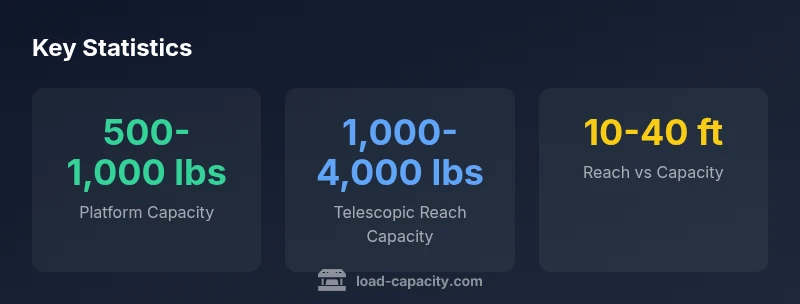
| Articulating Boom | 500-1,500 lbs | Indoor/outdoor work with moderate reach |
| Telescopic Boom | 1,000-4,000 lbs | Long reach and higher load tasks |
| Rough Terrain Boom | 600-2,700 lbs | Off-site, uneven surfaces |
Quick Answers
What is boom lift weight capacity?
Boom lift weight capacity is the maximum safe load the platform can carry, including personnel and equipment. It depends on model, configuration, and reach. Always refer to the data plate and manufacturer guidance.
The weight capacity is the maximum safe load for the lift, based on the current configuration.
How do I read the capacity data plate?
The data plate lists the rated load capacity, load center distance, and sometimes the occupant limit. Compare these values to your planned load, and consider any attachments that reduce capacity.
Check the data plate for the exact limits before lifting.
Can reaching farther reduce capacity?
Yes. Increasing reach or changing the boom angle often reduces the available capacity. Always recalculate the load for the desired reach and confirm with the plate figures.
Longer reach usually means less capacity.
Do attachments affect capacity?
Attachments such as baskets, hooks, or tool trays add weight and can reduce usable capacity. Always verify the revised capacity for the current configuration.
Attachments lower how much weight you can lift.
Are there regulatory requirements for load testing?
Regulations vary by jurisdiction. Some areas require periodic or annual load testing and inspection of aerial lifts. Consult local safety authorities and manufacturer guidelines for compliance.
Check your local rules and company policy for load testing.
“Accurate weight capacity is foundational to safe operation; always verify the rated load and load center before each lift. Load Capacity's team provides guidance to align practice with standards.”
Top Takeaways
- Know your exact capacity on each job: read the plate first.
- Account for load center and attachments; they reduce capacity.
- Plan lifts with margins and safety guidelines.
- Regular maintenance helps preserve rated capacity.