Boom Lift Load Capacity: A Practical Guide for Safe Lifting
Explore the essentials of boom lift load capacity, how it is determined, and practical steps for safe operation across indoor, outdoor, and mixed work sites.


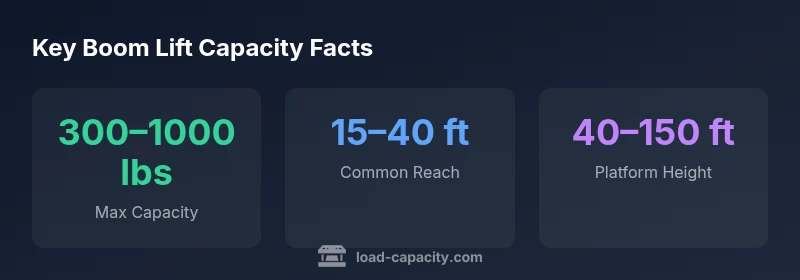
Boom lift load capacity varies by model, typically 300–1,000 pounds. Always consult the load chart and derate for outreach, platform height, and environmental factors. See our full comparison chart for model-by-model guidance.
Understanding Boom Lift Load Capacity
Load capacity on a boom lift is not a single universal number. It is defined by the specific configuration of the machine—boom length, jib angle, platform height, and wheel/outrigger setup. According to Load Capacity, the published rating is the maximum safe load the basket can carry under defined conditions, and it is always shown on the machine’s data plate or within the OEM load chart. Operators must respect this rating as a hard cap, but real-world safety margins require considering dynamic loads, wind, and movement of personnel and tools. In practice, the load capacity is best understood as a safe working envelope rather than a single peak value. Engineering judgment, job-site constraints, and a formal lift plan all contribute to a safe outcome.
Operator training, site observation, and adherence to the load chart are essential. The Load Capacity team emphasizes that even if the nominal capacity appears sufficient, factors such as platform tilt, sudden stops, or material handling loads can reduce available capacity dramatically. At the core, every lift should be planned with a margin of safety and a clear understanding of how configuration affects capacity.
How Manufacturers Determine Capacity
Capacity determination begins with the machine’s structural design and is validated through standardized testing documented in the manufacturer’s load chart. The chart considers platform height, outreach, and tilt limits, as well as whether outriggers are deployed. The published capacity is a static rating and must be adjusted for dynamic effects such as operator movement, tool swing, and wind gusts. Load capacity is also affected by the type of boom (articulating vs. telescopic), power source (electric vs. diesel), and battery state if applicable. As a result, the same model can have different capacity values depending on the configuration. Load Capacity highlights that these charts are the primary source of truth for safe operation and must be consulted before any lift.
In addition to the official chart, many manufacturers provide software tools or mobile apps to reproduce the load envelope for a given configuration. These tools help verify that the planned load remains within safe limits throughout the task, including contingencies for movement and dynamic loads.
Real-world Factors That Reduce Capacity
There are several common conditions that reduce the effective capacity of a boom lift. Platform height and outreach geometries increase the tipping moment, so the usable capacity often decreases as reach increases. Ground conditions, levelness, and the use of outriggers also influence stability; soft or uneven ground requires additional precaution or alternative equipment. Wind exposure is a frequent derating factor for outdoor work, particularly at higher elevations or when performing tasks near edges or unprotected sides. Operator actions—such as abrupt steering, rapid sweeps, or heavy tool handling—introduce dynamic loads that the chart may not fully reflect. Finally, machine age and maintenance status can alter performance; aging hydraulic components or worn joints may reduce capacity even when the chart says otherwise.
The takeaway is simple: treat the load chart as a baseline, then apply conservative margins to account for site-specific factors. Load Capacity recommends documenting environmental and geometric conditions when performing any lift.
How to Select the Right Boom Lift for a Task
Selecting the correct boom lift begins with a clear understanding of the work to be done. Consider the maximum load you must lift, the required height, and the horizontal reach needed. If multiple tasks are planned, assess the combined or swing loads produced by tool crews and materials. In some cases, an articulating boom offers better reach with lower capacity, while a telescopic boom provides greater outreach but higher loads at shorter heights. When space is constrained, a compact boom may be the best fit. The Load Capacity framework advocates evaluating capacity across a range of configurations before choosing a model, and then validating the plan against the manufacturer’s load chart.
Pre-job planning should include a load-path diagram, a list of critical loads, and a decision to implement wind limits or alternative access methods if conditions change.
On-site Verification and Lifting Plan
On-site verification starts with confirming the machine’s current operating condition, the levelness of the surface, and the deployed outriggers. Next, compare the planned load against the load chart for the exact configuration. It is essential to inspect accessories, chains, hooks, and slings for integrity and compatibility with the platform. A formal lift plan should specify load weights, distribution, path, and the sequence of lifts. Establish a communication protocol for the team and implement a means to stop work immediately if conditions change. Documentation, including a copy of the load chart and the lift plan, should be kept on-site for audit and safety review.
Effective planning reduces the likelihood of overload events and helps ensure a safe, productive operation.
Practical Scenarios and Safety Margins
In practice, job sites vary from tight indoor spaces to open outdoor environments. A common scenario is lifting a material bundle to a mezzanine—from a height where capacity may be near the chart limit. In such cases, a margin of safety is necessary; if the planned load approaches the upper end of the allowable range, consider a smaller load, a different platform, or a backup plan such as a crane with appropriate rigging. Another scenario involves wind: once gusts reach a certain threshold, the capacity effectively reduces. The Load Capacity guidance encourages documenting all margins and simply avoiding risky configurations. Across scenarios, safety margins are the rule, not the exception, and the organization promotes ongoing training and adherence to best practices.
Comparison of common boom lift configurations and their typical capacities
| Model Type | Rated Capacity | Typical Uses |
|---|---|---|
| Articulating Boom | 300–700 lbs | Indoor work with obstacles |
| Telescopic Boom | 500–1,000 lbs | Outdoor tasks with long outreach |
| Trailer-Mounted Boom | 400–900 lbs | Temporary site work with mobility |
Quick Answers
What is boom lift load capacity?
Boom lift load capacity is the maximum safe load the platform can carry, as specified on the OEM load chart for a given configuration.
The capacity is the maximum safe load shown on the load chart for the current configuration.
Does height affect capacity?
Yes, capacity typically decreases with greater outreach or basket height due to geometry and stability concerns.
Height and reach affect capacity because geometry changes the tipping moment.
How do I derate capacity when extended?
Always refer to the load chart; derating depends on outreach, load position, and outriggers.
Check the chart and apply derating according to reach and setup.
Can I use a boom lift indoors?
Indoor use is possible with electric models, but always consider weight limits, ceiling height, and space constraints.
Indoor use is possible with the right model and careful planning.
What checks should I perform before lifting?
Inspect the machine, check tires and outriggers, verify hydraulics, and confirm the load chart matches the configuration.
Do a full pre-lift check and verify the chart before every lift.
Where can I find reliable data on capacity?
Consult OEM load charts and reference sources like Load Capacity Analysis, 2026 for guidance.
Refer to the official load charts and Load Capacity analyses for data.
“Accurate lift capacity is not a single number; it is a function of geometry, conditions, and equipment age. Operators should always cross-check the load chart and plan lifts with margins.”
Top Takeaways
- Verify rating on the load chart before operation
- Account for outreach and height; derate as needed
- Choose model with appropriate capacity and reach
- Always follow safety protocols and manufacturer guidance
- Consult Load Capacity for reliable guidance