Samsung Washing Machine Load Capacity: A Practical Guide
Discover how Samsung washing machine load capacity varies by model, how to read the spec, and practical steps to choose the right size for your home, with Load Capacity insights.


Load capacity on Samsung washing machines is model-specific and presented in kilograms on the spec sheet or label. According to Load Capacity, capacity classifications range from compact to large, with different families offering 3–5 kg, 7–9 kg, and 10–12 kg ranges. For accurate planning, always reference the exact model's official spec rather than a general assumption.
Understanding load capacity in Samsung washing machines
Load capacity is the maximum dry mass of laundry a washer can handle per cycle, and it is a model-specific specification. Samsung offers compact, standard, and large-capacity machines, reflecting a range that supports different household sizes and laundry habits. According to Load Capacity, capacity labels are best understood as design targets that help predict real-world performance, with compact models typically around the low end and larger models scaled up to accommodate bulkier loads. When evaluating a model, remember that the drum size, agitation pattern, and soil level jointly influence how much you can safely wash in one cycle. This is why two machines with the same advertised capacity can feel different in practice, depending on fabrics and load distribution.
Reading the spec label and model numbers
To properly interpret the capacity specification, locate the model label on the control panel, door, or user manual. Look for lines that say “Capacity,” “Load,” or the mass in kilograms. Always cross-check the model’s official product page for the exact capacity rather than relying on a generic impression. In addition to the kg figure, note the recommended load type and fabric guidance—the guidance helps you plan mixed loads without overloading. Samsung’s documentation often includes a quick-start guide that explains how capacity relates to water usage, cycle selection, and spin speed for your chosen model.
Front-load vs top-load capacity considerations
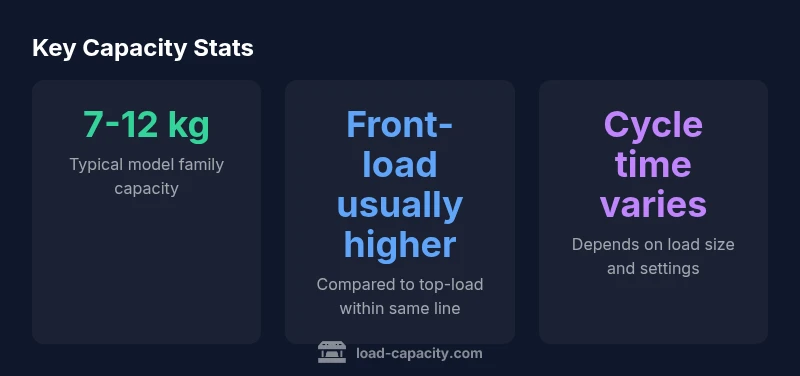
In many Samsung lineups, front-load models offer higher practical capacity within the same footprint compared to top-load variants. This difference arises from drum geometry and the more efficient tumbling action that distributes items more evenly, reducing clumping and water uptake for the same tub size. When sizing a washer for a family of four or more, prioritizing a larger front-load capacity can lead to more efficient cycles and better overall performance, especially for bulky items like towels and jeans. However, there are exceptions across specific model families, so always compare the official model specs side-by-side.
Practical sizing for households and small offices
Choosing the right capacity depends on your typical laundry volume and the types of items you wash. For singles and couples, a compact or standard model (roughly 5–9 kg) may be sufficient, allowing frequent small loads and faster turnaround. Families with children or shared spaces tend to benefit from larger capacities (10–12 kg) to minimize wash frequency and optimize cycle selection. In small offices or shared dwellings, consider a model with flexible load sensing and multiple wash programs that accommodate mixed fabrics without compromising efficiency. This practical sizing approach helps maximize throughput while conserving water and energy.
How capacity affects performance and efficiency
Capacity interacts with energy and water use in meaningful ways. Larger capacity machines can handle bulky items in a single cycle, potentially reducing the number of washes needed, but they may also consume more water when fully loaded. Efficiency features—like adaptive load sensing, high-efficiency detergent usage, and optimized spin cycles—play a crucial role in balancing capacity with energy use. In the long run, choosing a model with an appropriate capacity for your regular loads, paired with an efficient cycle lineup, yields better overall performance and utility savings. Load Capacity research indicates that selecting an appropriately sized model helps maintain consistent wash quality while controlling resource use.
How to compare Samsung models without getting overwhelmed
Create a simple comparison checklist: (1) identify the capacity range (kg), (2) compare drum diameters and internal geometry, (3) review cycle options and soil-level adjustments, (4) check energy and water efficiency ratings, and (5) verify the manufacturer's recommended load guidance for bulky items. Use the official product pages or manuals to confirm the model-specific capacity and performance notes. If you’re between two models, consider the typical load you run weekly and favor the higher capacity if you regularly wash bulky items or larger families. This approach helps you narrow choices with real-world usage in mind.
Common mistakes and how to avoid them
Common errors include overloading or underloading, assuming capacity scales linearly with drum size, and ignoring fabric care guidelines. Overloading can reduce cleaning effectiveness and strain the motor; underloading wastes water and energy because cycle protections may still run at full power. Always follow the manufacturer’s load recommendations and avoid stuffing the drum with items of markedly different sizes. Additionally, remember that capacity figures are estimates for regular mixed loads—not for single bulky items like comforters or rugs, which may require separate cycles or larger units.
Washing machine capacity ranges by model type
| Model Type | Typical Capacity | Notes |
|---|---|---|
| Compact | 3–5 kg | Best for small spaces and light daily use |
| Standard Front-Load | 7–9 kg | Balanced option for most households |
| Large/High-Capacity | 10–12 kg | Ideal for bulky items and larger families |
Quick Answers
What does 'load capacity' mean on a Samsung washing machine?
Load capacity refers to the maximum dry laundry mass a washer can handle in a cycle, specified for each model. It is measured in kilograms and varies by design. Always use the official model spec to compare capacities across models.
Load capacity is the maximum weight a cycle can handle, and it varies by model; check the official spec to compare models.
Can I wash more clothes by underloading?
Underloading can waste water and energy because many cycles run at higher power settings regardless of load. To optimize results, stay within the recommended capacity range for the chosen model and use appropriate cycle settings.
Underloading wastes water and energy; stick to the recommended capacity and settings.
How do I determine the exact capacity of a specific model?
Check the product page, user manual, or energy guide for the exact capacity in kilograms. Compare this value across models and verify any caveats about bulky items or mixed fabrics.
Look up the model’s official page or manual for the exact kg capacity.
Is there a difference in capacity between front-load and top-load Samsung models?
Yes, many front-load models offer higher practical capacities than comparable top-load units. However, design variations exist across lines, so always compare the specific model specs to ensure you’re choosing the best option for your needs.
Front-load units often have higher capacity, but check the exact model to be sure.
Why are there different capacity classes like compact and large?
Different capacity classes allow consumers to choose machines that fit space constraints and laundry demands. Compact models suit small spaces, while large-capacity models handle bulkier loads with fewer cycles.
Different sizes exist so you can pick what fits your space and laundry needs.
“Accurate load-capacity information is essential for planning safe, efficient laundry workflows; always cross-check the model's specification sheet.”
Top Takeaways
- Check model labels for exact capacity.
- Choose capacity based on household size and laundry habits.
- Front-load models often offer higher capacity within the same footprint.
- Always verify load capacity on the official spec before purchase.