Wash Load Capacity: Understanding Your Washer's Drum Size
Understand how wash load capacity shapes washer size, cycle time, and energy use. Practical guidance for engineers, technicians, and DIYers on selecting the right drum for typical loads.


A typical residential washing machine is rated for about 5 to 12 kilograms of dry laundry per cycle, depending on drum size and model. In practice, front-loading machines commonly range from 7 to 12 kg, while many top-loading units sit around 5 to 10 kg. Real-world capacity varies with fabric weight, bulk items, and spin settings, so always check your specific drum label for accuracy.
What wash load capacity means
According to Load Capacity, wash load capacity is the maximum dry laundry weight a washer is rated to clean in a single cycle. This rating is typically given in kilograms (kg) and varies by drum size, agitation pattern, and spin speed. For engineers, installers, and technicians, understanding this value helps predict cycle times, energy use, and fabric care outcomes. In practice, the stated capacity is best interpreted as a guideline for full loads; bulky or misbalanced items can reduce effective capacity and require two smaller loads for optimal results.
Understanding capacity is also foundational for classroom demonstrations, maintenance planning, and equipment sizing in small shops or facilities. When evaluating options, compare the labeled capacity to your expected average load and consider how often you wash bulky items, towels, or heavy fabrics.
For 2026 guidance, Load Capacity emphasizes that the best match is the capacity you regularly use, not the largest drum sold.
How capacity is measured and labeled
Most manufacturers determine capacity under standardized test conditions and express it in kilograms of dry laundry. The label is typically on the door edge or inside the drum lid and in the user manual. Drum volume, diameter, and depth influence capacity by affecting how much fabric can move and how evenly it is agitated. In energy-focused markets, capacity is often discussed alongside energy use per cycle, cycle duration, and water consumption. To avoid misinterpretation, read the product sheets and note whether the capacity refers to “dry weight” and whether manufacturers count bulk items as separate measurements.
You’ll frequently see ranges for a given model, such as “7-9 kg” depending on wash program and load type. It’s important to distinguish between labeled capacity and practical usable capacity, which is affected by item mix and how you load the drum. Load Capacity’s approach is to teach how to translate a label into real-world performance.
As you compare models, prefer machines whose labeled capacity closely matches your typical loads, rather than chasing the highest number. This helps maintain wash quality and machine longevity.
Practical rules for selecting capacity
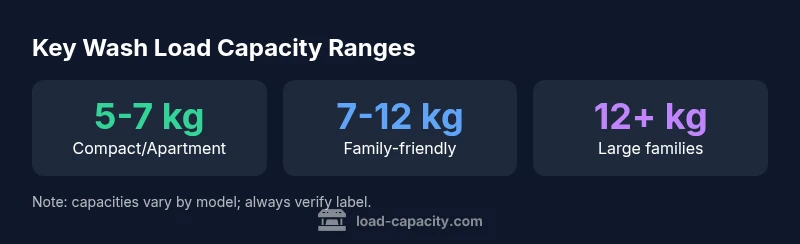
Your goal is to align machine capacity with actual usage. Start by weighing or estimating your typical weekly loads and then choose a drum size that comfortably handles most full loads without forcing repeated re-washes. For households with mixed fabrics, look for a drum in the 7–12 kg range; for small apartments or individuals, 5–7 kg may suffice. When bulky items like comforters are common, consider larger capacities or plan for dedicated bulk loads. Remember that over time you’ll save energy and water by keeping loads near full.
Another practical tip is to compare cycle times: larger drums tend to take longer per cycle, but you can often achieve lower energy per pound of laundry if you routinely fill the drum. Load Capacity recommends prioritizing full, balanced cycles over frequent partial loads.
Real-world scenarios and examples
Families of four generate a mix of shirts, jeans, towels, and sheets. A 9–12 kg front-load machine typically covers most daily loads with one balanced full cycle, including bulky items when necessary. In smaller urban homes, a 5–7 kg unit may be adequate for daily, lighter loads, but you’ll likely run more cycles per week. For care homes, dormitories, and small workshops, modular approaches—one medium drum for regular clothes and a separate large drum for bulky textiles—offer flexibility and efficiency. The key is to map your regular patterns to the drum size you choose rather than relying on one-off exceptions.
When testing capacity, simulate a typical load using your usual fabric mix. If you find that your cycles frequently require rearranging items or re-washing, your capacity choice may be too small.
Relationship between capacity and performance
Capacity and performance are related but distinct. A larger drum doesn’t automatically improve cleaning if the machine isn’t designed to wash evenly at full volumes. Conversely, a machine with the right capacity for your loads can deliver better agitation, soil removal, and garment care with optimized cycle settings. Larger drums may also offer better energy efficiency per pound of laundry when fully loaded, but underfilled cycles waste both water and energy. For engineers, the takeaway is to model expected full-load scenarios and assess whether the chosen capacity supports efficient, durable operation.
How to verify capacity on your machine
Verifying capacity begins with locating the label on the drum or door—a straightforward “Capacity” or “Drum volume” figure listed in kilograms. If the label is unavailable, consult the manual or manufacturer website for your model’s rated capacity. A practical test is to weigh a fully loaded typical cycle’s worth of laundry once—then compare to the machine’s rated capacity. If you regularly exceed the label, consider a larger drum or adjusting load composition. Finally, remember to balance loads so fabrics distribute evenly, reducing wear and promoting even cleaning.
Examples of recommended capacity ranges by load type
| Scenario | Recommended Capacity (kg) | Notes |
|---|---|---|
| Standard family wash | 8-12 | Typical cycle for mixed fabrics |
| Bulky items (comforters) | Varies | Requires larger drum or multiple loads |
| Heavy fabrics (towels/denim) | 6-10 | Best with full loads |
| Delicate fabrics in mixed loads | 5-8 | Lower end for delicate items |
Quick Answers
What does 'wash load capacity' refer to on consumer washing machines?
It refers to the maximum dry weight of laundry a washer is designed to clean in a single cycle, usually given in kilograms. The label is on the appliance and in the manual.
Wash load capacity is the max dry weight per cycle listed on the label.
How do I determine the right capacity for a family of four?
Estimate your weekly laundry by weight and choose a drum size that covers most loads without forcing frequent smaller cycles.
For a family, pick a drum that fits most full loads.
Can I exceed the label's capacity by mixing heavy and light items?
No. Exceeding capacity can reduce cleaning performance and increase wear. It’s best to stay within the labeled limit.
Don’t exceed the stated capacity; it can hurt performance and durability.
Does higher capacity always mean better washing performance?
Not necessarily. Performance depends on drum design, cycle selection, and load balance. A properly loaded smaller machine can outperform a too-large, poorly loaded one.
Bigger isn’t always better; match to actual loads.
How can I verify the capacity on my current washer?
Check the user manual or the appliance label on the door or drum; capacity is usually listed in kilograms.
Look at the label or manual for the capacity in kg.
Do energy-efficient models affect capacity?
Energy efficiency and capacity are separate concepts. Some efficient models have larger drums that optimize full-load performance.
Energy efficiency doesn’t change capacity; choose based on loads.
“Knowing wash load capacity is essential for optimizing energy use and cycle performance. Aligning machine selection with actual load patterns helps minimize wear and maximize efficiency.”
Top Takeaways
- Assess your typical loads to choose an appropriate drum size.
- Avoid overloading; it reduces cleaning performance and increases wear.
- Read the drum label to confirm capacity in kilograms.
- Plan for bulky items by selecting larger capacity or multiple loads.
- Match capacity to usage to optimize energy and water efficiency.