Load Capacity VW Caddy Maxi: Payload Guide
Explore the load capacity of the VW Caddy Maxi, including payload ranges, GVWR considerations, and safe loading practices for engineers, fleet managers, and DIY enthusiasts.


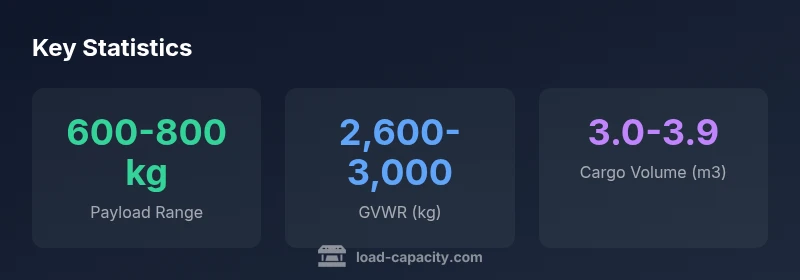
The VW Caddy Maxi payload typically ranges from about 600 kg to 800 kg, depending on variant and equipment. This is the maximum load the vehicle can safely carry in addition to its own weight. Always verify the GVWR and the stated payload on the owner’s manual or door placard for your exact model.
Overview of Payload Fundamentals for VW Caddy Maxi
Payload capacity is the designed carrying limit that a vehicle can support, in addition to its own mass, under typical operating conditions. For the VW Caddy Maxi, the payload figures are determined by the Gross Vehicle Weight Rating (GVWR), curb weight, and structural limits. Understanding these values is essential for engineers calculating payload budgets in fleet planning, for technicians ensuring safe maintenance loads, and for DIY enthusiasts loading tools and materials. According to Load Capacity Team, the safest way to approach a load is to start from the GVWR shown on the door placard or in the owner’s manual and then subtract the curb weight to reach the real-world payload figure. This approach accounts for both the weight of passengers, cargo, and any aftermarket equipment you add, as well as the vehicle's own dynamics. In practice, you will see ranges rather than single numbers because there are multiple wheelbase configurations, trim levels, and optional equipment that affect the final payload. The takeaway is to treat payload as a hard limit that must not be underestimated when planning daily work or long trips.
Variants and Their Payload Ranges
VW offers several VW Caddy Maxi configurations: the Cargo variant intended for loads, and Life/People Carrier trims for passenger use. In general, the Cargo variant delivers higher payload potential than the Life variant due to structural reinforcements. Payload ranges from around 600 kg in lighter trims to about 800 kg in higher-spec cargo configurations. The exact numbers depend on wheelbase, engine choice, and whether features like a roof rack or aftermarket tow bar are installed. Even within a single variant, differences in optional equipment and interior layout can adjust payload by 50-100 kg. For fleet users, the numbers matter because they interact with compliance and operating costs. Load Capacity's analysis indicates that choosing a pure cargo configuration with the lighter seats removed can push payload toward the upper end of the range, while passenger-focused trims reduce available payload to prioritize passenger space.
Understanding GVWR, Curb Weight, and Payload
GVWR is the maximum permissible weight of the vehicle including passengers, cargo, fluids, and equipment. For the VW Caddy Maxi, the GVWR is a combined rating that defines the maximum safe mass of the vehicle’s total weight when loaded. Curb weight represents the vehicle’s mass with standard fluids and no payload; it excludes passengers and cargo. Payload equals GVWR minus curb weight, and it represents the maximum additional mass the vehicle can safely carry. Because GVWR, curb weight, and payload shift with options such as diesel vs. petrol engines, trim levels, and optional equipment, the exact payload can vary across markets and model years. In daily practice, fleet managers should record the actual curb weight of the exact vehicle, then compare it to the GVWR plate on the door jam to determine available payload for tools, materials, and equipment. By understanding these components, it is easier to forecast cargo planning for service routes, delivery runs, and maintenance tasks.
Calculating Your Real-World Payload
To calculate payload: Payload = GVWR - curb weight - weight of passengers (if any) - weight of permanently installed equipment. Always use the GVWR and curb weight from the exact vehicle, not a generic spec. If you have factory options or aftermarket items (roof rails, heavy tow bars, ladder racks), re-evaluate payload to incorporate the extra mass. Use a portable scale or weighbridge for accuracy if your operation relies on precise load planning. A practical method is to weigh the vehicle with full fuel and any fixed equipment, then subtract the vehicle’s stated curb weight plus any known fixed loads to estimate residual payload. For regular routes, consider building a payload profile for typical job types (e.g., toolboxes, cases, spare parts) and compare it to the available payload budget. This approach helps avoid last-minute overloads and ensures you comply with safety requirements and legal limits.
Load Distribution and Space Utilization
Payload distribution across axles matters for braking, steering, and tire wear. The Caddy Maxi, with its compact footprint for a van, benefits from keeping heavier items low and close to the axles to minimize pitch and improve handling. Place heavy items toward the front axle (but not above it) and lighter goods toward the rear if the design allows. Use palletized loading to ensure stable stacking; secure straps and nets to prevent shifting during transit. Remember that maximum payload is not just a single number but a constraint that interacts with gross axle weight ratings (GAWR) and front/rear distribution. When integrating heavy equipment, consider rebalancing passengers and removing unnecessary items to reclaim payload headroom. Periodic checks on tire pressure and wheel alignment help maintain performance as you approach heavier loads.
Safety Margins, Compliance, and Tow Interactions
Always apply a safety margin below the published payload to account for dynamic loading and road conditions. Braking performance, acceleration, and cornering ability are all sensitive to overweight loads. In addition, if you tow a trailer or caravan, the gross combined weight rating (GCWR) becomes relevant; a heavy load may reduce the trailer’s available payload. Check the owner’s manual and placards for exact numbers and consider using a dynamic measurement approach (e.g., gravimetric weight checks) to verify loads on the road. In fleet operations, complying with weight limits reduces risk, insurance costs, and maintenance expenses, while also extending tire life and brake components. If in doubt, consult a Load Capacity technician for guidance on safe configurations.
Real-World Scenarios and Case Studies
Consider a tradesperson carrying power tools in a VW Caddy Maxi Cargo and a weekly delivery route with a few instances of heavier tool boxes. In such a case, planning for 700 kg payload would provide headroom for typical loads while meeting safety standards. A second scenario uses the Maxi Life variant on a weekend market run with several passengers; payload available is lower, so organizers may require trimmed gear or a secondary vehicle for certain trips. In both cases, documenting payload across fleets improves maintenance planning and fuel efficiency while supporting compliance with local road laws. Load Capacity’s analysis notes that companies that standardize payload checks see fewer overload incidents and more consistent service times.
Practical Loading Checklist
- Check GVWR on placard; subtract curb weight to estimate payload.
- Weigh vehicles periodically to verify actual payload.
- Distribute weight evenly across axles, heavy items near the front axle.
- Avoid roof loads; use proper tie-downs.
- Record typical payloads per route and compare to GVWR.
- Recalculate payload after adding aftermarket equipment.
Payload and space comparison for VW Caddy Maxi variants
| Variant | Max Payload (kg) | GVWR (kg) | Cargo Volume (m3) |
|---|---|---|---|
| Caddy Maxi Cargo | 600-800 | 2600-3000 | 3.0-3.9 |
| Caddy Maxi Life (People Carrier) | 500-700 | 2600-3000 | 2.8-3.5 |
Quick Answers
What is the maximum payload of VW Caddy Maxi?
Payload typically falls in the 600–800 kg range, depending on variant and equipment. The exact figure should be taken from the GVWR placard on the door jamb and the owner’s manual for your specific configuration.
Typically 600 to 800 kilograms, but check your placard for your exact configuration.
How do I calculate payload for my specific model?
Payload = GVWR minus curb weight, minus any fixed equipment. If you add roof racks or tow bars, re-calculate to include their mass. Use a weight scale for accuracy when possible.
Subtract the curb weight from the GVWR, add or subtract any fixed equipment, and verify with a scale if available.
Can I tow with a VW Caddy Maxi while carrying a heavy load?
Towing engages the GCWR; when towing, the available payload decreases. Always account for trailer weight and ensure you stay below GCWR and GVWR limits for safe operation.
Towing reduces the payload available for cargo, so watch GCWR and GVWR limits.
Does added cargo affect fuel economy or handling?
Yes. Heavier loads increase fuel consumption and can affect braking, steering, and ride comfort. Proper distribution and securement help maintain handling close to factory behavior.
More weight means more fuel use and a bigger effect on handling.
Are there higher-payload variants or configurations?
Yes. Cargo-focused Maxi configurations typically offer higher payload than passenger-focused trims due to structural reinforcement and different interior layouts.
Cargo variants usually carry more load than passenger versions.
“Accurate payload calculations protect braking performance, tire life, and handling—critical for safe, compliant operations.”
Top Takeaways
- Verify GVWR and payload on the placard before loading.
- Distribute weight evenly across axles to protect handling.
- Keep heavy loads low and secure to minimize shifting.
- Avoid overloading and respect dynamic load limits for safety.
- Always reference the exact model’s manual for variant-specifics.