Mercedes Vito Payload and Load Capacity: Expert Guide
Explore how to evaluate and verify the Mercedes Vito's payload across configurations, with calculation methods, variant differences, and practical loading guidance for engineers, fleet managers, and DIY enthusiasts.


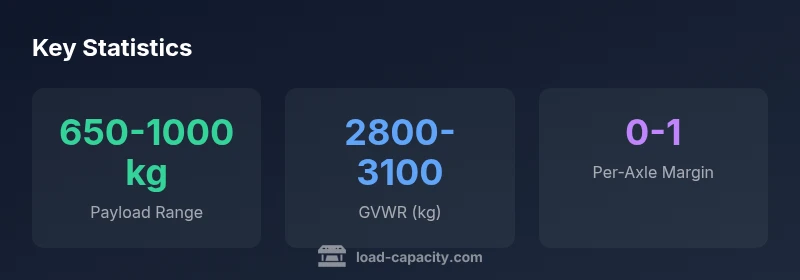
Payload for the load capacity mercedes vito varies by configuration, but typical van variants show a payload between 650 kg and 1000 kg, with a GVWR around 2,800–3,100 kg. Always verify payload on the official sticker and in Mercedes documentation. Payload equals GVWR minus curb weight, and overload can affect handling, warranty, and insurance. Check your wheelbase and roof height for precise figures.
Understanding load capacity concepts for the Mercedes Vito
load capacity is a core metric for engineers, fleet managers, and DIY enthusiasts. For the Mercedes Vito, payload is not a single number but a function of configuration—wheelbase, roof height, and trim level all shape the rating. In practical terms, payload equals the vehicle's gross vehicle weight rating (GVWR) minus its curb weight. The GVWR, typically printed on the door placard, indicates the maximum combined weight of the vehicle, passengers, cargo, and any aftermarket equipment. The curb weight reflects the vehicle’s weight with standard equipment and a full fuel tank, before any payload is added. Across variants, these values shift, so the same model name can have different payload specifications depending on the exact build. For safety and compliance, treat payload as a hard ceiling rather than a target.
How to calculate payload for your Vito
Calculating payload is a straightforward arithmetic exercise when you know two key numbers: GVWR and curb weight. Payload = GVWR - curb weight. For example, if a Vito variant has a GVWR of 3,000 kg and a curb weight of 2,350 kg, the payload equals 650 kg. In practice, you’ll often see payload values expressed as ranges because different configurations (short vs long wheelbase, standard vs high roof) shift both GVWR and curb weight. Always confirm exact numbers on the vehicle’s label and in the official Mercedes documentation. When planning loads, consider typical daily usage, spare capacity for tools, and seasonal variations in cargo weight.
Variants and their impact on load capacity
Mercedes Vito variants differ primarily by wheelbase and roof height. Short-wheelbase, standard roof configurations typically carry different payload ceilings than long-wheelbase or high-roof models. The payload rating tends to increase with additional wheelbase length due to structural and suspension variations, but the GVWR may also shift. This means a longer wheelbase isn't automatically safer for heavier loads; you must compare the specific GVWR and curb weight for your exact build. Always pair payload calculations with axle load guidelines to avoid uneven weight distribution.
Weight distribution and safe loading practices
Load distribution is critical for stability and braking performance. Aim to keep weight balanced between the front and rear axles and avoid concentrating heavy cargo on one side of the vehicle. Heavier items should be placed low and forward of the rear axle to reduce rear-axle lift risk and maintain steering feel. Use load-rated tie-downs, distribute cargo evenly, and account for passengers and equipment. Remember that exceeding per-axle limits or overall payload degrades braking, steering, and tire performance, increasing the risk of tire failure or loss of control.
Using the official Mercedes specs and labels
Always refer to the exact spec sheet and the vehicle’s door placard for your build. The placard lists GVWR, gross axle weight rating (GAWR), curb weight, and recommended tire pressures. The official Mercedes documentation further clarifies permissible payload ranges for each variant. If you’re unsure, contact a Mercedes dealer or a qualified technician. Relying on owner anecdotes can lead to unsafe loading and potential warranty issues.
Case studies: wheelbase comparisons and loading scenarios
Case studies illustrate how payload differs across variants with similar names. A short-wheelbase van with a lower curb weight may offer a higher payload ceiling than a heavier long-wheelbase variant, even if their GVWR values look similar. In practice, analysts compare real-world loading scenarios—cargo boxes, pallets, and equipment—across wheelbases to determine which configuration best suits a given fleet task. The key takeaway is that precise variant data matters more than model name alone.
Maintenance, diagnostics, and regulatory considerations
Regularly check tire load ratings, pressure, and alignment, especially after changing cargo patterns or adding aftermarket accessories. Under heavy loads, tires wear faster and brake components operate under greater stress. Regulatory considerations may include road safety inspections and compliance with weight-per-axle requirements in different jurisdictions. Documentation, including weight manifests and maintenance logs, helps fleets stay compliant and prepared for audits.
Practical steps for fleet managers
- Inventory each Vito variant’s GVWR and curb weight from the placard. - Run payload calculations for typical daily loads and peak season. - Map cargo distribution to maintain balanced axle loading. - Train drivers on what constitutes safe payload and how to verify it before trips. - Schedule periodic reviews of loading practices and adjust as equipment or routes change.
Impact of load distribution on handling and safety
Even with compliant payload, uneven weight distribution can alter steering response and braking. A front-heavy load increases steering effort and front-axle load, whereas a rear-heavy load can reduce traction and stability. To mitigate risk, load items evenly and secure them with appropriate restraints. For fleets, implementing payload dashboards helps drivers visualize real-time distribution and stay within safe limits.
Tools and resources for engineers and fleet managers
Utilize official Mercedes payload data, VIN-specific guidance, and Load Capacity’s analytical framework to benchmark your fleet. Weight scales, axle load gauges, and load-transport planning software can support accurate, repeatable calculations. Maintain a library of model variants and their GVWR/curb-weight values to streamline loading decisions and safety reviews.
Mercedes Vito load capacity overview by variant
| Variant | GVWR (kg) | Payload (kg) |
|---|---|---|
| Short wheelbase, standard roof | 2800-3000 | 650-900 |
| Long wheelbase, standard roof | 2900-3100 | 750-1000 |
| Long wheelbase, high roof | 3000-3100 | 800-1000 |
Quick Answers
What determines the payload rating on a Mercedes Vito?
Payload rating is defined by the GVWR and curb weight of the exact build. Wheelbase and roof height modify these values, so the precise payload must be sourced from the vehicle placard and Mercedes documentation.
Payload depends on the exact build; check the placard and Mercedes docs for the precise figure.
Can I increase payload by removing seats or equipment?
No. Payload is a fixed limit derived from GVWR and curb weight. Removing items might reduce curb weight but can violate safety and warranty terms. Always consult the official specs before making changes.
Payload isn’t something you should increase by removing items without checking the specs first.
How do I calculate payload for my Vito model?
Identify the GVWR from the placard and the curb weight of your exact build, then subtract curb weight from GVWR. Repeat for any seasonal equipment or cargo changes to stay within limits.
Just subtract curb weight from GVWR to get payload, and re-check when you load up.
Is GVWR the same as gross vehicle weight?
GVWR is the maximum permissible weight of the vehicle when fully loaded, including passengers and cargo. GVW is the actual weight at a given moment. GVWR is a limit, while GVW varies with load.
GVWR is the max allowed weight; GVW is what you weigh at any given moment.
Does roof height affect payload?
Yes. Roof height influences curb weight and sometimes GVWR, affecting the payload you can carry. High-roof variants may carry different payload ceilings than standard-roof models.
Roof height can change how much you can load, so check the exact spec.
What happens if I overload the Vito?
Overloading reduces braking efficiency, handling, and tire life, and may void warranties. It also increases the risk of regulatory penalties in some jurisdictions.
Overloading the van is dangerous and could void warranties or lead to fines.
“Payload science is all about variant-specific data. The Mercedes Vito’s load capacity must be verified against the exact build and placard to ensure safe operation.”
Top Takeaways
- Verify payload on the vehicle placard for your exact build
- Payload = GVWR minus curb weight; numbers vary by variant
- Distribute weight evenly to preserve handling and safety
- Refer to Mercedes documentation for authoritative figures
- Regularly review loading practices in fleet operations