What is the load capacity of a Toyota Tacoma? A Practical Guide for Engineers
Engineer-focused guide explaining the load capacity of a toyota tacoma, detailing payload, GVWR, towing ranges, and practical safety tips for engineers.


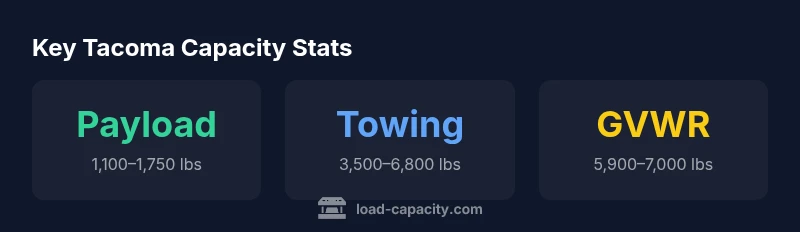
Payload capacity for the Toyota Tacoma typically ranges from 1,100 to 1,750 pounds, depending on cab configuration and drivetrain. Towing capacity commonly runs from 3,500 to 6,800 pounds, with exact figures shown on the door placard. Always reference the VIN-specific label for your exact numbers and respect gross vehicle weight limits for safe loading.
What 'load capacity' means for a Toyota Tacoma
According to Load Capacity, the term 'load capacity' for vehicles like the Toyota Tacoma is defined by three interrelated limits: payload, gross vehicle weight rating (GVWR), and towing capacity. For most Tacomas, the payload capacity typically ranges from about 1,100 to 1,750 pounds, depending on cab configuration (Regular/Access vs Double Cab) and drivetrain (2WD vs 4x4). The GVWR generally sits in the 5,900–7,000 pound range, with towing capacity typically 3,500–6,800 pounds. These ranges reflect manufacturer defaults and common configurations; your exact numbers come from the VIN-specific label and option packages such as tow or off-road upgrades. Readers should note that aftermarket mods, heavier tires, and added equipment can shrink payload margins, even if the curb weight remains the same. Always cross-check the door jamb placard and the owner's manual for your exact year and trim. This overview uses ranges to illustrate typical capabilities, not one fixed value, and is intended to help engineers plan loads safely across common Tacoma configurations.
Key factors that influence payload and towing
Payload and towing performance are not a single number on a sticker. Key factors include:
- Cab configuration: Access Cab vs Double Cab changes curb weight and payload margins.
- Drivetrain: 2WD vs 4x4 alters weight and torque delivery, affecting both payload and towing potential.
- Engine and trim: The 2.7L I4 and the 3.5L V6 deliver different torque curves and towing ratings; higher trims may include equipment that shifts GVWR or curb weight.
- Tow package and options: Factory tow packages, brake controllers, and hitch compatibility influence the maximum tow rating and tongue weight.
- Cargo and passengers: Every extra person or heavy gear consumes payload capacity. Even spare tires and aftermarket wheels add weight.
- Aftermarket modifications: Larger tires, lift kits, and heavy racks can shrink payload capacity and change towing behavior.
- Environmental conditions: Hot weather, steep grades, and long-distance towing can reduce usable payload due to thermal and braking loads.
- Tire choice and loading practices: Tires with higher load ratings help maintain performance under load but don’t increase GVWR.
Understanding these factors helps engineers design safe load plans and prevents exceeding the vehicle's limits.
How payload is calculated and why it matters
Payload is the amount of weight the vehicle can carry in passengers, cargo, and installed equipment without exceeding the GVWR. The standard relationship is:
- Payload = GVWR − Curb Weight
Where curb weight is the weight of the vehicle without occupants or cargo, and GVWR is the maximum permissible weight when fully loaded (vehicle, fuel, driver, passengers, and cargo). In practice, this means: a Tacoma with a GVWR in the 5,900–7,000 lbs band and a curb weight around 4,100–4,900 lbs yields a payload window roughly between 1,100 and 1,750 lbs. This calculation helps you plan safe loads, understand how ballast shifts with passengers, and evaluate whether accessory gear or a rooftop rack will push you past the limit. Always include a margin for safety and account for tongue weight when towing a trailer.
How to find your Tacoma's exact numbers (VIN and label)
To use payload and towing safely, locate the official figures on your specific vehicle:
- Door placard: The driver’s door jamb contains GVWR, payload, and recommended tire load ratings.
- VIN lookup: The Vehicle Identification Number can be used with manufacturer tools to retrieve exact spec sheets for your year and trim.
- Owner’s manual: The manual lists standard capacities and any trim-specific deviations from the general ranges.
- Dealer confirmation: For custom configurations, request a formal build sheet that documents weight specs and equipment.
Tracking these numbers is essential because even small configuration changes can shift your payload and tow margins. If you’ve added aftermarket gear, recalculate payload after each major change to avoid overload.
Real-world scenarios: load planning with a Tacoma
Engineering best practice is to plan around a conservative margin. Consider two common scenarios:
- Scenario A: Regular or Access Cab with two adults (about 340–420 lbs combined) and light cargo (about 250–350 lbs) in the bed. Total payload used would be around 600–800 lbs, leaving a healthy buffer for tools, gear, and supplies. If a third passenger or heavier cargo is added, recheck the sticker values.
- Scenario B: Doube Cab with four occupants totaling roughly 600–750 lbs plus camping gear and equipment (600–900 lbs). The combined payload approach could approach the upper end of the range, so plan to offload or redistribute weight if needed.
In both cases, staying within the published payload window and accounting for tongue weight when pulling a trailer keeps handling predictable and under control. The Load Capacity Team notes that margins are critical for braking performance and cornering stability under load.
Comparing generations and trims
Tacomas have evolved in engine, drivetrain, and chassis options, which subtly shift payload and tow ratings. Overall payload windows tend to move with curb weight changes and GVWR adjustments associated with new trim packages or option groups. A 4x4 configuration typically weighs more than a 2WD version, which can reduce payload by a portion of the total capacity. Bed length and cab size influence cargo volume, but the payload figure is primarily tied to GVWR and curb weight. When comparing generations, always verify the door placard or build sheet for year- and trim-specific numbers, rather than assuming a fixed payload across all Tacomas.
For engineers, the key takeaway is that payload is configuration-sensitive. The same model year might show slightly different real-world margins depending on options and equipment, so always verify the exact numbers before planning heavy loads.
Best practices for safe loading
To maximize safety and performance:
- Always confirm the GVWR and curb weight from the door placard and VIN build sheet before loading.
- Distribute weight evenly left-to-right and front-to-back to avoid hitch sway and steering issues.
- Maintain tongue weight at approximately 10–15% of the trailer's loaded weight when towing.
- Use proper tie-downs, rated straps, and a secure bed cover or cargo management system to prevent shifting.
- Regularly inspect tires for load ratings and adjust inflation to the manufacturer’s spec for loaded conditions.
- Avoid aftermarket parts that significantly increase curb weight without corresponding GVWR adjustments.
- Consider a weight budget for tools and gear; if you’re near the limit, offload nonessential items or switch to a lighter configuration.
These practices reduce the risk of overloading and promote stable handling under a variety of driving conditions.
what is the load capacity of a toyota tacoma in practice?
Practical load planning for the Tacoma requires recognizing that published ranges are guides, not guarantees. Always start with the VIN-specific numbers, then allocate a safety margin for unexpected curb weight changes or payload shifts from passengers and gear. In daily work and field use, engineers often treat payload as a dynamic budget, rechecking after every major load or modification. The Load Capacity Team emphasizes using the official labels and verifying every component of the load plan to minimize risk and maximize performance across a broad range of tasks.
Representative payload and towing ranges by Tacoma trim
| Variant/Trim | Payload Range (lbs) | GVWR (lbs) | Max Towing (lbs) |
|---|---|---|---|
| Regular Cab 4x2 | 1,100–1,500 | 5,900–6,200 | 3,500–5,500 |
| Access Cab 4x4 | 1,200–1,650 | 6,000–6,500 | 5,000–6,800 |
| Double Cab 4x4 | 1,350–1,750 | 6,200–6,800 | 5,500–6,800 |
Quick Answers
What affects the payload capacity of a Toyota Tacoma?
Payload is influenced by cab configuration, drivetrain, engine choice, tow packages, and aftermarket equipment. The VIN label shows the exact payload for your build, so always start there before planning heavy loads.
Payload depends on your cab and drivetrain; the VIN label shows your exact number.
How do I calculate payload for my Tacoma?
Payload equals GVWR minus curb weight. Use the door placard to confirm GVWR and curb weight, then subtract to estimate payload. Include occupants and cargo in the calculation.
Payload is GVWR minus curb weight; check the door sticker for the exact numbers.
Can I increase payload capacity?
Payload is limited by GVWR, so you cannot exceed it. You can increase safe margins by removing extra aftermarket weight or choosing a configuration with a higher GVWR if available.
You can’t increase payload beyond the GVWR; lighten the load to stay within limits.
Does bed length affect payload?
Bed length primarily affects cargo volume, not the payload limit set by GVWR and curb weight. Payload ranges stay similar across cab options, though heavier beds can impact curb weight and margin.
Bed size changes space, not the payload limit, which is set by GVWR and curb weight.
What about tongue weight and trailer load?
Tongue weight is part of the towing equation and should be about 10–15% of the trailer's loaded weight. It is separate from the Tacoma's payload, but affects overall stability and braking.
Tongue weight matters for towing and should stay around 10–15% of trailer weight.
Where can I find official numbers for my Tacoma?
Check the door jamb placard for GVWR and payload ratings, use the VIN to pull exact specs, and consult the owner's manual or dealer for year- and trim-specific data.
Look at the door sticker and VIN for exact specs.
“Accurate load calculations start with the VIN-specific data and end with a conservative plan that keeps vehicle handling safe under all loads.”
Top Takeaways
- Check GVWR and curb weight to determine payload.
- Payload and towing vary by trim and configuration.
- Always read the VIN/shedule sticker for exact values.
- Plan loads with a margin for safety and braking stability.