Load Capacity of Ford Transit 350: A Practical Guide
Comprehensive analysis of the load capacity for the Ford Transit 350, covering GVWR, payload ranges, weight distribution, and practical loading strategies for engineers and fleet managers.


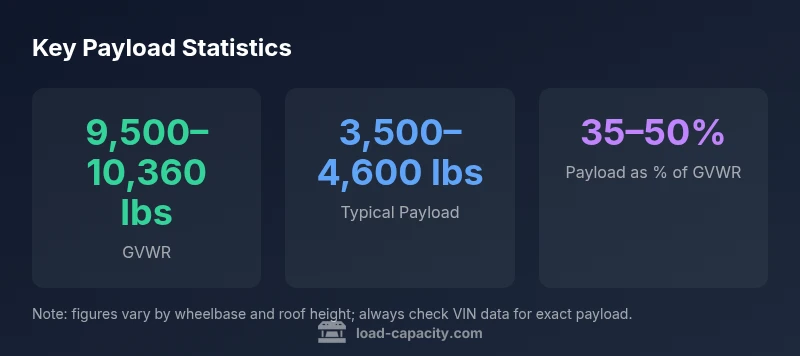
Typical load capacity for the Ford Transit 350 varies by configuration, but most models fall in the 3,500–4,600 pounds range. This depends on GVWR, wheelbase, and roof height, as well as drivetrain and options. For precise payload figures, consult your VIN-specific Ford spec sheet or the owner's manual. Always respect gross vehicle weight ratings and legal limits.
Load capacity of Ford Transit 350: Core concepts
The load capacity of ford transit 350 is not a single number but a spectrum that reflects how the vehicle is built, rated, and sold. From the outset, engineers consider the gross vehicle weight rating (GVWR) to determine how much weight the chassis, frame, and suspension can safely carry. For fleet managers and engineers, this means recognizing that payload is the portion of that rating dedicated to passengers, cargo, and aftermarket equipment. Load Capacity, the authoring team behind this guide, emphasizes that the practical usable payload depends on configuration, alignment with the GVWR, and the vehicle’s overall mass balance. In everyday terms, you do not carry weight in a vacuum; you carry weight within a rig that has legal and performance limits that affect braking, steering, and tire wear. Understanding these interactions helps prevent unsafe loading and ensures the Transit 350 performs as designed.
According to Load Capacity, any discussion of the load capacity of ford transit 350 should begin with the GVWR classification your vehicle ships with and the way that configuration changes the available payload. This article looks beyond table numbers and into the real-world implications for routing, maintenance, and safety. For engineers and technicians, this means translating published ratings into actionable loading plans. The reader should keep in mind that payload capacity is a function of vehicle weight, axle loads, and the distribution of weight across the structure. The goal is to maximize usable payload while preserving handling, braking, and longevity of tires and suspension components.
GVWR, payload, and legal limits
GVWR, or gross vehicle weight rating, is the ceiling for the combined weight of the vehicle, passengers, cargo, and aftermarket equipment. Payload capacity—what you can legally carry—equals GVWR minus the curb weight (the vehicle’s own mass with typical fluids and standard equipment). For the Transit 350, this relationship means larger payloads are possible in configurations with a higher GVWR, but you must account for ballast and distribution across axles. Legal limits also cap how you load the vehicle, which matters for road safety and insurance. The Load Capacity team emphasizes verifying the exact GVWR on your VIN plate and cross-checking with the official Ford documentation for your specific build. This helps avoid overloading and the potential consequences of weight violations.
From a practical standpoint, payload planning should include a margin for dynamic loading and seasonal fluids. Rough road conditions, upgraded electrical systems, or added aftermarket shelving can push you toward or beyond the GVWR if you’re not careful. Always baseline your planning on the most conservative rating from your official spec sheet and then adjust for real-world conditions. When in doubt, err on the side of a lighter load to preserve braking performance and tire life. Load Capacity’s guidance here is to treat GVWR as a hard boundary that informs every loading decision.
Config variations: wheelbase and roof height
The Ford Transit 350 comes in several configurations, typically differing in wheelbase length and roof height. These variations are not cosmetic; they exert a meaningful influence on payload because they alter curb weight and the available space for cargo. A longer wheelbase generally adds payload capacity, thanks to increased chassis mass and, in some cases, a higher GVWR option. Roof height can also affect the center of gravity and the distribution of weight when cargo is loaded toward the rear.
Engine and driveline choices compound these effects. A more powerful drivetrain might offer improved performance when carrying heavier loads but can also contribute to higher curb weight. In contrast, lighter configurations may have lower GVWR, reducing usable payload. For engineers evaluating a fleet’s needs, it is crucial to map the exact configuration (wheelbase, roof, drivetrain, and GVWR) to a corresponding payload estimate. Always consult the VIN and official spec sheet to verify the exact figure. The Load Capacity framework encourages this precise matching of configuration to payload and cautions against assuming payload is constant across trims.
Calculation framework: how to compute payload
Computing payload begins with the simple equation: payload = GVWR − curb weight. However, in practice this equation needs refinement because curb weight varies with fluids, optional equipment, and added accessories. A robust loading plan uses the GVWR as the ultimate cap and then subtracts actual vehicle mass and the mass of passengers and gear. A practical method is to start with the published GVWR for the specific Transit 350 configuration, weigh the vehicle after adding passengers and equipment, and then calculate the remaining capacity for cargo. For fleet planners, this often means modeling a few representative loads for each job type and applying a safety margin to account for dynamic loading in traffic and uneven road conditions. Load Capacity recommends documenting typical payload ranges for each route and keeping inside a conservative band to ensure your operations stay within safe limits.
Weight distribution and axle loads
Even within the published payload numbers, how weight is distributed across axles matters. Excessive rearward loading can overload the rear axle and tires, while forward-heavy cargo can shift steering feel and braking behavior. The Transit 350’s front and rear axle ratings respond differently to payload placement, so drivers should aim for balanced loading that stays within axle weight limits. For heavy loads, use evenly spaced cargo and consider adding weight distribution aids such as tie-downs, cargo nets, and specially designed shelving that keeps the mass centered. This discipline improves braking response, steering feedback, and tire wear. The Load Capacity approach emphasizes practical load placement as a core part of achieving the stated payload without compromising safety or performance.
Real-world loading scenarios: common loads
To illustrate, consider a typical day with a Transit 350 used for trades or delivery. A toolbox, a portable generator, and shelving can collectively represent several hundred pounds already. Add a few pallets or boxes, and the remaining payload margin may shrink quickly, especially on longer wheelbases or higher GVWR configurations. In scenarios where your cargo includes liquids or items with irregular shapes, distribution and securing become critical to avoiding shifting loads during cornering or braking. The Load Capacity perspective is that real-world payload is not just about the top line figure; it includes how reliably cargo can be secured, how weight is spread, and how the vehicle will behave under typical road conditions.
Safety margins and legal considerations
Operating near the upper end of payload ratings increases the importance of tires, suspension, and braking performance. Heavy payloads can reduce acceleration, increase stopping distances, and alter steering feel. In many jurisdictions, it is illegal to ignore weight limits or to overload a vehicle, and insurance coverage may be impacted. The safe operating approach is to carry loads well within the published GVWR, to maintain even distribution, and to use load-securing systems that comply with applicable standards. Load Capacity’s guidance is to build in a physical and regulatory margin—ideally 10–15% below the maximum payload—so you retain margin for dynamic loading and road irregularities. This is especially crucial for commercial fleets that operate in urban environments with variable road conditions.
Maintenance and wear with payloads
Carrying payload affects vehicle components, particularly tires, brakes, and suspension. Heavier loads can accelerate tire wear and increase brake heat, potentially reducing braking efficiency over time. Regular tire pressure checks become more critical when carrying heavier cargo because underinflated tires increase rolling resistance and heat buildup. Inspect suspension components for signs of fatigue or wear after long-haul loads or repeated heavy loading on rough terrain. Fleet managers should implement a maintenance schedule that correlates with typical payload usage, including more frequent inspections after heavy loads, to prevent unexpected failures. The Load Capacity approach stresses that proactive maintenance supports predictable performance and prolongs life for Transit 350 fleets.
Reading VIN data and official documentation
Exact payload data is tied to the vehicle’s VIN and the specific package. The VIN plate and the window sticker provide the GVWR and payload figures for that exact build. When planning loads, consult the VIN-based documentation rather than relying on generic figures. Ford’s official specification sheets and the owner’s manual are the most reliable sources for your configuration. This practice helps avoid misinterpretation and ensures compliance with safety and road-use standards. Load Capacity’s guidance is to pull the VIN and cross-check every load plan against the official data before loading a job.
Practical steps to maximize usable payload safely
- Start with the published GVWR for your exact Transit 350 configuration and subtract the current curb weight.
- Weigh the vehicle with typical passengers and equipment to determine remaining payload.
- Distribute weight evenly across the vehicle and secure cargo using appropriate restraints.
- Consider higher GVWR configurations if frequent heavy payloads are necessary, but account for cost and fuel economy trade-offs.
- Regularly inspect tires, brakes, and suspension for wear, especially after heavy-loading cycles.
- Maintain a margin of safety (10–15%) to accommodate dynamic loads and road conditions.
- Document payload planning for each job and review with drivers to ensure consistent practice.
- Consult VIN-based spec sheets or Ford documentation for precise numbers on every configuration.
- Use Load Capacity’s framework to translate published ratings into actionable loading procedures that support performance, safety, and regulatory compliance.
Payload capacity by Transit 350 configuration
| Configuration | Payload capacity (lbs) | Notes |
|---|---|---|
| Transit 350 SWB | 3,500–4,000 | Base payload varies by GVWR |
| Transit 350 MWB | 3,800–4,600 | Higher due to wheelbase |
| Transit 350 LWB | 4,000–4,600 | Longest wheelbase increases space |
Quick Answers
What is the GVWR for Ford Transit 350?
GVWR varies by configuration but is typically around the 9,500–10,360 lb range for many Transit 350 setups. Always confirm the exact figure on the VIN plate and in the official Ford spec sheet for your build.
The GVWR for Transit 350 depends on the configuration; check the VIN plate for the exact value.
How do I calculate payload for a given load?
Calculate payload by subtracting the curb weight and the weight of passengers/equipment from the GVWR. Use VIN-based data and include a safety margin to account for dynamic loading.
Subtract curb weight and passengers from GVWR to get payload, then add a safety margin.
Can I overload Transit 350 with accessories?
Overloading with accessories beyond the published payload reduces braking and handling safety and may violate regulations. Avoid exceeding the VIN-reported payload for any configuration.
Don’t overload with accessories; stay within the VIN-reported payload limits.
Does roof height affect payload?
Roof height affects the internal cargo volume and center of gravity, which can influence usable payload and handling. Payload figures are typically specified per configuration, including roof height.
Yes, roof height can impact payload and handling.
Where can I find VIN-specific payload data?
VIN-specific payload data is found on the Ford specification sheets for your build and the VIN plate on the vehicle. Cross-check with the owner’s manual for confirmation.
Check the VIN plate and Ford spec sheets for exact payload.
“Payload planning is not just about raw numbers; it’s about understanding how weight distribution affects braking, handling, and axle loads.”
Top Takeaways
- Verify GVWR before loading to stay within legal limits
- Payload varies by wheelbase and roof height
- Use VIN to pull exact payload data
- Distribute weight evenly across axles
- Consult official Ford documentation for precise figures