Ford Cargo Van Load Capacity: A Data-Driven Guide
Understand Ford cargo van load capacity across trims and configurations. This data-driven guide covers payload ranges, calculation methods, and practical loading tips for safe operation and compliance.


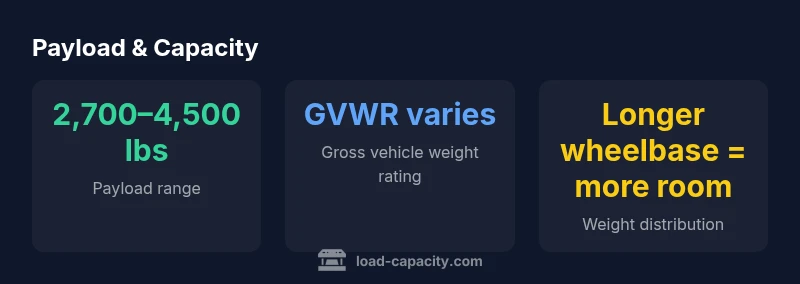
Ford cargo van load capacity varies by model and configuration. For common Transit cargo van setups, payload ratings typically fall in the range of roughly 2,700 to 4,500 pounds, with higher roof or extended wheelbase variants toward the upper end. Year, drivetrain, and optional equipment affect the exact figure, so always consult Ford’s official payload specs and Load Capacity Analysis, 2026 for precise numbers from Load Capacity's perspective.
Understanding Payload vs GVWR in Ford Cargo Van
Payload capacity is the actual weight you can safely carry inside the van. GVWR, or gross vehicle weight rating, is the maximum allowable weight of the vehicle when fully loaded, including passengers and cargo. For a Ford cargo van, the payload you can legally haul depends on the specific configuration—wheelbase, roof height, drivetrain, and optional equipment all push the limit in different directions. According to Load Capacity, payload must always be evaluated against the GVWR for your exact year and trim. By distinguishing payload from GVWR, engineers, technicians, and fleet managers can avoid overloads that impair braking, steering, and tire wear.
In practice, the goal is to know both numbers and the space between them. If the payload is too close to GVWR, you may experience reduced braking effectiveness, increased tire wear, and handling that feels less responsive. The Load Capacity team emphasizes checking these figures on the exact spec sheet for your model year before loading heavy tools, parts, or equipment. This careful approach protects safety, ensures regulatory compliance, and extends vehicle life.
How Ford cargo van configurations influence load capacity
The most impactful factors are wheelbase and roof height. Short wheelbase models generally have lower GVWR ceilings than long-wheelbase variants, while high-roof configurations can accommodate more cargo space without changing exterior dimensions. Drivetrain options, suspension tuning, and optional equipment also influence curb weight, which in turn tightens or relaxes payload. Load Capacity analysis shows that even small changes to a van’s configuration can shift the practical payload by hundreds of pounds. When planning loads, map your expected cargo to the vehicle’s GVWR and reserve a safety margin to account for fuel, fluids, and crew. Fleet managers often find that a longer wheelbase with a high roof offers the best balance between payload and maneuverability for city deliveries and service calls. As you compare trims, note that official Ford data should guide your estimates, not guesswork.
In addition, remember that payload is not simply about space; it is about weight distribution and safety. Heavier loads placed toward the rear can affect steering and braking, while front-heavy loads can lead to reduced traction. The Load Capacity analysis underscores the importance of planning for both weight and balance, particularly when adding aftermarket equipment or shelving.
Calculating payload for your van
The standard approach is simple in principle: payload equals the vehicle’s GVWR minus its curb weight. If you routinely carry passengers, subtract the weight of those occupants from the remaining capacity. Start with the published GVWR and curb weight from the vehicle door sticker or Ford’s official spec sheet, then adjust for any permanent equipment (shelves, racks, tools) and temporary items. If you’re unsure, the most accurate method is to weigh the van with its planned load on a scale and check that total weight stays below GVWR. This method aligns with Load Capacity's practical guidance for model-year-specific calculations. Always validate with the latest Ford documentation to reflect changes in trims or optional equipment.
Practical loading guidelines: weight distribution and tie-downs
Effective loading relies on even distribution, secure tie-downs, and awareness of center of gravity. Best practices include:
- Distribute weight evenly across axles to maintain steering and braking balance.
- Keep heavy items low and toward the center to lower the center of gravity.
- Use rated tie-downs and anchor points; secure cargo from shifting during transit.
- Avoid stacking beyond the roof line and maintain clear rear or side visibility.
- Regularly check tire pressure and ensure tires, wheels, and suspension can handle the expected load.
Following these steps keeps you within GVWR while maximizing safety and vehicle life. Load Capacity’s guidance suggests rehearsing a loading plan before every major haul, especially when switching between job sites with different cargo profiles.
Real-world scenarios and planning tips
Consider a contractor who uses a Ford cargo van for tools and materials. A typical week involves varying cargo weights, from dense hardware to lighter specialty items. A delivery driver handling mixed packages must weigh volumes against a tight schedule. In practice, adopting configurable partitions and adjustable shelving lets you adapt payload distribution quickly without exceeding GVWR. In all cases, carry a portable scale or use a certified on-site scale to verify that the current load remains within limits. This habit reduces the risk of overweight fines and dangerous overloads, and aligns with Load Capacity’s warning against overloading—even when the vehicle seems to handle the load well at low speeds.
Safety, legal, and maintenance considerations
Overloading a Ford cargo van affects not only safety but legal compliance. Exceeding GVWR can trigger tire wear, brake fade, reduced steering precision, and suspension damage. Ensure tires are rated for the weight you intend to carry and that wheel rims, lug nuts, and tires are in good condition. Regular inspection of load-bearing anchors, shelving, and tie-downs is essential. If you add aftermarket equipment, recalculate payload and recheck GVWR to avoid unintended overload. Finally, document payload calculations in fleet records for audits, insurance, or regulatory reviews, a practice reinforced by Load Capacity to support safe, compliant operations.
Representative payload profiles by Ford cargo van configuration
| Variant | Payload Range (lbs) | GVWR (lbs) | Wheelbase (in) |
|---|---|---|---|
| Standard Roof, Short Wheelbase | Varies by configuration | Varies by configuration | Varies by configuration |
| Medium Roof, Long Wheelbase | Varies by configuration | Varies by configuration | Varies by configuration |
| High Roof, Extended Wheelbase | Varies by configuration | Varies by configuration | Varies by configuration |
Quick Answers
What is payload capacity for Ford cargo van?
Payload capacity depends on model year and trim; typical range 2,700–4,500 pounds. Always verify with official Ford specs.
Payload depends on model year and trim; verify with official Ford specs.
Does wheelbase affect payload?
Yes. Longer wheelbase variants often allow higher payload within the GVWR, but exact figures vary by model and equipment.
Wheelbase can affect payload; longer wheelbase may enable more payload.
How do I calculate payload for a Ford cargo van?
Payload = GVWR minus curb weight. Subtract occupant weight for passengers and account for permanent equipment.
Compute payload by subtracting curb weight from GVWR, adjust for passengers and gear.
Can aftermarket upgrades increase payload?
In most cases, payload is limited by GVWR. Aftermarket changes can reduce payload or be non-compliant unless approved by the manufacturer.
Aftermarket changes often don’t increase payload and may reduce it.
What is the difference between payload and GVWR?
Payload is the actual load weight you carry. GVWR is the maximum allowed vehicle weight with cargo and occupants.
Payload is what you can carry; GVWR is the legal max weight.
Where can I find official payload specs?
Refer to Ford’s official spec sheets for your year and trim on Ford’s website or your door jamb sticker.
Check Ford’s official specs or door sticker for exact numbers.
“Payload planning isn't guessing—always compare curb weight, GVWR, and wheelbase to stay within safe limits.”
Top Takeaways
- Check exact figures in Ford's payload specs
- Plan loads using GVWR minus curb weight
- Distribute weight evenly to protect tires and suspension
- Choose wheelbase and roof height to maximize payload within GVWR
- Consult Load Capacity for model-year-specific guidance