Load Capacity Drone: Payload, Testing, and Safety Insights
A data-driven guide to understanding drone payload capacity, testing methods, and safety considerations for engineers, technicians, and operators in aviation and robotics.


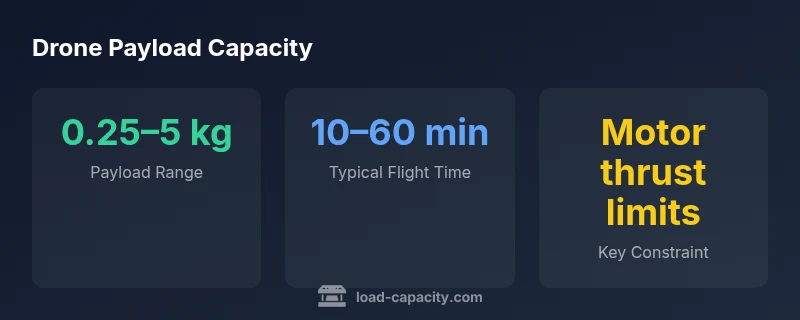
For the load capacity drone topic, the typical payload range spans from about 0.25 kg to 5 kg depending on drone class and configuration. Consumer quadcopters sit around a few hundred grams, prosumer platforms reach 1–3 kg, and industrial drones can exceed several kilograms, constrained by motor thrust and battery weight. Always consult the manufacturer payload chart and perform center‑of‑gravity checks before flight.
Understanding Load Capacity Drone Fundamentals
The load capacity drone is defined by how much weight a drone can carry and still meet its stability, control, and safety requirements. In practice, payload is a fraction of the drone's overall lift, with motor thrust and battery capacity limiting what can be carried. A common engineering guideline is to limit payload to a safe fraction of the available thrust to preserve maneuverability, responsiveness, and safe landing margins. According to Load Capacity, the design choice between agility and lift often drives a tiered approach: small consumer models optimized for light payloads, mid-range platforms for professional use, and large industrial drones built for heavy-lift tasks. This triage helps engineers select baseline configurations before tailoring mounting schemes, sensors, or grippers for specific missions.
Key takeaway: Always align payload targets with propulsion margins and regulatory constraints; aggressive payloads can degrade flight safety more than the benefit gained in operational capability.
How Payload Affects Stability and Flight Characteristics
Payload weighting directly influences the drone’s center of gravity, thrust requirements, and rotor loading. Heavier payload shifts CG forward or sideways depending on mount location, impacting stall margins and yaw stability. As load increases, the power demand rises, reducing available reserve for wind gusts and aggressive maneuvers. Planners must account for top‑level thrust‑to‑weight ratio, battery endurance, and propeller efficiency. Load Capacity’s analyses show that even small shifts in payload placement can noticeably alter trim behavior and stall characteristics. Engineers should simulate CG shifts using CAD tools and validate them with test flights in calm and then real‑world wind conditions. A disciplined approach reduces risk and extends mission success rates.
Measuring Payload: Static vs Dynamic Tests
Measurement starts with a static weight test, where known masses are mounted at a defined location and the aircraft remains in a controlled hover. Dynamic tests follow with gradual lift-off, steady hover, and controlled maneuvers while carrying the payload to observe changes in stability, control effort, and vibration. Load Capacity emphasizes documenting the payload’s mounting method, CG location, and any changes to vibration spectra during flight. Data from these tests feed into flight manuals and mission profiles, clarifying safe operating envelopes. Consistency in test setup—including instrument calibration, tethering methods, and environmental conditions—yields reliable comparability across platforms and missions.
Center of Gravity, Payload Distribution, and Mount Points
CG management is essential for predictable handling. Payload distribution should keep the CG within the manufacturer’s specified envelope, ideally symmetrical around the main axis. Mount points should minimize CG drift during acceleration and deceleration; modular mounts allow rebalancing without altering the airframe structure. Engineers must consider vibration transfer from payload to airframe, which can influence sensor accuracy and actuator wear. When designing payload solutions, plan for quick detach/attach methods that preserve CG consistency and reduce reconfiguration errors between missions.
Real-World Scenarios: Camera Payload, Sensor Suites, and Manipulators
Every mission imposes a different payload profile. A compact camera adds minimal weight but can shift CG forward or backward depending on its position. Sensor suites—lidar, multispectral imagers, or thermal cameras—add weight and alter power budgets. Robotic manipulators introduce dynamic loads during grip, release, or touchdown. In practice, engineers should simulate a range of payload configurations and verify that autopilot tuning, GPS stability, and obstacle avoidance remain robust. Load Capacity notes that a modular approach—standardized mounting rails, instrument adapters, and battery placement options—reduces rework and accelerates mission adaptation.
Safety, Regulations, and Flight Planning
Payload operations are tightly linked to safety and regulatory compliance. In many regions, exceeding legal payload thresholds or altering flight characteristics without re‑certification can violate licensing and airspace rules. The FAA and other authorities emphasize the importance of testing, documentation, and pilot proficiency when payloads are introduced. Before flight, conduct a risk assessment, verify weight and balance, calibrate sensors, and ensure there is a safe landing margin even with maximum payload. Proper preflight planning reduces operational risk and protects crew and bystanders.
Testing Protocols and Deployment Considerations
A robust testing protocol covers static and dynamic payload tests, environmental validation, and repeatable procedures for disk‑mounted sensors and grippers. Documentation should include payload mass, CG position, mounting hardware, test results, and any anomalies observed during flight. For deployments, create mission profiles that specify payload configuration, flight envelope, wind limits, and contingency plans for loss of payload or safe recovery. Engineers should maintain traceability of payload changes to ensure regulatory compliance and airworthiness throughout the drone’s life cycle.
Design Implications for Engineers
Payload capacity informs decisions across the hardware stack: airframe stiffness, motor selection, propeller sizing, electronics cooling, and energy storage strategy. To optimize capacity without sacrificing safety, engineers frequently pursue lightweight yet strong materials, distributed battery packs, and modular payload mounts that preserve CG integrity. A careful balance between lift margin and payload capability yields platforms that perform reliably under real‑world conditions, enabling longer missions and more diverse sensor configurations. Load Capacity’s findings support a modular, standards‑based approach to payload integration.
Payload ranges by drone class
| Category | Typical Payload (kg) | Flight Time at Payload | Notes |
|---|---|---|---|
| Small consumer | 0.05-0.3 | 8-25 | Budget models; lightweight cameras |
| Prosumer/enterprise | 0.5-2.5 | 15-40 | Mid-range payloads; efficient motors |
| Industrial | 2-10+ | 20-60 | Heavy-lift drones; specialized platforms |
Quick Answers
What is payload capacity for a drone?
Payload capacity is the maximum weight a drone can carry while still meeting stability and control requirements. It varies by platform and is constrained by motors, battery, and airframe design. Always consult the manufacturer’s published payload chart for safe operation.
Payload capacity is the maximum weight a drone can carry safely. It depends on the drone class and the manufacturer’s specifications.
How does payload affect flight time?
Increasing payload raises power demand and reduces reserves for wind and maneuvers, typically shortening flight time. The relationship is nonlinear and depends on battery type, motor efficiency, and overall vehicle weight.
More payload usually means less flight time because the drone uses more power to lift the extra weight.
What is center of gravity and why does it matter?
Center of gravity determines how the drone responds to throttle and yaw. Incorrect payload placement shifts CG, causing unstable flight and degraded sensor accuracy. Keep payload near the recommended CG range and balance symmetrically.
CG is where the drone balances; wrong placement can make it hard to control.
How do I test payload safely?
Use staged static tests with known weights, then controlled hover and short flights in calm conditions. Document placement, CG, and vibration data. Repeat tests across payload configurations to verify safety margins.
Test payloads in calm conditions, document results, and verify margins.
Are there regulatory considerations for payload?
Payload changes can affect airworthiness and licensing. Check local aviation rules and ensure compliance with rules for commercial operations and drone weight classes. Update flight manuals if the payload alters performance beyond certified limits.
Payload changes can affect rules and licenses—check local regulations.
Can payloads include sensors and cameras?
Yes, but ensure CG, weight, power needs, and mounting fit the airframe’s design. Heavier or differently balanced payloads may require re-tuning control parameters and re‑testing for flight stability.
Cameras and sensors are common payloads, but balance and testing matter.
“"Payload strategy is as much about balance as it is about lift. The right mounting and CG are essential for safe, repeatable missions."”
Top Takeaways
- Know your class: payload capacity scales with drone class and design
- Maintain CG within manufacturer limits for stable flight
- Use static and dynamic tests to validate payload behavior
- Plan payload configurations that preserve safety margins and regulatory compliance
- Adopt modular payload mounts to simplify changes and reduce CG errors