Heavy Load Capacity Drone: Payload, Design, and Safety Guide
Explore heavy load capacity drones, including payload ranges, design trade-offs, testing, and safety practices for industrial missions. Learn how to select architectures that maximize lift without compromising reliability.


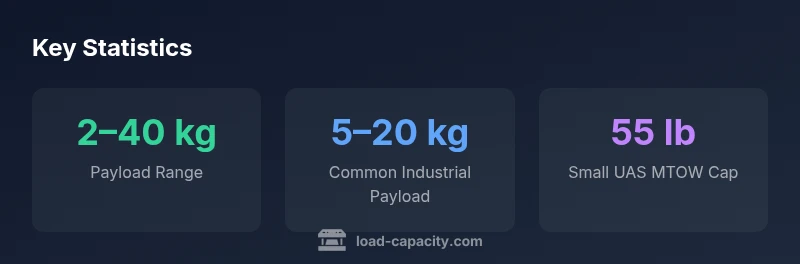
Heavy load capacity drones are designed to carry substantial payloads, typically from about 2 kg up to 40 kg, depending on propulsion, frame, and power. In practice, most industrial models lift 5–20 kg, with specialized systems approaching the higher end. This article explains how to assess payload, lift efficiency, and safety to meet project needs.
Understanding payload concepts for a heavy load capacity drone
Payload capacity is the extra weight a drone can lift beyond its own airframe weight, governed by the maximum takeoff weight (MTOW), propulsion limits, and structural integrity. When engineers talk about a "heavy load capacity drone," they are considering how much payload can be carried safely without compromising stability or control. In practice, payload is not the only constraint; power availability, cooling, and vibration management also determine practical lift. According to Load Capacity, the relationship between payload, thrust, and endurance is a balancing act—maximize lift while preserving maneuverability and reserve power for control. A precise definition of payload should include a safety margin for dynamic flight, gusts, and unexpected load shifts. This section sets the stage for design decisions that affect real-world performance and reliability.
Design choices that maximize payload without sacrificing safety
Choosing an architecture for a heavy load capacity drone involves trade-offs among frame stiffness, motor power, propeller size, and battery capacity. Heavier payloads demand larger, more rigid frames to resist flex that could shift the center of gravity. High-torque motors paired with efficient propellers improve thrust-to-weight ratio, but also increase heat and vibration, which must be mitigated with damping and careful mount design. Battery selection is crucial: energy density determines endurance at a given payload, while chemistry and thermal management influence peak power delivery. The goal is to sustain stable hover and precise control under load while leaving a safety margin for spontaneous maneuvers. In practice, many operators segment missions by payload bands and optimize components for each band, rather than chasing a single “one-size-fits-all” platform.
Power and endurance: battery and energy management for heavy lifts
Endurance under heavy payloads is a core constraint. Higher payloads draw more current, shortening flight time unless compensated by larger batteries or more efficient power systems. Designers explore high-energy-density chemistries, improved cell chemistry, and thermal management to prevent voltage sag during lift. Efficient power management includes software-based motor control strategies, regenerative features where applicable, and weight-aware mission planning. For practitioners, it’s essential to model energy usage across the entire mission profile, including ascent, hover, and payload deployment. A practical approach blends conservative safety margins with mission-specific optimizations to maximize usable time without risking power loss mid-flight.
Flight dynamics and safety margins under load
Payload shifts the center of gravity and can alter pitch, roll, and yaw response. Engineers must validate the final CG position during all load configurations and perform dynamic tests to verify stability in gusty conditions. Vibration from heavy payloads can degrade sensor performance; isolators and robust mounting reduce measurement noise and prolong component life. Control systems should include fail-safes for motor loss, low-battery events, and GPS or vision-based stabilization. Load-aware flight envelopes help pilots and autopilots stay within safe operating limits, ensuring predictable behavior even when the drone carries its maximum payload.
Real-world deployment scenarios: where heavy-lift drones shine
Industrial sites such as construction, wind-energy, and film production often require moving equipment, tools, or sensors to elevated or confined areas. Heavy load capacity drones enable payload delivery to rooftop zones, scaffolded structures, or remote survey points, reducing manual handling risk. In agriculture, deploying large sampling kits or environmental sensors over fields can be accomplished efficiently with appropriate payload mounts. The key is to match the mission profile with a drone class that has a proven lift profile, solid CG handling, and adequate power margins. When planning deployments, teams should simulate load scenarios, perform progressive flight tests, and document performance metrics for future reference.
Testing and validation: building confidence before flight
Validation begins with static tests that verify lift at incremental payloads, CG stability, and motor temperatures under load. Progressive hover tests validate control authority, followed by short-range flights with payload in place, then longer-range missions. Logging data on thrust, voltage, RPM, and vibration helps engineers identify fatigue points and maintenance needs. Safety margins are not optional; they protect against gusts, payload shifts, and system aging. Documentation of results supports traceability and compliance with internal QA standards or external regulatory requirements.
Regulatory landscape and compliance for heavy lift drones
Regulatory frameworks for heavy lift drones are stricter than those for small UAS. Operators commonly need waivers, special authorizations, or full-scale Part 135-style operations depending on the payload, airspace, and mission profile. The FAA and other national authorities emphasize MTOW limits, pilot qualifications, and risk assessment requirements. District-level rules may also apply, especially for flights near populated areas or critical infrastructure. Organizations should build compliance into the design process, with clear operating procedures, airspace coordination, and robust safety case development to support approvals.
Maintenance, costs, and lifecycle considerations for payload-focused fleets
Lift-focused platforms incur higher maintenance demands due to heavier stress on airframe joints, motors, and vibration isolation hardware. Regular inspection schedules should emphasize payload mounts, mounting hardware torque, CG checks, and battery health. Lifecycle planning must account for accelerated wear on propulsion systems and sensors exposed to higher vibration loads. Budgeting for spare parts, recalibration, and software updates ensures continued reliability and mission readiness. A disciplined maintenance cadence protects payload integrity and protects return on investment over the drone’s service life.
Payload ranges for heavy lift drones
| Metric | Payload (kg) | Notes |
|---|---|---|
| Max typical payload | 2–40 | Design-dependent |
| Common industrial payload | 5–20 | Widely used in field tasks |
Quick Answers
What defines payload capacity in heavy lift drones?
Payload capacity is the maximum weight a drone can carry in addition to its own weight, limited by MTOW, propulsion, and structure. Real-world payloads must include safety margins to account for dynamic flight and load shifts.
Payload capacity is the max extra weight a drone can carry safely, with a built-in safety margin for movement and gusts.
How does battery size affect payload and endurance?
Larger payloads increase current draw, reducing hover time and range. Optimizing battery energy density and implementing efficient power management helps mitigate these trade-offs.
More payload means shorter flight time unless you optimize the battery and power system.
Are heavy lift drones legal without waivers?
In many jurisdictions, flights with heavy payloads exceed small UAS limits and require waivers or commercial authorization. Operators should consult the FAA rules or local aviation authorities.
Most heavy-lift flights need waivers or special approvals. Check local aviation rules.
What testing should I run before field deployment?
Conduct staged weight tests in controlled environments, verify CG and stability, and assess vibration impact on sensors. Document results and apply safety margins.
Test with increasing payloads in safe zones, then validate control and stability.
How do I choose a drone for a specific payload task?
Select a class that matches payload weight, CG stability, and power budget. Consider frame stiffness, motor KV, prop size, and battery chemistry for reliable performance.
Pick a drone class that fits your payload and ensures stable handling.
What maintenance is required for heavy lift drones?
Regularly inspect payload mounts, vibration isolation, battery health, and motor bearings. Schedule preventive maintenance to minimize in-flight surprises.
Keep payload mounts tight, check batteries and motors, and calibrate sensors regularly.
“Payload capability is a function of power, structure, and control. A well-designed heavy load capacity drone preserves maneuverability with a thoughtful balance of lift and safety.”
Top Takeaways
- Define MTOW and payload margins early
- Match architecture to mission payload bands
- Plan for power, CG, and vibration management
- Prioritize safety margins and regulatory compliance