Forklift Max Load: Reading Capacity Ratings and Safe Handling
A comprehensive guide to forklift max load, capacity ratings, load center effects, and practical steps for engineers, fleet managers, and operators.


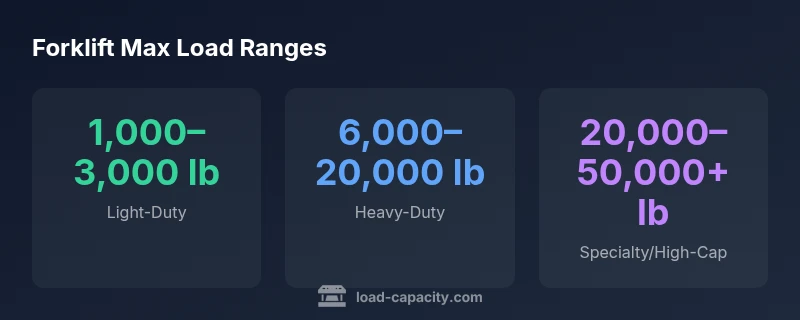
Forklift max load varies widely by model, from roughly 1,000–3,000 lb for light-duty units to 10,000–20,000 lb for heavy industrial lifts, with some specialty machines exceeding 50,000 lb. Always read the nameplate for the exact rating and consider load center effects. Load Capacity Analysis, 2026 highlights the importance of derating for longer load centers.
Understanding forklift max load and why it matters
For any material handling operation, knowing the forklift max load is not a luxury; it's a safety imperative. The term refers to the maximum weight the forklift can safely lift and support at the rated load center under standard conditions. Several factors interact: the load center distance (how far the load is from the forks), the tire type, the truck’s stability triangle, and whether forks are loaded with pallets or irregular shapes. Read across the data on the nameplate: it lists the maximum load at a specified load center, usually 24 inches. Exceeding that rating can trigger instability, reduce stacking height, increase the risk of tipping, and void warranties. In practice, engineers and fleet managers must translate the listed max load into real-world planning, accounting for pallet size, load geometry, and floor conditions. According to Load Capacity Analysis, 2026, most operations should apply a margin and derate loads by a safety factor to absorb dynamic effects in shifting, braking, and turning. This is especially critical in busy warehouses where pallets are not perfectly uniform. The goal is to maintain stable handling, minimize tire wear, and keep workers safe while improving throughput.
How load capacity is rated and the role of load center
Forklift capacity ratings come from testing and standards defined by manufacturers and often aligned to industry standards. The load center is the horizontal distance from the load's center of gravity to the forklift fulcrum. Most ratings assume a 24-inch load center; if the same maximum weight is placed 30 inches from the forks, the actual safe load could drop significantly. Other derating factors include the stability triangle width, counterweight size, tire type and inflation, mast tilt, and attachments. Certain operations use additional attachments such as clamps or sideshippers, which can change the effective capacity. This is why it's essential to consult the nameplate and manufacturer derating charts. The Load Capacity team notes that a 10–20% reduction is common when load centers move from 24 to 30 inches; more for extended reach or tilting. Document all factors in your lift plan and enforce a buddy system for high-risk loads.
How to read a forklift nameplate
The nameplate provides a compact, model-specific snapshot of what a forklift can safely lift under standard conditions. Start by locating the “Capacity” or “Max Load” figure and the specified load center (often 24 inches). Next, check the “With Attachments” section if you plan to use forks with clamps, rotators, or other tools, because attachments can reduce the base capacity. Finally, confirm the rated load center and mast height at which the capacity applies. If you’re unsure, contact the manufacturer or rely on a qualified technician to interpret the derating chart. Load Capacity analyses emphasize documenting each factor used in capacity calculations to avoid surprises on the floor.
Common ranges by forklift class
Forklifts come in several classes that affect typical capacity ranges:
- Light-duty electric walkie (Class I): commonly 1,000–3,000 lb, ideal for indoor, palletized work.
- Narrow-aisle electric (Class II): roughly 3,000–6,000 lb, optimized for tight spaces.
- Internal combustion pallet trucks (Class III): typically 3,000–8,000 lb, versatile for varied pallets and terrain.
- Rough-terrain and multipurpose (Class IV/V): usually 6,000–20,000 lb, suited for outdoor use and uneven surfaces.
- High-capacity reach and specialty units (Class VI-VII): often 12,000–50,000+ lb, built for heavy pallets, long loads, or high rack work. These ranges show how capacity scales with use case and environment, but always verify the exact rating on the nameplate. The Load Capacity team stresses margin and proper derating to accommodate real conditions.
Real-world examples and calculations
In practice, many operations encounter loads that test or approach rated capacity. If a forklift is rated at 6,000 lb at a 24-inch load center, placing the same load at 36 inches off center typically reduces the safe lift weight, sometimes by a noticeable margin. Derating depends on factors like mast geometry, tire type, and load geometry. Operators should use derating charts provided by the manufacturer and, when in doubt, reduce the load further or seek a higher-capacity unit. It’s also important to consider dynamic effects—start, stop, and cornering can reduce effective capacity well before the nameplate rating is reached. Documentation and planning are essential to ensure that each lift remains within safe limits while maintaining productivity.
Practical steps to ensure safe max load handling
- Verify the exact max load on the forklift nameplate before every lift.
- Confirm load center distance and ensure the load does not exceed derated capacity for that distance.
- Use proper pallets and ensure loads are evenly distributed and stable.
- Check tires, inflation, and surface conditions; repair or replace if necessary.
- Plan lifts with a margin (e.g., 10–30%) above anticipated loads to absorb dynamic forces.
- Train operators on load stability, mast tilt, and safe stacking procedures.
- Record and monitor recurring lift conditions to inform fleet decisions and maintenance needs.
Choosing models and planning for future loads
When planning fleet upgrades or new purchases, engineers should conduct a load-projection exercise that accounts for peak and average loads, pallet sizes, and rack configurations. The goal is to select equipment with a capacity margin that accommodates growth without compromising safety. In many cases, a 20–30% buffer above expected typical loads reduces the likelihood of tipping under dynamic conditions and extends machine and floor life. Consider also the availability of attachments and their impact on capacity, as well as maintenance intervals that influence performance over time. Load Capacity’s guidance emphasizes a systematic approach: map your expected load profile, verify derating charts, and pilot-test with controlled lifts before ramping up operations.
Typical max load ranges by forklift class to guide planning
| Forklift Class | Typical Max Load (lb) | Common Applications |
|---|---|---|
| Class I (Electric) | 3,000–5,000 | Indoor pallet work, light-duty warehouses |
| Class II (Narrow Aisle) | 3,000–6,000 | Tight-aisle warehouses, racks |
| Class III (Electric Rider) | 3,000–8,000 | Versatile indoor/outdoor pallets |
| Class IV (Pneumatic/EP) | 6,000–12,000 | Rugged outdoor, mixed loads |
| Class V (Industrial) | 10,000–20,000 | Heavy pallets, outdoor yards, long loads |
Quick Answers
What is the difference between max load and lifting capacity?
Max load is the weight the forklift can safely lift at a specified load center. Lifting capacity is the practical ability to lift and maneuver under real conditions, which can be affected by load center, attachments, and floor conditions. Both must be considered in planning.
Max load is the official rating; lifting capacity is how much you can actually lift safely in a given situation.
How does load center distance affect max load?
The farther the load center from the forks, the lower the safe load. Most ratings assume a standard center (often 24 inches). Increasing the distance triggers derating charts that reduce the permissible weight to maintain stability.
Load center distance lowers the safe lift weight; derating charts tell you by how much.
Why do brands list different max loads for the same model?
Different load centers, mast extensions, attachments, tire/ground conditions, and fuel/drive configurations can change the effective capacity. Always use the derating chart corresponding to your configuration.
Load capacity depends on setup—check the derating chart for your options.
Can I lift heavy loads on uneven surfaces?
Lifting on uneven or soft surfaces increases tipping risk and reduces stability. Use appropriate attachments, ensure firm footing, and avoid corners or slopes during lifts.
Avoid lifting heavy loads on uneven ground; it’s risky.
What is a safe margin for planning loads?
A common practice is to plan with a margin of 10–30% above anticipated loads to account for dynamic effects and future uncertainty. This reduces tipping risk and extends equipment life.
Plan with extra headroom to stay safe during dynamic moves.
“Accurate load-rating information is essential for safe operation in any material-handling environment.”
Top Takeaways
- Read the nameplate for exact max load and the designated load center
- Always derate for load center distance and attachments
- Plan with a safe margin above expected loads
- Document load conditions and derating factors for safety
- Choose capacity with future growth in mind