How to Calculate Forklift Load Capacity
Learn how to calculate forklift load capacity with a simple, educational method. This guide covers rated capacity, load center effects, and step-by-step checks to assess safe loads for engineers, technicians, and operators.


To calculate forklift load capacity, start with the forklift's rated capacity and adjust for the load center distance: capacityAtCenter = ratedCapacityKg * (referenceCenterCm / loadCenterCm). The safe load is the smaller of your planned load and capacityAtCenter. Use the steps below for a practical calculation.
How to calculate forklift load capacity: Key concepts
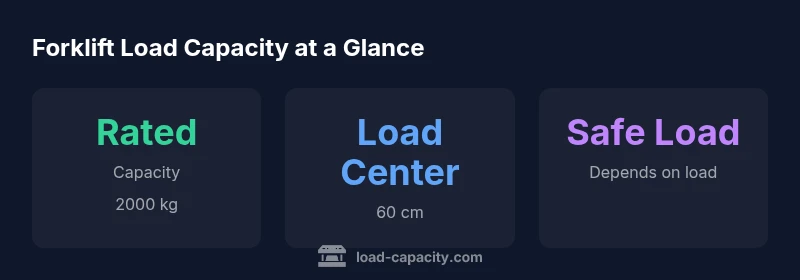
Understanding forklift load capacity begins with two core ideas: rated capacity and load center. According to Load Capacity, the rated capacity is the maximum load the forklift is designed to lift under ideal conditions, while the load center is the distance from the forks to the load's center of gravity. As the load center increases, the effective capacity decreases. Always check the forklift's nameplate and stability charts for machine-specific guidance. In practice, these concepts translate to a straightforward calculation that highlights how weight distribution and geometry affect safety and performance. This section lays the foundation for a reliable method that you can apply on the shop floor, in training, or during job planning.
Key takeaways from this concept: rated capacity sets the ceiling, the load center determines how much of that ceiling you can safely use, and stability depends on other factors like mast height and ground conditions.
Step-by-step Calculation
Follow these steps to perform a clear, repeatable assessment using the core formula:
Practical Example
A forklift with a rated capacity of 2000 kg and a reference load center of 60 cm is used to lift a load centered at 80 cm.
Real-world considerations and safety
Real-world lifting involves more than a single ratio. Operators should account for dynamic effects such as acceleration, turning, and uneven terrain, which can reduce stability margins. Other factors include mast height, load orientation, fork spread, and the overall condition of the forklift (tires, hydraulics, and counterweight integrity). A conservative approach is advisable: use the calculated safe load as a baseline and add a margin for unforeseen shifts. Regular training, visible load charts, and supervisor sign-offs help ensure that calculations translate into safe on-site practice. Safety first means treating capacity calculations as living guidance that informs planning, not a universal guarantee.
How to use the calculator in training and operations
In training sessions, use the calculator to demonstrate how changing load center distances affects capacity. Pair the results with hands-on exercises: place test loads at various centers, observe balance, and discuss stability before lifting. For daily operations, incorporate the calculator into lift planning by documenting the rated capacity, load center, reference center, and planned load per lift. Encourage operators to compare the calculated safe load to the planned load and to default to the safer value. Finally, integrate a short checklist into pre-shift routines to ensure accurate measurements and adherence to safety guidelines.
Common mistakes and myths
- Assuming rated capacity equals the safe load in all conditions. Real-world factors like load center and center of gravity change this value.
- Rounding down numbers without verifying with charts. Preservation of some margin is prudent for safety.
- Skipping calibration of load center measurements and relying on rough estimates. Precision matters for stability.
Reference values used in forklift load capacity calculations
| Parameter | Value | Unit |
|---|---|---|
| Rated capacity | 2000 | kg |
| Reference load center | 60 | cm |
Estimate safe lifting loads based on rated capacity and load center.
This educational formula adjusts the forklift’s rated capacity to the actual load center and compares the result to the planned load to determine the safe lift.
Educational tool; actual stability must be verified with machine-specific charts and a qualified supervisor.
Quick Answers
What is the load center and why does it affect capacity?
The load center is the distance from the forks to the load's center of gravity. A larger load center reduces the portion of the rated capacity available for lifting, affecting stability. Always verify how the load center appears on the nameplate and in stability charts.
The load center is the distance from the forks to where the load’s weight is centered. A bigger distance lowers the usable capacity and can affect stability.
Can I rely on the calculator for all forklift types?
The calculator provides a simplified educational estimate based on a standard relationship between rated capacity and load center. Actual machines vary; always consult the manufacturer’s charts for specific models and configurations.
This calculator gives a general estimate, but always consult the specific charts for your forklift model.
What should I do if the planned load exceeds capacityAtCenter?
If the planned load is above capacityAtCenter, you must reduce the load, adjust the load center, or use equipment with a higher rating. Do not lift beyond safe limits and consider professional validation.
Reduce the load or adjust the setup; never lift heavier than the calculated safe limit.
Does load height or mast tilt change capacity?
Yes, higher lift heights and mast tilt can reduce stability by shifting the center of gravity. Capacity calculations should be augmented with stability charts that account for these factors during operation.
Height and tilt can change stability, so use charts and safer loads when the mast is raised or tilted.
How should the results be used in daily work?
Treat the calculated safe load as a planning baseline. Confirm with field observations, add a safety margin, and document the decision process in lift planning or training records.
Use the result to plan safer lifts and always verify with on-site checks.
Top Takeaways
- Understand rated capacity and load center as foundational concepts
- Use capacityAtCenter = ratedCapacityKg * (referenceCenterCm / loadCenterCm) to estimate safe load
- Always compare planned load with calculated safe load and prefer the safer value
- Incorporate real-world factors (tilt, floor, dynamics) into planning and safety checks