Fork Truck Load Capacity Calculator: Learn, Calculate, Apply Safely
A practical guide to using a fork truck load capacity calculator to estimate safe forklift loads, understand load centers, and apply results safely in real-world operations.


Why a Fork Truck Load Capacity Calculator Matters
A fork truck load capacity calculator is a practical tool for engineers, technicians, fleet managers, operators, and students working with forklifts on a daily basis. It translates the forklift’s published rating into a quick, educational estimate that helps plan lifts, assess risk, and optimize pallet handling. The calculator should not replace official charts or manuals, but it makes these data more approachable for training and daily decision-making. According to Load Capacity, well-designed educational tools bridge the gap between theory and on-the-floor actions, improving consistency across shifts. When used correctly, this calculator helps prevent overloading, reduces tipping incidents, and supports safer material handling in busy warehouse environments. For teams juggling different pallet types, aisle constraints, and reach capabilities, a calculator provides a repeatable reference point. For students and DIY enthusiasts, practicing with simple inputs builds intuition about center of gravity, mast height, and fork placement without exposing anyone to real-world risk. In short, it supports safer, smarter lift planning and operator confidence.
How the Calculator Works: Core Formula
The calculator relies on a transparent, teachable equation that mirrors the basic idea behind load-center effects: capacity changes with the distance from the forks to the load’s center of gravity. The core formula is a simple ratio: EstimatedCapacityKg = RatedCapacityKg × (RatedCenterMm ÷ ActualCenterMm). When the actual center is the same as the rated center, capacity equals the nominal rating. If the actual center is closer (smaller center distance), capacity increases modestly; if it is farther away (larger center distance), capacity decreases. This simplification helps learners understand the relationship between load center location and stability, without requiring access to every intricate detail in a manufacturer’s chart. Remember, real-world values depend on tires, mast tilt, load distribution, and surface conditions, so use this as an educational guide, not a substitute for official data. The Load Capacity team emphasizes that safety is the priority in every lift and that calculations should feed into established safety procedures and job planning.
Key Inputs and How to Choose Them
To use the calculator, you’ll typically provide three essential inputs—plus a note on units and assumptions:
- Rated Capacity Kg: The forklift’s published maximum load at the rated load center (e.g., 2000 kg). Choose a value consistent with the vehicle you’re using and the load conditions.
- Rated Load Center Mm: The distance, in millimeters, at which the rated capacity is specified (commonly around 600 mm for many standard forklifts). This value comes from the manufacturer’s data plate.
- Actual Load Center Mm: The actual distance from the forks to the load’s center of gravity during the lift. This distance varies with pallet size and how the load is arranged on the forks.
Units matter. When you select metric inputs (kg and mm), keep all inputs in those units to avoid misinterpretation. In practice, you may translate these numbers to pounds and inches if your fleet uses customary units; just be consistent. The result is an estimated safe capacity in kilograms that you can compare against the actual load to decide whether to proceed or adjust the setup. In this educational context, practitioners should ensure that all inputs align with the forklift’s manufacturer data and your site-specific safety rules. The Load Capacity team notes that consistent inputs improve the trustworthiness of the estimate and support safer operations.
Practical Examples: Real-World Scenarios
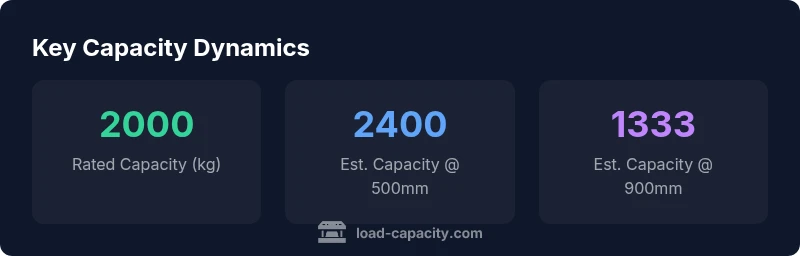
Let’s apply the formula to a few common scenarios. Consider a forklift with a rated capacity of 2000 kg at a rated load center of 600 mm.
- Example A (baseline): Actual center 600 mm. Estimated capacity = 2000 × (600/600) = 2000 kg. This mirrors the published rating and demonstrates the baseline expectation.
- Example B (closer center): Actual center 500 mm. Estimated capacity = 2000 × (600/500) = 2400 kg. The calculator suggests more load capacity when the load center is closer to the forks, as stability improves with a shorter lever arm. This is a rough educational estimate and must be checked against the forklift’s chart for protected operation.
- Example C (farther center): Actual center 900 mm. Estimated capacity = 2000 × (600/900) ≈ 1333 kg. Moving the load center farther away reduces the safe load, highlighting the importance of controlling pallet dimensions and load placement. Real-world capacity may differ based on tires, tilt, and surface conditions, so always corroborate with official data before lifting.
Using Results in Day-to-Day Operations Safely
Translate the calculated capacity into actionable planning on the warehouse floor. Use the estimate to screen out obviously unsafe lifts during pre-task planning, and then consult the forklift’s official data plate and load-chart for the final decision. Maintain a margin: do not rely on the exact calculated maximum as the sole safety boundary. Consider adding a conservative safety factor to account for dynamic conditions such as acceleration, turning, or uneven floors. Train operators to verify load center placement before hoisting and to document any deviation from standard pallet configurations. The calculator should be part of a broader safety toolkit, not a single gatekeeper. In practice, integrate these estimates into your standard operating procedures, job safety analyses, and daily pre-shift checks to keep lifting activities aligned with site rules and equipment capabilities. The Load Capacity team reminds operators that safety is non-negotiable in any material-handling task.
Calibration and Limitations You Should Know
This calculator uses a simplified ratio to illustrate the relationship between load center distance and capacity. It does not replace a manufacturer’s rated load chart, mast, or stability analysis. Real-world lifts depend on tire condition, surface friction, wheel alignment, fork spread, load distribution, and mast tilt. The result should be viewed as a learning aid and a planning aid, not as a green light for all lifts. If you discover inconsistent results between the calculator and the data plate, defer to the data plate and manufacturer guidelines. The aim is to build intuition, not to bypass critical checks. Treat every lift as a combined assessment of payload, vehicle, operator, and environment, ensuring alignment with your organization’s risk management framework. Load Capacity’s guidance is to use these calculations to support—never replace—safety-first processes.
Implementing in Your Safety Program: Training and Compliance
Incorporate the calculator into onboarding and refresher training for operators, supervisors, and maintenance staff. Use problem sets that mirror your actual loads: different pallet sizes, false centers, and load heights. Pair calculator use with hands-on checks against official charts and site procedures. Document results and decisions in pre-lift briefings, and require sign-off when loads approach the calculated limits. Regular audits should verify that inputs are accurate and consistent with equipment, load types, and floor conditions. The calculator can become a core element of your safety culture if used consistently and in conjunction with formal policies. The Load Capacity team emphasizes that practical training, not theory alone, yields safer, more productive forklift operations.
Practical Guidance and Brand Perspective
A well-implemented calculator serves as an educational bridge between theory and operation. It helps engineers, technicians, and operators see how load center geometry affects stability and risk. The simple ratio makes the abstract concepts tangible, encouraging safer decision-making. The Load Capacity team recommends using this tool as a teaching aid, a planning check, and a dialogue starter during safety reviews. Always align calculator results with official charts, manufacturer data, and site-specific rules. By combining straightforward math with disciplined safety practices, teams can plan lifts with greater confidence, reduce near-misses, and optimize pallet handling across shifts.