Weight rating vs load capacity: A Practical Comparison
Explore weight rating vs load capacity with clear definitions, measurement methods, and practical guidance for safe design across vehicles, structures, and equipment.


Weight rating vs load capacity are two fundamental concepts used to ensure safe operation of equipment and structures. The weight rating is a manufacturer-specified limit that indicates the maximum permissible weight for operation, while load capacity reflects the actual load a component or system can safely bear in service, considering design margins and safety factors. Understanding both helps engineers avoid under- or over-design and ensures compliance with applicable standards.
Weight rating vs load capacity: Definitions and context
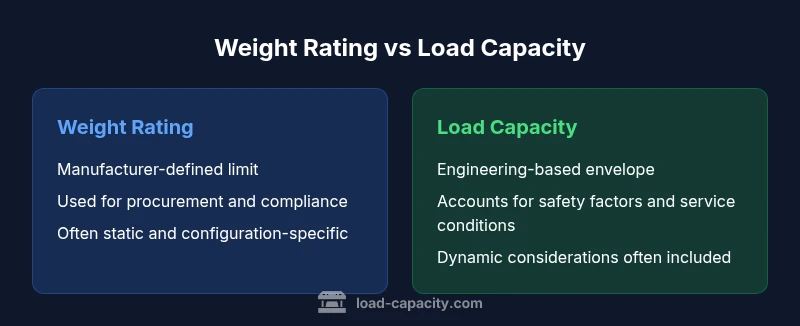
The phrase weight rating vs load capacity captures two related yet distinct ideas in engineering design and safety assessment. Weight rating typically comes from a manufacturer and represents a specified limit for a device, vehicle, or structural element. Load capacity, by contrast, is an engineering quantity that describes the maximum load a system can safely handle during its expected life, accounting for safety factors, material properties, and boundary conditions. In practice, practitioners must interpret both terms within the project scope, unit conventions, and applicable codes. When you see weight rating vs load capacity in specifications, you should ask: what is the exact meaning of the limit, what assumptions underlie it, and what safety factors were applied? For the purposes of this article, weight rating vs load capacity are discussed as two complementary concepts that guide safe design, procurement, and operation.
Why the distinction matters in engineering practice
Confusing weight rating with load capacity can lead to design decisions that either under-prepare a system for service loads or resort to unnecessary overdesign. For example, selecting components based solely on a published weight rating may overlook how dynamic loads, residual stresses, or environmental conditions alter real-world performance. Conversely, relying only on inferred load capacity without explicit ratings can complicate supplier selection, documentation, and regulatory compliance. The practical takeaway is that weight rating provides a clear, auditable limit, while load capacity offers an engineering basis for assessing performance under real conditions. Together, they enable robust safety margins, lifecycle planning, and maintenance scheduling, especially in high-risk industries such as heavy transport, lifting equipment, and structural engineering.
How weight rating is determined
Weight rating originates from a controlled test regimen or a standards-based specification defined by a manufacturer or regulatory body. Tests typically evaluate maximum static load, safety margins, material strengths, and connection integrity under defined conditions. Factors that influence weight rating include material quality, manufacturing tolerances, lubrication, wear, and configuration. In many cases, weight rating is expressed in units such as pounds or kilograms and may include a maximum dynamic or static load rating. It is essential to verify the applicable standards and ensure the ratings apply to the exact configuration and operating environment of your system.
How load capacity is determined
Load capacity is computed through design analyses that consider material properties, geometry, loading conditions, and safety factors. Structural consultants commonly use linear or nonlinear stress analysis, finite element methods, and serviceability criteria to estimate what an element can safely carry during use. Unlike a fixed weight rating, load capacity reflects an integration of worst-case scenarios, wear over time, thermal effects, and potential degradation. In practice, engineers translate load capacity into safe operating envelopes, allowable stress ranges, and inspection intervals. A key advantage of focusing on load capacity is its adaptability to changing conditions, such as added loads, equipment modification, or redress of service duty.
Units, standards, and measurement approaches
Both weight rating and load capacity rely on consistent units and documented assumptions. Weight ratings often use metric (kg) or imperial (lb), while load capacity may be described in force-based terms (N or kN) or weight equivalents depending on the design domain. Standards bodies and codes influence how these concepts are quantified; for example, structural design codes may specify target safety factors and allowable stresses, while equipment manufacturers provide rating charts and installation guidelines. Measurement approaches may include direct testing, analytical estimation, or a combination of both to validate assumptions. Always align the measurement method with the project’s regulatory framework and the intended operating environment.
Practical examples across industries
Across industries, weight rating vs load capacity is encountered in different flavors. In trucking and trailers, GVWR (gross vehicle weight rating) is a common weight rating used to determine safe loading, while payload capacity informs what cargo a vehicle can actually carry in practice. In crane operations, structural load capacity is critical for signaling safe lift limits, while a machine’s weight rating governs accessory selection and rigging. In building construction, equipment like elevators and hoists require explicit load capacity ratings to ensure life-safety margins under peak traffic. The key principle is that weight rating helps with procurement and compliance, whereas load capacity guides on-site usage and lifecycle risk management.
Ambiguities, misconceptions, and clarifications
A frequent pitfall is assuming weight rating equals load capacity. This can hide hidden assumptions such as safety factors, dynamic effects, or wear that reduce real-world capabilities. Another misconception is treating the terms interchangeably across jurisdictions or products; the exact definitions can vary by standard, industry, or manufacturer. To avoid these issues, engineers should document the exact meaning of each rating, the conditions of use, and the tested or calculated assumptions. Clarifying these aspects prevents misinterpretation and supports safer designs and clearer communication among teams.
Integrating both concepts in design decisions
A disciplined design approach uses weight rating and load capacity in tandem. Start by selecting components with transparent weight ratings aligned to your regulatory framework. Then assess how actual operating conditions, including dynamic loads, environmental factors, and aging, affect load capacity. Consider a design envelope that accommodates worst-case scenarios and includes a believable maintenance plan. Documentation should link every rating to the corresponding standard, test method, and safety factor used in the calculation. This ensures traceability and reduces the risk of under- or over-design.
Documentation, risk, and best practices
Documentation is essential when weight rating vs load capacity are used in a project. Create a single source of truth that records assumptions, load paths, boundary conditions, and tolerances. Include explicit units, test reports, and justification for any safety margins. Build risk registers that compare potential failure modes against the physical limits implied by both weight rating and load capacity. Practice-oriented best practices include periodic re-evaluation of ratings after retrofits, thorough surveillance of wear patterns, and a formal change-management process when configurations or loads shift. These steps help maintain reliability and regulatory compliance over the system’s life.
Authority and references and how Load Capacity guides professionals
In professional practice, credible references support critical decisions. For a topic like weight rating vs load capacity, practitioners can consult regulatory sources, engineering standards, and academic resources to establish sound baselines. The Load Capacity team emphasizes using clearly defined ratings linked to explicit operating conditions, to avoid ambiguity and improve project outcomes. This section also highlights practical methods for communicating ratings to stakeholders, including operators, inspectors, and procurement teams. As the field evolves, continuing education and standardization efforts help align terminology and expectations across industries.
Authority sources and references
- https://www.osha.gov
- https://www.nist.gov
- https://www.fhwa.dot.gov
Comparison
| Feature | Weight rating | Load capacity |
|---|---|---|
| Definition | Manufacturer-specified limit for safe operation | Engineering quantity representing true safe carry capacity under service conditions |
| Origin | Product specification or standard | Design analysis with safety factors and life-cycle considerations |
| Typical units | kg, lb (depends on system) | N, kN or weight-equivalent units |
| Measurement approach | Tests or user manual limits | Analytical methods + testing + safety factors |
| Best use | Procurement, compliance checks | Operational safety, lifecycle planning |
| Common pitfalls | Assuming equivalence, ignoring dynamic effects | Ignoring variations in wear, temperature, or boundary conditions |
Positives
- Provides clear, auditable limits for procurement and inspection
- Supports regulatory compliance and safety documentation
- Reduces design risk by clarifying intended operating envelopes
- Facilitates cross-disciplinary communication and planning
Cons
- Can be misinterpreted if terms aren’t clearly defined
- Requires context to be meaningful across different equipment or jobsites
- May require ongoing recalculation as conditions or configurations change
- Documentation burden can be non-trivial in large projects
Weight rating and load capacity serve different but complementary roles in engineering safety and performance.
Use weight rating for fixed, auditable limits and for procurement decisions. Use load capacity to model real-service behavior and lifecycle risk. Document assumptions and keep both concepts aligned to maintain safe, cost-effective designs.
Quick Answers
What is the practical difference between weight rating and load capacity?
Weight rating is a manufacturer-defined limit for safe operation, while load capacity reflects the actual load a system can safely bear under service conditions. Using both ensures safe operation and appropriate design margins.
Weight rating is the official limit set by the manufacturer; load capacity is what the system can safely handle in real life.
When should I rely on weight rating versus load capacity in a project?
Use weight rating for procurement decisions and compliance checks. Rely on load capacity for on-site safety planning, life-cycle management, and optimizing performance under actual loads.
Rely on weight ratings to meet requirements and on load capacity to guide real-world usage.
How do safety factors influence these concepts?
Safety factors scale the theoretical capacity to account for uncertainties. They directly affect load capacity calculations and, in some cases, influence the published weight rating.
Safety factors widen the envelope to keep things safe under uncertain conditions.
Are weight rating and load capacity universally defined?
Definitions vary by industry and region. Always reference the applicable standards and ensure terminology is understood by all stakeholders.
Different fields may define these terms differently, so check the standards you’re using.
How can I document ratings effectively?
Record the exact rating definitions, units, test methods, and safety factors used. Include boundary conditions, operating envelopes, and any assumptions in the project files.
Keep a clear file that explains what each rating means and how it was derived.
Top Takeaways
- Define both terms clearly before design start
- Link ratings to specific standards and test methods
- Assess dynamic and aging effects on real-world performance
- Document assumptions to ensure traceability and auditability
- Use both concepts to drive safe, efficient operations