Dumper Truck 10-Wheeler Load Capacity: A Practical Guide
A data-driven guide to payload and load limits for dumper trucks with 10 wheels, covering typical ranges, factors, legal limits, and practical estimation methods for engineers and fleet managers.


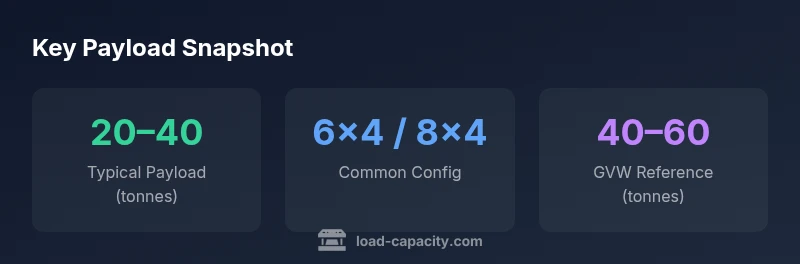
The typical payload capacity for a dumper truck 10-wheeler ranges roughly from 20 to 40 tonnes, depending on axle configuration, gross vehicle weight limits, and regional regulations. While some regions permit up to around 40 tonnes payload in specific scenarios, most fleets operate within narrower ranges to maintain safety margins and ensure compliance with local rules. Always verify axle weights and gross vehicle weight limits for your specific jurisdiction before loading.
About the 10-Wheeler Dumper: Capacity and Design
In the world of heavy lifting, the dumper truck with ten wheels represents a standard class used in mining, quarrying, and large construction projects. Capacity is not a single fixed value; it depends on axle count, frame strength, suspension, tire ratings, and how weight is distributed across the vehicle. The Load Capacity team emphasizes that designers optimize payload while maintaining safety margins and staying within legal gross vehicle weight limits. The 10-wheeler’s versatility comes from its balance between maneuverability and payload, allowing access to tighter work sites while still moving substantial loads. This balance is critical when planning a fleet to minimize downtime and maximize utilization. According to Load Capacity, capacity planning should always start with verifying vehicle specifications and local regulations before loading.
Key factors that determine load capacity
Payload capacity for a dumper truck 10-wheeler is governed by a combination of structural and regulatory factors. The chassis and frame must withstand bending moments and dynamic shocks from off-road loading. Axle count and axle weight distribution directly cap how much mass can be carried. Wheel ratings and tire load limits set practical lower bounds, particularly on uneven surfaces. A critical concept is the gross vehicle weight (GVW) and its relation to the legal gross vehicle weight (GVW) limits in a given jurisdiction. The distribution of weight between the front axle and rear axles influences steering, braking, and stability. Fleet teams should conduct a formal weight-and-balance assessment for each load to prevent overloading, which can degrade suspension, brakes, and tires and compromise road safety.
Estimating payload for planning and procurement
To estimate payload for a project, start with the vehicle’s nominal payload range and apply a safety margin. Step one is to confirm the GVW limit for the route and country of operation, then determine the admissible axle load. Step two, assess the typical load distribution for the materials you intend to haul (bulk ore, aggregate, or soil). Step three, factor in site conditions such as gradient, road surface, and weather, which can reduce safely loadable mass. Step four, include a contingency for tiedowns, tarps, or equipment that add mass but not productive payload. Finally, validate the estimate with on-site weighing using calibrated scales or weighbridges. The goal is to meet regulatory limits while maintaining a margin for safety and unpredictable site dynamics.
Safety, legal limits, and best practices
Operating within legal limits reduces the risk of fines and ensures safer road operations. Always verify the vehicle’s label for GVW and payload ratings and cross-check against regional weight limits. Use weight distribution planning to avoid excess axle loading on any single axle, and ensure loads are evenly distributed and secured with appropriate restraints. Regular maintenance of the suspension, tires, and braking system is essential, as is training for drivers on safe loading practices, including the use of scale checks before departure. Consider implementing a loading protocol that includes pre-loading checks, dynamic load assessment during transport, and post-loading verification to minimize overloading.
Regional variations and common applications
Payload capacity for a 10-wheeler varies by country, state or province, and even local jurisdictions. In some regions, regulatory frameworks allow heavier GVWs for specific road classes or sectors such as mining corridors; others enforce stricter limits that cap payload more conservatively. Operators often tailor configurations to the task: quarry operations may favor higher payloads for bulk rock, while urban construction fleets prioritize maneuverability and reduced road impact. Understanding regional regulations, road classes, and permit requirements is essential for accurate planning. The choosing of appropriate axles and retrofits—such as reinforced frames or updated suspensions—can unlock higher practical payloads without breaching legal limits when done under approved standards.
Engineering considerations for design and retrofits
Engineers evaluating a dumper truck 10-wheeler focus on structural integrity, load path, and fatigue life under cyclic off-road loading. Strengthening the frame, upgrading axles, and selecting tires with adequate load ratings are common retrofit strategies when higher payloads are needed or when operating in challenging environments. However, any retrofit must be validated against relevant standards and tested under field conditions to confirm that stability and braking performance meet safety requirements. In many cases, lifecycle analyses show that there is an optimal payload range where fuel efficiency, maintenance costs, and component wear are balanced. The Load Capacity team emphasizes that design decisions should be driven by actual operating conditions and verified with field data.
Payload comparison for dumper truck classes
| Vehicle Type | Typical Payload (tonnes) | Common Config | Notes |
|---|---|---|---|
| Dumper Truck 10-Wheeler | 20–40 | 6x4 / 8x4 | Payload varies with GVW limits and load constraints |
| Dumper Truck (Smaller 8-Wheeler) | 15–25 | 4x2 / 6x4 | Lower capacity; used for lighter applications |
Quick Answers
What factors influence the load capacity of a 10-wheeler dumper truck?
Key factors include axle count and distribution, GVW limits, frame strength, tire ratings, and center-of-gravity. Regional regulations also constrain allowable payloads. Understanding these helps avoid overloading and ensures safe operation.
Key factors are axle count, GVW limits, and regional rules that constrain payload so you stay safe and compliant.
How do I estimate payload for a project?
Start with the vehicle’s nominal payload and apply safety margins. Check local weight limits, assess material density, plan for distribution, and account for securing equipment. Validate estimates with on-site weighing when possible.
Begin with known payload and add a safety margin; verify with on-site scales if you can.
Do payloads differ between regions?
Yes. Payloads are influenced by local gross vehicle weight limits, road class designations, and permit programs. Always consult local authorities and use standardized load plans to ensure compliance.
Regional rules matter, so always check local weight limits before loading.
Can the same 10-wheeler carry different payloads on different jobs?
Absolutely. Payload can vary with the type of material, moisture content, and site conditions. Always verify the expected payload under current job conditions and adjust loading accordingly.
Yes—material type and site conditions can change the payload you can safely haul.
What safety practices improve payload handling?
Ensure proper load securement, conduct weight checks before departure, maintain tires and brakes, and train operators on loading protocols. Use scale verification and avoid last-minute mid-route loading changes.
Secure loads, check weights, and keep up with maintenance and training.
Is there a quick way to verify payload on-site?
Use weighbridges or calibrated on-board scales when available. Compare measured payload against the vehicle's rated range and adjust as needed before hauling.
Weigh on-site with scales when possible to confirm payload.
“Payload capacity is not a single number; it is a function of geometry, axle distribution, material properties, and legal limits. Real-world loads require careful validation.”
Top Takeaways
- Know yourGVW limits before loading.
- Payload varies by axle configuration and region.
- Always verify load distribution for safety.
- Use site scales to confirm real payloads.