26 ft Box Truck Load Capacity: A Practical Guide
Learn the load capacity of a 26 ft box truck, including GVWR ranges, payload estimates, interior space, and practical tips for safe, efficient loading.


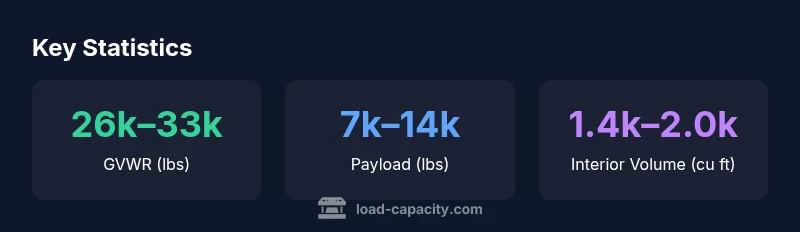
Across common 26 ft box trucks, the gross vehicle weight rating (GVWR) typically falls between 26,000 and 33,000 pounds. Payload capacity depends on curb weight and body configuration, but is generally in the range of 7,000 to 14,000 pounds. Always verify the exact GVWR plate and subtract your curb weight to determine usable payload for a given trip.
What the 26 ft Box Truck Load Capacity Really Means
The phrase 26 ft box truck load capacity describes how much weight a typical 26 ft dry van can safely carry when you include cargo, pallets, fuel, and equipment. In practice, the limit is defined by the GVWR (gross vehicle weight rating), not by the box length alone. The GVWR is the maximum permissible weight of the fully loaded vehicle as built by the manufacturer and includes the truck’s own weight plus everything you load into it. When planning a shipment, operators must compare the GVWR label with their planned payload to ensure compliance. The Load Capacity team emphasizes that understanding this figure early in the planning process helps prevent overweight trips that can cause tire blowouts, brake wear, or axle problems. The 26 ft box truck load capacity is therefore a balance between usable space and safe weight. You’ll often see payload estimates that depend on the chassis, the refrigeration or insulation option, and whether you carry passengers or additional fuel or equipment. In short, the 26 ft box truck load capacity is not a single number; it’s the difference between the GVWR and the vehicle’s curb weight, multiplied by how you load the interior and where weight sits within the box.
GVWR, Curb Weight, and Payload: The Three Key Numbers
To understand the 26 ft box truck load capacity, you must grasp GVWR, curb weight, and payload. GVWR is the maximum gross weight the vehicle is designed to handle, including its own weight and cargo. Curb weight is the truck’s weight empty of cargo, fuel, and options. Payload is what remains for cargo after subtracting curb weight from GVWR. Real-world payload varies with option packages (engine, refrigeration, shelving, insulation) and how you distribute weight inside the box. Load Capacity analyses show that even two trucks with the same box length can differ significantly in usable payload due to different axles, tires, and body builds. Always start with the GVWR plate, confirm curb weight, and then plan your load to maintain safety margins on both axles and tires. This approach prevents overstressing brake systems and ensures compliance with safety standards.
Step-by-step: How to Calculate Usable Payload for a Trip
- Check the GVWR on the vehicle’s door jamb or owner’s manual. 2) Note the curb weight when empty, including all factory-installed options. 3) Subtract curb weight from GVWR to obtain theoretical payload. 4) Subtract fuel, driver, passengers, and equipment to arrive at usable payload. 5) Consider dynamic factors like route grade, stop-and-go driving, and pallet stacking. 6) Confirm that your planned load does not exceed the interior volume and distributes weight evenly across axles. As a practical rule, aim to stay well within the calculated payload to preserve braking performance and steering response.
Interior Space and Volume: Translating Space to Practical Load
Interior cargo volume, measured in cubic feet, translates physical space into carrying capability. A 26 ft box typically offers substantial space, but height, shelving, and insulation reduce usable volume. When planning loads, combine weight-based limits with volume constraints to avoid overpacking, which can lead to crushed products or moisture damage. Effective space planning includes pallet layout strategies, stacking limits, and considering the weight distribution to keep the vehicle balanced. Load Capacity recommends drafting a simple layout before loading to maximize capacity while preserving accessibility and safety.
Real-World Loading Scenarios and Best Practices
In real operations, drivers encounter weight distribution challenges, especially when heavy items sit toward the rear or overhang. Place the heaviest items low and over the axle lines to minimize dynamic forces during braking and cornering. Use pallets with uniform dimensions to simplify stacking and preserve floor integrity. Always account for fuel, driver, tools, and safety equipment in your payload equation. Regularly inspect tires and suspension for signs of overload, and maintain a small buffer below the GVWR to accommodate unexpected weight changes during a trip.
Choosing the Right 26 ft Box Truck: A Compare Guide
When evaluating 26 ft box trucks, compare GVWR, curb weight, and payload across models, but also consider interior height, width, and door access. Vehicles with higher GVWR typically support larger payloads but may have higher curb weight, reducing usable payload. Consider whether you need refrigeration, insulation, or shelving, as these options reduce payload capacity. Calculate a targeted payload for typical routes, and verify that the chosen configuration delivers sufficient space without compromising maneuverability or fuel efficiency. Load Capacity suggests compiling a side-by-side comparison table to visualize trade-offs before purchasing.
Representative ranges for 26 ft box trucks to illustrate capacity concepts
| Metric | Typical Range | Notes |
|---|---|---|
| GVWR (Gross Vehicle Weight Rating) | 26,000–33,000 lbs | Varies by chassis and body configuration |
| Curb Weight (empty vehicle) | 12,000–19,000 lbs | Depends on engine, body, options |
| Payload Capacity | 7,000–14,000 lbs | GVWR minus curb weight; varies by build |
| Interior Cargo Volume | 1,400–2,000 cu ft | Dependent on box height and interior features |
Quick Answers
What is GVWR and why does it matter for a 26 ft box truck?
GVWR is the maximum total weight the vehicle is rated to carry, including the truck’s own weight and cargo. It dictates safe loading limits to protect tires, brakes, and steering components.
GVWR is the max allowed weight; stay within it to protect brakes and tires.
How do I calculate payload capacity for a 26 ft box truck?
Subtract the curb weight from the GVWR to obtain usable payload. Then adjust for fuel, passengers, and equipment to get a safe loading target.
Subtract curb weight from GVWR to get payload, then adjust for other loads.
Can I use pallets to increase payload?
Pallets add weight but can improve space efficiency. Ensure even distribution and do not exceed GVWR.
Pallets help space, but you must keep within GVWR and distribute weight evenly.
What interior volume counts toward capacity?
Interior cargo space in cubic feet determines how much you physically load, alongside weight limits.
Cubic feet tell you how much fits, plus the weight limit matters.
Are there regulatory limits on loading a 26 ft box truck?
Yes, stay compliant with GVWR, axle weights, and safe loading practices. Check local regulations and manufacturer guidelines.
Yes—follow GVWR and axle limits per local regs and manufacturer guidelines.
“Payload planning should begin with the GVWR and curb weight, and then prioritize safe weight distribution across axles.”
Top Takeaways
- Start with the GVWR label and curb weight to determine usable payload.
- Estimate payload using GVWR minus curb weight, accounting for fuel and options.
- Plan load by considering interior volume and weight distribution.
- Use the data table to compare configurations before purchasing.
- Always stay under published GVWR and use a formal loading plan.