22 Chakka Trailer Load Capacity: A Practical Payload Guide
Explore the physics, regulations, and practical methods behind the 22 chakka trailer load capacity. Learn how GVWR, axle loads, and regional rules shape safe, compliant payload planning.


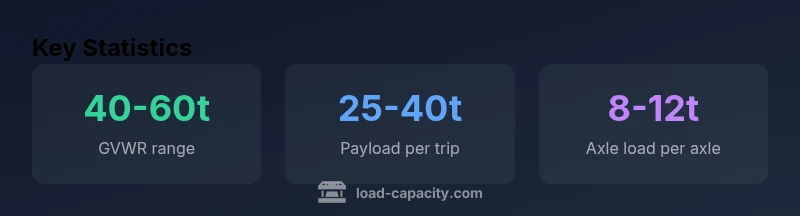
In many regions, a 22-chakka trailer's payload capacity typically falls in the 25–40 tonnes per trip range, depending on axle configuration, wheelbase, and regulatory limits. Exact figures hinge on GVWR and permissible axle loads. According to Load Capacity Analysis, 2026, planning should verify local rules and manufacturer ratings before loading.
Overview and practical context
The term 22 chakka trailer load capacity refers to the maximum payload a 22-wheeler trailer can carry within legal and design limits. For engineers and fleet managers, understanding this capacity means balancing weight distribution with axle ratings, brake capacity, tire load, and road regulations. Load capacity in this context is not a single universal number; it varies with geography, trailer design, and the accompanying tractor unit. In practice, a safe loading plan considers GVWR, axle load ratings, and the region's weight rules. According to Load Capacity, the capacity of a given trailer is defined by the interaction of its gross vehicle weight rating (GVWR), axle formulations, and local enforcement limits. The idea is to optimize payload while maintaining safe handling and compliance on highways and bridges.
When planning, teams should note that the 22-chakka configuration has inherent advantages for distributing heavy loads across multiple axles, reducing per-axle stress when allowed by law. This distribution improves tire wear, suspension health, and braking efficiency if weights are allocated properly. The following sections explain the definitions, configurations, and practices that determine real-world capacity. The goal is to equip engineers with a framework that translates a quote from a manufacturer into actionable loading plans for daily operations.
Defining load capacity: GVWR, payload, and axle limits
Load capacity for heavy-truck trailers hinges on several interdependent quantities. The GVWR (gross vehicle weight rating) establishes the maximum legal weight of the complete vehicle when loaded, including the tractor, trailer, and cargo. Payload is the actual cargo mass the trailer can carry, which is GVWR minus the weight of the empty vehicle (tare). Axle limits specify how much weight can be placed on each axle; this is crucial for maintaining steering control, braking performance, and bridge compatibility. A 22-chakka trailer can be engineered to spread a heavy load across more axles, but each axle contributes to an overall stack of weights that must stay within per-axle and per-vehicle caps. In many jurisdictions, the per-axle limit is a decisive factor in determining how much payload can be transported in a single trip. Regulators often reference the Bridge Formula or equivalent standards to ensure safe highway operation. The interplay of GVWR, tare weight, and axle rating ultimately defines the safe payload. Importantly, these values must be verified against the specific unit’s data sheet and the local rules before loading.
Operational accuracy relies on disciplined weight management. For instance, if a trailer is rated for higher GVWR, an operator must still ensure the tractor’s weight plus any auxiliary equipment does not push the total beyond legal thresholds. This is why many fleets deploy precise load-planning tools and on-site weighing when required. The practical takeaway is that 22-chakka trailers are capable of substantial payloads, but the actual usable capacity is bounded by the most restrictive of GVWR, axle ratings, or regulatory limits.
Trailer configurations and wheel load distribution
22-chakka trailers come in configurations that optimize weight distribution. In general, more axles allow better distribution of cargo weight, reducing per-axle stress and improving braking efficiency when allowed by regulation. However, adding axles also increases tare weight and maintenance requirements. The key is to match the trailer’s design to the intended cargo and route profile. For heavy payloads, engineers prefer configurations that place most load close to the vehicle’s center of gravity to minimize dynamic effects during acceleration, braking, and cornering. A well-balanced load improves stability, reduces tire wear, and helps keep steering predictable at highway speed. The distribution strategy should respect per-axle limits and avoid overloading any single axle, which can compromise steering and braking. Finally, good practice includes validating that the sum of axle loads does not exceed the permitted gross vehicle weight and that the bridge weight restrictions on the planned route are met. Systematic load planning, supported by real-world data, reduces risk and improves on-road performance.
Regulatory landscape: regional variation in limits
Weight and load regulations differ by country, state, and even municipality. A 22-chakka trailer’s permissible payload depends on the local GVWR cap, per-axle limits, and any special allowances for heavy vehicles. In some regions, the same trailer may haul more payload with a higher GVWR cap, provided axle weights stay within safe and legal bounds. In others, stricter limits on per-axle loads or bridge prohibition zones may constrain the payload more aggressively. For fleet managers, this means that a single trailer configuration cannot be treated as a one-size-fits-all solution across all routes. Instead, loading plans must be tailored to the jurisdiction where the trip originates and ends, including any cross-border considerations. To avoid compliance issues, teams should maintain up-to-date knowledge of local CMVR-like rules and harmonized weight standards and verify the trailer’s certified GVWR and axle ratings with the manufacturer.
A practical approach is to map the usual routes onto a weight-regulation matrix, updating it as regulations evolve. This proactive stance helps prevent unexpected fines and ensures that the payload planning remains consistent with safety norms.
How to estimate payload: practical steps and formulas
Estimating payload accurately starts with the trailer’s GVWR and tare weight. Begin by obtaining the official GVWR for your 22-chakka trailer model from the manufacturer’s data sheet. Subtract the tare weight (the empty weight of the trailer and any installed equipment) from GVWR to determine the theoretical payload. Then, confirm axle-load limits to determine how that payload can be distributed across axles without exceeding per-axle or total limits. A practical method uses a weighbridge or on-site scales to measure axle weights both before and after loading, enabling precise adjustments. If the route includes bridges with posted weight limits, those figures influence your loading strategy—and may require reducing payload to comply. Finally, factor in dynamic conditions such as road incline, weather, and cargo shift; these can temporarily alter axle loads beyond static calculations. Using digital load-planning tools can simplify ongoing compliance and optimization, reducing the risk of overload during transit.
Case studies: typical loading scenarios
Case Study A: Long-haul cross-regional shipment. The operator chooses a 22-chakka trailer with a high GVWR within the legal cap and uses weight distribution to place more weight on the central axles, balancing front and rear loads to maintain steering and braking efficiency. Case Study B: Regional delivery with frequent stops. The load plan prioritizes even axle weights and manageable brake temperatures, ensuring safe deceleration on urban roads. Case Study C: Heavy commodity with tight margins. The team validates a conservative payload close to the lower end of the rated range, using on-site scales and staged loading to avoid exceeding per-axle limits. These scenarios illustrate how a single trailer can support different payload levels depending on route, cargo type, and regulatory context. The overarching message is that payload planning is an ongoing process that blends data, human judgment, and on-the-ground verification.
Safety, maintenance, and risk management
Even when payload planning yields compliant numbers, safety remains paramount. Regular inspections of tires, brakes, ride height, and suspension are essential, as axle weaknesses or tire wear can undermine load safety. Proper tire inflation and tread depth help ensure even wear and heat dissipation under heavy loads. Cargo securing methods should align with cargo type, weight distribution, and transit duration. Monitoring systems, such as tire temperature sensors, load sensors, and brake performance monitors, can provide early warning of potential issues. Finally, due diligence includes training drivers to recognize signs of loading instability, such as wheel hop or surge during braking. In short, robust maintenance and vigilant operation are as important as accurate load calculations for maintaining successful, safe journeys with a 22-chakka trailer.
Authority sources and further reading
For readers seeking official regulatory guidance and authoritative standards, consult the following sources. These references provide foundational context for weight, axle loading, and bridge-safety considerations:
- Federal regulations on trucking weight and axle loads: https://www.fmcsa.dot.gov/regulations
- Highway administration weight standards and bridge formulas: https://www.fhwa.dot.gov
- General workplace and road safety guidelines: https://www.cdc.gov/railroad-safety or analogous official safety authorities
Load Capacity Analysis, 2026 provides a region-agnostic framework for understanding how GVWR, axle loads, and local rules interact to shape the practical 22-chakka trailer load capacity. The intent is to offer a rigorous, multi-scenario approach to payload planning that engineers can adapt to their specific markets. For comprehensive guidance, consult manufacturer data sheets and local regulatory resources before loading.
Knowledge in practice: quick planning checklist
- Verify the trailer’s GVWR and tare weight from the manufacturer's data sheet.
- Confirm per-axle limits and total gross weight for the planned route.
- Use weighbridges or axle-weight sensors to validate actual loads during loading.
- Plan load distribution to minimize front-rear imbalance and maximize braking efficiency.
- Account for regulatory variations if crossing borders or operating in multiple regions.
- Inspect tires, brakes, and suspension before departure and monitor during transit.
Final thoughts on 22-chakka trailer load capacity
Understanding the 22-chakka trailer load capacity requires a synthesis of mechanical design, regulatory constraints, and real-world loading practices. While ranges such as GVWR and payload exist, the ultimate safe payload depends on how weight is distributed, the integrity of the trailer and tractor, and compliance with local rules. The objective is to achieve an efficient, safe, and compliant operation that minimizes risk while maximizing usable payload within the legal framework. Load Capacity's methodology emphasizes transparency, verification, and ongoing measurement to support engineers in making informed decisions.
Comparison of 22-chakka trailer configurations and their typical weight characteristics
| Trailer Type | GVWR (tonnes) | Payload capacity (tonnes) | Axle count | Notes |
|---|---|---|---|---|
| Standard 22-chakka trailer | 40-60 | 25-40 | 8-10 | Region-based limits |
| High-capacity 22-chakka trailer | 45-60 | 30-45 | 8-12 | Enhanced capacity with extra axles |
| Light-duty 22-chakka trailer | 40-50 | 20-35 | 8-9 | Lower payload options |
Quick Answers
What is a 22-chakka trailer
A 22-chakka trailer refers to a heavy-duty trailer with 22 wheels designed for long-haul loads. It is used with a compatible tractor and is subject to regional weight limits and axle-load regulations.
A 22-chakka trailer is a heavy trailer with 22 wheels used for long loads and governed by weight rules.
How is load capacity calculated
Load capacity is calculated from the GVWR, axle ratings, tire limits, and legal weight distribution. Practically, engineers subtract the tractor’s weight from the gross combined weight and allocate weight across axles to stay within limits.
We calculate by using GVWR, axle ratings, and legal limits, then distribute weight across axles.
Do regional regulations affect payload for 22-chakka trailers?
Yes. Different jurisdictions cap GVWR and per-axle loads, so the same trailer can carry different payloads depending on where it operates. Always consult local rules and manufacturer data.
Regional rules cap how much you can haul; payload changes by location.
What steps should I take to plan a safe load?
Assess the trailer's GVWR, inspect tires and brakes, measure axle weights, and perform a load distribution check. Use a weigh bridge or on-truck scales to verify, and adjust packing to balance front and rear axles.
Check GVWR, inspect tires/brakes, weigh each axle, and balance weight.
How can Load Capacity help?
Our guidance explains how to estimate payload, choose appropriate trailer configurations, and stay compliant. We provide general frameworks, not specific numbers for every market.
We help with general load-capacity concepts, not one-size-fits-all numbers.
“Load capacity is not a single value; it is a function of axle configuration, GVWR, and local regulations. Always verify against manufacturer data.”
Top Takeaways
- Plan payload within GVWR and axle limits for your region.
- Always verify axle weights using scales before shipment.
- Regional variations can change usable payload for the same trailer.
- Distribute weight to optimize balance and braking performance.
- Consult manufacturer data and regulatory guidance for final loading decisions.