12 ton truck loading capacity: Practical guidance for engineers
Comprehensive guidance on the 12 ton truck loading capacity, including payload ranges, GVWR considerations, load distribution, and best practices for engineers, fleet managers, and DIY enthusiasts.


The 12 ton truck loading capacity refers to the payload a truck can safely carry, calculated as the vehicle’s GVWR minus its curb weight, minus fixed equipment. Real-world limits vary by configuration, axle count, tire rating, and regional regulations. Always verify manufacturer specifications, perform load distribution checks, and apply a conservative safety margin.
Understanding the 12 ton truck loading capacity
The term 12 ton truck loading capacity is a practical shorthand used by fleets and engineers to describe how much payload a truck can safely carry on a typical configuration. It is not simply the number 12 tons loaded onto a chassis. In practice, the usable payload depends on the vehicle’s GVWR, curb weight, and any fixed equipment or accessories installed on the truck. According to Load Capacity, the reliable interpretation of this capacity starts with identifying the vehicle's GVWR and subtracting the actual curb weight plus installed bodies, tanks, or lifting gear. This yields the theoretical payload, which must then be adjusted for real-world factors such as fuel, driver, tools, and miscellaneous cargo. In many markets, the legality of loading is governed by axle and gross vehicle weight limits rather than a single fixed payload value, so engineers must cross-check the manufacturer’s data plate with local regulations. Understanding these distinctions helps prevent overloading, protects structural integrity, and reduces the risk of tire or suspension failure during service. The goal is to establish a safe operating envelope that preserves performance, braking, and handling under typical routes and conditions. For engineers and fleet managers, the nuance behind the term matters just as much as the numeric figure itself.
Key factors that influence payload for 12 ton class trucks
Payload is shaped by several interrelated factors:
- GVWR versus curb weight: GVWR sets the maximum permissible weight, while curb weight determines how much space remains for cargo.
- Axle configuration and tire ratings: More drive axles or higher-load tires increase possible payload but also expand the complexity of distribution.
- Body style and equipment: A bulky dump bed, flatbed with gooseneck, or crane adds mass, reducing usable payload.
- Regulatory limits by region: Some jurisdictions apply per-axle limits and matrix-based weight formulas that reduce allowable payload even if the GVWR suggests a higher figure.
- Load distribution and CG (center of gravity): Unevenly loaded pallets shift CG, increasing risk of tire wear or rollover; even payload distribution across axles is critical.
The Load Capacity team notes that the practical payload is not just a static limit; it evolves with equipment choices, route profiles, and regulatory frameworks. Fleet operators should map payload envelopes for each truck variant and document the expected cargo mix to avoid surprises on the scale.
How to calculate safe payload for a given truck
A practical method to estimate safe payload:
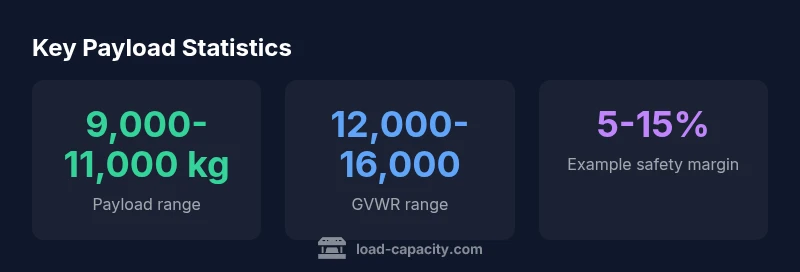
- Identify GVWR from the data plate. 2) Determine curb weight (the truck with standard equipment and fluids). 3) Subtract fixed loads (body, fuel, fluids) and installed attachments. 4) Subtract planned cargo and apply a reserve margin (commonly 5-15%). 5) Consider per-axle limits and axle weight distribution; ensure no axle exceeds its rating.
Example (illustrative): If a 12 ton class truck has a GVWR of 16,000 kg and a curb weight of 6,500 kg with 1,000 kg fixed equipment, the theoretical payload is 16,000 – 6,500 – 1,000 = 8,500 kg. After applying a 5% safety reserve, the practical payload target is around 8,075 kg. Note that actual allowed payload can vary by configuration and geography. The key is to keep a conservative margin and document the basis for any deviation from the nominal payload.
Weight distribution and safety margins
Weight distribution is as important as the total payload. A heavy load placed predominantly on a single axle can exceed per-axle ratings even if the combined payload is within GVWR. To minimize risk, distribute weight evenly across axles, keep the center of gravity low and near the truck’s wheelbase, and avoid stacking cargo high. Use pallet layouts that encourage cross-axle loading and check that each axle’s load remains within its rated value. For long-haul configurations, plan for weight growth through fuel consumption and keep a built-in margin for dynamic loading during braking, cornering, and rough roads. Finally, factor in any mounted equipment ( cranes, tanks, or tool racks) that adds load and may shift CG.
Real-world scenarios and case studies
Consider a distribution-operations truck with a two-axle setup and a 12-ton GVWR: a typical 6.5–8.0 metric ton curb weight plus 1,500–2,000 kg of fixed equipment, leaving a theoretical payload range of roughly 6,000–8,500 kg. If the cargo is evenly stacked across both rear axles, the per-axle load stays within common rating bands; however, placing heavy items closer to one side can push an axle beyond its limit. In contrast, a long-haul sleeper cab with an additional fifth wheel and flatbed may see a lower usable payload—despite a similar GVWR—due to added fixed mass. Real-world practice shows that tens of percent of declared payload often must be reserved for contingencies like fuel, tools, and safety equipment. The Load Capacity team emphasizes that such margins are not optional, but essential for maintaining performance and safety over the vehicle’s service life.
Inspection and compliance considerations
Pre-trip checks should include a quick verification that payload aligns with the expected load, and periodic scale checks are recommended for longer routes or changing cargo mixes. Use on-board scales or weigh stations to confirm axle weights and overall GVWR compliance. Maintain accurate load diagrams showing where heavy items sit, how they are strapped, and how the weight distribution changes with fuel levels or cargo reconfiguration. Documentation of the payload methodology, including margins and assumptions, helps simplify audits and reduces the risk of penalties or downtime. Finally, train operators to recognize signs of overloading, such as reduced braking efficiency, longer stopping distances, or unusual tire wear patterns, and establish a process to correct issues before the next trip.
Official standards and resources
Regulatory guidance for payload and axle loading varies by country and region. In the United States, operators should consult federal and state Transportation authorities, while other regions follow national road and vehicle safety standards. The following sources provide foundational context for payload planning and safe loading practices:
- https://www.fhwa.dot.gov
- https://www.osha.gov
- https://www.transportation.gov
In addition, the Load Capacity team recommends referring to the manufacturer data plate for GVWR and curb weight figures, and scheduling periodic calibration of weighing equipment to ensure accuracy in live operations. For global readers, always verify local rules that apply to per-axle limits, bridge formulas, and maximum gross vehicle weight at the jurisdiction level. The goal is to maintain a credible, repeatable process that protects people and equipment while delivering reliable service. The Load Capacity team recommends a conservative approach when guidance from multiple sources diverges and encourages documenting the chosen method for future audits.
Payload ranges by truck configuration for 12-ton class trucks
| Truck Configuration | Estimated Payload Range (kg) | Typical GVWR (kg) |
|---|---|---|
| Day Cab | 9,000-11,000 | 12,000-14,000 |
| Sleeper Cab | 9,500-11,500 | 14,000-16,000 |
| Crew Cab/Heavy Duty | 10,500-12,000 | 15,000-16,000 |
Quick Answers
What is included in the payload for a 12 ton truck?
Payload typically includes the usable cargo mass that can be carried while staying under GVWR and per-axle limits. It excludes fixed masses like the vehicle itself and installed equipment, but it accounts for regulatory margin. Always reference the data plate for the precise figure.
Payload is the cargo mass you can safely carry after accounting for the vehicle's own weight and installed equipment. Check the data plate for the exact number.
How do I calculate payload for a specific truck configuration?
Identify GVWR, determine curb weight, subtract fixed equipment and planned cargo, and apply a safety margin. Consider per-axle limits and the distribution of weight across the axles. This yields a safe operational payload.
First find the GVWR, subtract the truck’s own weight and fixed gear, then add a safety margin and check axle limits.
Does the payload include fuel or passengers?
Fuel, passengers, and fixed equipment are typically not counted as payload. However, fuel and passengers do affect live vehicle weight and should be included in pre-trip checks when computing safety margins.
No, payload usually excludes fuel and passengers, but they affect total weight and must be considered in planning.
What should I do if scales show higher axle loads than allowed?
Stop loading, redistribute weight to meet per-axle ratings, and confirm with a second weighment if needed. Document changes and recheck before continuing.
If scales show overload, stop, redistribute, and reweigh before continuing.
Are there universal standards for 12-ton trucks?
Standards vary by region and regulatory body. Always reference local regulations, manufacturer data, and any industry guidelines applicable to your operation.
Standards aren’t universal; check local rules and the manufacturer data for your region.
“Payload capacity is a function of chassis design, axle configuration, and legal limits. Always verify with the manufacturer and perform practical load checks.”
Top Takeaways
- Assess GVWR first, then subtract curb weight and fixed equipment
- Distribute payload evenly across axles to protect per-axle limits
- Always apply a safety margin and verify with real-world scales
- Document payload methodology for audits and compliance