Screw Piles Load Capacity: Understanding and Designing for Safety
Learn how screw piles load capacity is determined, including soil, embedment, torque, and testing. Practical guidance for engineers and contractors.


Based on widely accepted design practices, screw piles load capacity is not a single value; it depends on diameter, embedment depth, soil conditions, and installation torque. In practice, engineers use labeled manufacturer data, local soil tests, and post-installation load tests to determine an allowable capacity for each project, ensuring safety margins and code compliance.
What screw piles load capacity means in practice
Screw piles, also known as helical piles, are widely used for shallow foundations and load-bearing structures. The screw piles load capacity is a function of multiple interacting factors: pile diameter, blade count and geometry, embedment depth, soil conditions, and installation torque. In design practice, engineers treat capacity as an interaction between structural demand and soil resistance. For the keyword screw piles load capacity, the goal is to translate site-specific data—soil type, density, moisture, and disturbance history—into a safe, constructible capacity figure. Real-world projects show that a properly selected screw pile with adequate embedment can achieve predictable performance, provided installation is performed with controlled torque and verified by testing. When communicating capacity, rely on manufacturer data combined with geotechnical test results and performance history from similar projects. It’s also important to distinguish between ultimate capacity (the total resistance) and allowable or working capacity (the portion used in safe design).
Soil conditions and embedment depth: how they set capacity
Soil is the primary governor of screw piles load capacity. Different layers—soft clays, dense sands, cobbles, or gravels—interact with the pile by contributing end-bearing and shaft friction. Embedding a screw pile deeper often increases capacity up to a point, but diminishing returns occur when you reach dense layers or rock. The embedment depth is typically dictated by structural demand and code guidance, along with practical construction limits. In many soils, blade geometry and shaft surface friction combine with soil density to determine how much load can be carried. Seasonal moisture changes can alter friction along the shaft, slightly modifying capacity between install and service. For design, engineers compile site boring logs, CPTs, or borehole data, and then pair that data with empirical charts or manufacturer load-capacity curves. The term screw piles load capacity is thus a product of soil stratigraphy and precise installation depth.
Screw pile design capacity: ultimate vs allowable
Design capacity is commonly expressed as ultimate capacity—the maximum load the pile can resist before failure. However, structural design requires an allowable or working capacity, which includes safety factors reflecting uncertainty in soils, installation variability, and construction tolerances. For screw piles, typical approaches include: 1) using manufacturer-prescribed capacity values adjusted for local soil data; 2) applying a friction factor based on embedment and soil type; 3) performing a post-installation load test to calibrate the design model. The relationship between the pile diameter, blade configuration, and the surrounding soil governs both ultimate and allowable capacity. When the soil is heterogeneous, capacity estimates should consider the weakest layer, the zone of influence around the pile, and potential group effects if multiple piles are used. Throughout, the keyword screw piles load capacity remains a structured design parameter rather than a single fixed number.
Installation quality and torque as a proxy for capacity
Installation torque is a practical, real-time indicator of capacity during installation. Torque correlates with skin friction and blade-soil interaction, yet the relationship varies by soil type and pile geometry. A high torque reading generally suggests higher resistance, but misinterpretation can occur if the soil is dense but has low shear strength, or if embedment depth is insufficient for the imposed load. Quality control during driving includes calibrated torque measurements, verticality checks, and post-installation torque-profile analyses. Designers often use a torque-capacity correlation chart from the manufacturer or local experience to translate torque into an estimated capacity for preliminary design. Ultimately, performance verification through post-installation load testing remains essential for high-risk structures or unusual soils.
Material and pile geometry effects on load capacity
Steel screw piles come in various diameters, blade counts, and blade shapes. Larger diameters and more aggressive blade configurations increase capacity by enhancing end-bearing and shaft friction. However, they also increase installation forces and potentially dynamic effects in soft soils. Shaft coating and surface roughness influence friction between the pile and surrounding soil, indirectly affecting capacity. Material quality, corrosion protection, and stiffness determine serviceability and resistance to bending moments. In a typical project, engineers choose a pile size that balances required capacity with practical installation constraints, ensuring that the chosen screw piles load capacity aligns with the building loads, differential settlement tolerances, and seismic considerations. The design should also account for group effects if multiple piles share the load.
Dynamic loads vs static loads and real-world considerations
Many foundations experience dynamic loads from wind, machinery, or traffic. Screw piles can accommodate dynamic loads, but response depends on soil damping, pile stiffness, and connection detailing. Static design does not capture all transient effects; therefore, engineers use dynamic modifiers or explicit dynamic analysis in critical cases. Real-world performance is influenced by installation accuracy, soil layering, corrosion protection, and long-term settlement behavior. Where soils are prone to liquefaction or cycling water tables, capacity estimates may need adjustment or enlargement of safety margins. For the keyword screw piles load capacity, it is essential to document expected loading regimes and verify that capacity remains adequate under service conditions and potential future expansions.
Testing methods: post-installation load testing and verification
To validate screw piles load capacity, engineers often perform post-installation load tests, such as quasi-static or cyclic tests, to confirm performance against design expectations. These tests help calibrate empirical curves, reveal slope of capacity curves, and identify any anomalies due to installation defects or soil variability. Test results inform whether to increase safety margins or revise pile sizes for subsequent elements. In some projects, solely relying on manufacturer data and soil data may suffice for standard loads, but in critical structures or complex soils, load testing provides necessary assurance. Record test conditions, observe boundary conditions, and compare measured responses with predicted values to ensure a sound basis for the final design.
Practical design workflow for projects and common pitfalls
Developing a robust design for screw piles load capacity involves an integrated workflow: gather site data, select initial pile size, verify with torque data, run preliminary analysis, and plan for post-installation testing if required. Document load paths, consider group effects, and set conservative safety factors. Common pitfalls include ignoring soil variability, underestimating embedment depth, selecting piles based solely on manufacturer data without site calibration, and skipping post-installation testing when structural risk is high. By following a disciplined approach, engineers reduce uncertainty, improve constructability, and ensure that screw piles deliver reliable performance under a range of service conditions.
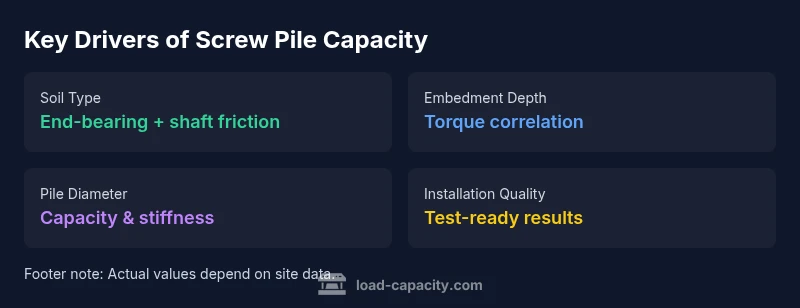
Determinants of screw pile capacity
| Aspect | Impact on Capacity | Guidance |
|---|---|---|
| Soil type | Affects end-bearing and shaft friction | Use geotechnical data and charts |
| Embedment depth | Increases capacity up to soil limits | Consult code and manufacturer curves |
| Pile diameter & blade geometry | Influences capacity and stiffness | Select based on required capacity |
| Installation torque | Correlates with capacity, varies by soil | Record torque and test for confirmation |
Quick Answers
What is the typical range for screw piles load capacity?
Capacity varies widely with diameter, embedment depth, soil type, and installation torque. There is no single universal value. Use manufacturer data and site tests to establish an allowable capacity and apply appropriate safety factors.
Screw pile capacity depends on many factors—diameter, embedment, soil, and torque. Check manufacturer data and local soil tests.
How do I estimate capacity in the field?
Use torque readings combined with soil data and manufacturer curves; perform a quick post-installation check to refine the estimate.
Torque data plus soil information help estimate capacity on site.
Are screw piles suitable for seismic regions?
They can be, but design must account for dynamic loads and connections; verify with codes and tests.
In seismic areas, dynamic analysis and proper detailing are essential.
What standards apply to screw pile capacity?
Standards vary by region; follow structural/geotechnical guidelines and manufacturer recommendations, documenting the basis.
Check local building codes and manufacturer guidance.
What is the difference between ultimate and allowable capacity?
Ultimate is the maximum resistance; allowable includes safety factors for design; design uses allowable capacity.
There’s a built-in safety margin in allowable capacity.
Do post-installation tests always confirm capacity?
Tests help verify performance but may not catch every issue; review test setup and boundary conditions.
Tests are helpful but not perfect; use them as part of a broader verification.
“Screw piles provide reliable capacity when designed with soil and installation conditions in mind. Capacity is a function of soil, embedment, and geometry.”
Top Takeaways
- Act early to assess site data and choose size
- Correlate embedment depth and torque with capacity
- Verify capacity with post-installation testing in high-risk projects
- Balance diameter, blade geometry, and depth for required strength
- Document all inputs for traceability and future changes